OpenHands Deep Dive: How an Open-Source AI Coding Agent is Redefining Software Development

OpenHands: A deep dive into the open-source AI platform for fully automated software development
OpenHands is an MIT-licensed open-source AI software development agent platform that goes beyond traditional code completion tools to achieve full closed-loop automation from requirement description to code commit. Built on the ReAct framework and Agent SDK engine, it features sandboxed code execution, multi-tool orchestration, multi-turn long-running tasks, and self-iterating debugging across CLI, GUI, Cloud, and Enterprise forms—ideal for backend engineers and indie developers, representing the trend shift from AI-assisted to AI-automated development.
From Code Completion to Automated Delivery: OpenHands' Positioning
On the evolutionary path of AI programming tools, we've progressed from code completion (Copilot) to conversational programming (ChatGPT) to CLI interactive assistants (Claude Code). This evolution reflects a paradigm shift across the entire field: when Copilot launched in 2021, its core was "predicting the next line of code" based on OpenAI's Codex model; conversational programming upgraded the interaction model to "Q&A," but output remained at the text level with execution authority still in human hands; the emergence of the Agent paradigm marks the third leap—AI is no longer just a "suggester" but has gained tool invocation rights, environment interaction rights, and iterative execution rights, capable of completing end-to-end engineering tasks in real computing environments. What OpenHands aims to do goes even further—it wants to become a complete AI software development agent platform, providing near-Devin fully automated development capabilities in the open-source world.
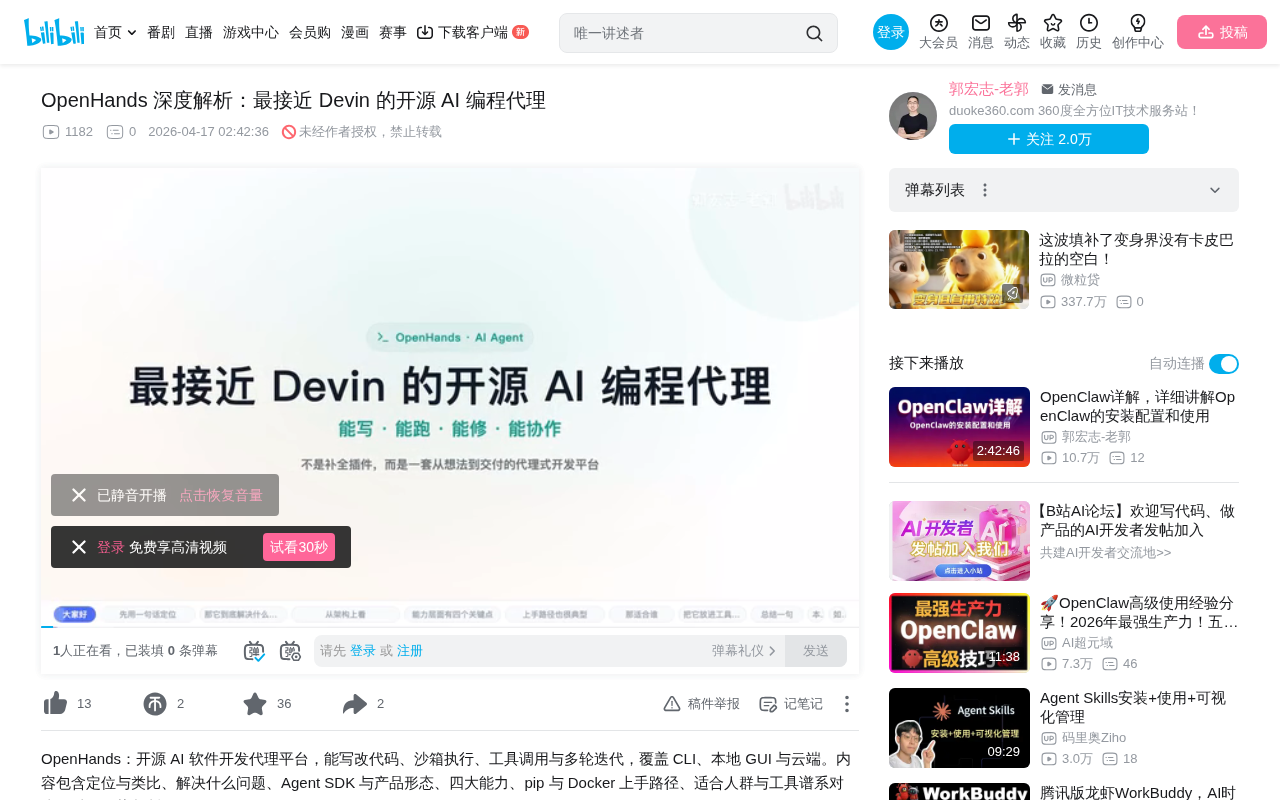
Put simply, OpenHands isn't a chatbot that can only "talk"—it's an "AI programmer" that can break down tasks, write code hands-on, run commands, iterate on errors, and operate GitHub and browsers to research information. The official positioning is a platform for AI-driven development, with the goal of helping teams automate more of their software building workflows.
Here's a horizontal comparison with mainstream tools on the market:
- Copilot: Focused on code completion, solving the problem of "writing faster"
- ChatGPT: Focused on conversational consulting, more like a technical advisor
- Claude Code: Strong CLI interaction, but still a "highly interactive development assistant"
- Devin: Closed-source product, high degree of automation, but cannot be self-hosted or extended
- OpenHands: Complete Agent, open-source MIT license, locally deployable, extensible
What Problem Does OpenHands Actually Solve?
End-to-End Development Automation
The pain point of traditional AI programming tools lies in "fragmentation"—it gives you a code snippet, and then it's done. You still need to paste, run, debug, and commit it yourself. What OpenHands aims to do is run through the complete Agent loop of planning → execution → observation → iteration.
This closed loop corresponds academically to the ReAct (Reasoning + Acting) framework—proposed by Google Research in 2022, its core idea is to have language models alternate between "reasoning" (generating chains of thought) and "acting" (calling external tools), incorporating tool-returned observations into the next round of reasoning. Compared to pure reasoning models, the ReAct framework significantly improves model accuracy on complex multi-step tasks, because real feedback from each action step can correct the model's subsequent judgments, preventing "hallucinations" from accumulating and amplifying across long chains. OpenHands engineers this framework into production, enabling it to stably handle the uncertainty inherent in real software development scenarios.
You describe requirements, and it analyzes code, modifies code, runs tests, and even collaborates around GitHub Issues and PRs. The entire process doesn't require you to repeatedly copy and paste—the agent autonomously completes the loop.
Eliminating Repetitive Work
Software development involves massive amounts of mechanical work: code refactoring, fixing Issues, adding test cases, batch modifications... These tasks are tedious and time-consuming for human developers, but they're precisely what AI agents excel at. OpenHands' goal is to absorb this repetitive labor, freeing developers to focus on more creative work.
Architecture Design: Engine + Multiple Product Forms
OpenHands isn't a single small tool—it's a systematically designed architecture.
Core Engine: Agent SDK
At the foundation is the Agent SDK, used to build a multi-model, extensible-tool agent engine with memory and collaboration capabilities. This is the heart of the entire system, determining the agent's reasoning and execution capabilities. The SDK's extensibility is built on the Function Calling mechanism of modern large language models—the model outputs in structured JSON format "which tool to call and what parameters to pass," allowing heterogeneous tools like Shell command execution, Git operations, browser control, and API requests to be unified within the model's decision space. Developers can customize tool sets and configure different tool access permissions for different scenarios.
Multiple Entry Points
- CLI (Command Line): Execute tasks like many terminal-based AI development tools, suitable for developers who prefer terminal operations
- Local GUI: With file tree, terminal, conversation, and process visualization, providing an experience close to cloud agent products
- Cloud Version: Supports team collaboration, integration, and permission management
- Enterprise Edition: Emphasizes private deployment, environment isolation, and security policies
This "engine + multiple product forms" design allows OpenHands to cover the full spectrum from individual local development to enterprise-grade cloud deployment.
Four Core Capabilities Explained
1. Sandboxed Code Execution
This is the key capability that distinguishes OpenHands from ordinary chat models. It doesn't simply output text code—it actually runs code in a sandbox environment, views execution results, and then makes modifications based on those results. This "write → run → observe → fix" cycle is what real development workflow looks like.
OpenHands uses a Docker container-based sandbox approach, where each task runs in an isolated container environment completely separated from the host system. This design solves the core security problem of AI agents executing arbitrary code: even if the model generates dangerous commands (like file deletion or network scanning), the impact is confined within the container boundary. Containerized sandboxing also brings the advantage of environment consistency—developers can pre-configure specific runtime environments (Python versions, dependency libraries, etc.), ensuring reproducible execution results from the agent. The Enterprise Edition further strengthens network isolation policies, preventing the agent from accidentally accessing sensitive internal systems during execution.
2. Multi-Tool Orchestration
Shell, Git, browser, APIs, and other tools are combined for use together. A real programmer doesn't just use an editor—they need to check documentation, run commands, manage versions, and call interfaces. Through tool chain orchestration, OpenHands simulates this authentic development behavior.
3. Multi-Turn Long-Running Tasks
Capable of handling long-running, multi-step engineering problems rather than ending after a single Q&A exchange. This is crucial for complex software development tasks—implementing a feature often involves modifications across multiple files, multiple test runs, and multiple rounds of adjustment.
4. Self-Iteration and Debugging
After encountering errors, it can automatically return to the modify-and-re-execute loop, behaving more like a human programmer's debugging process. This ability to "not give up when encountering errors, but analyze causes and fix them" is the fundamental difference between an Agent and simple code generation tools.
Getting Started Guide and Target Audience
Quick Start Paths
CLI Method: Install via pip or brew, configure your model (supports OpenAI, Claude, local Ollama, etc.), then start tasks directly in the terminal.
GUI Method: Spin up local services with Docker Compose, access the local port via browser, and get a visual operation console.
Cloud Method: Use the official hosted version directly, eliminating environment configuration costs.
Typical task scenarios include: fixing GitHub Issues, writing scrapers, auto-generating test cases—all essentially handing goal descriptions to the agent for closed-loop execution.
Who Benefits Most from OpenHands?
High-ROI users: Backend engineers, AI engineers, automation specialists, and indie developers. These roles often have large amounts of automatable repetitive work, and OpenHands can significantly boost efficiency.
Scenarios requiring caution: If you have zero programming knowledge, OpenHands isn't yet "plug-and-play" enough to replace all learning costs. If your system demands 100% zero-error output every time, you'll need to build verification workflows as a safety net—behind this lie deep engineering challenges: the "hallucination" problem accumulates exponentially in long chains, where seemingly low single-step error rates become significantly amplified across 20-step complex tasks; large codebases often exceed the model's effective processing range; AI-generated code passing unit tests doesn't equal satisfying business semantics, requiring human developers to design higher-level acceptance criteria.
Trend Assessment: From AI-Assisted to AI-Automated Development
OpenHands represents more than just "writing code faster"—it embodies a deeper trend shift: AI moving from an assistive role to genuinely participating in delivery—capable of writing, running, fixing, and collaborating.
The direction of this trend is clear: from AI-assisted programming to AI-automated development. But we also need to soberly recognize that the current stage still requires engineering and verification systems as safety nets. AI agents aren't omnipotent—they need human developers to set goals, review results, and build quality assurance processes.
Open-source, MIT license, locally runnable, freely extensible—these are OpenHands' core competitive advantages. The MIT license is one of the most permissive open-source licenses, allowing commercial use, modification, and private deployment without requiring disclosure of modified source code. This stands in stark contrast to the strategy of closed-source products like Devin that build moats through SaaS models. OpenHands chose to trade openness for ecosystem—attracting developers to contribute tool plugins, adapt more model backends, and deeply customize for vertical scenarios. This strategy closely mirrors the success paths of Linux and Kubernetes: open the core capabilities, establish de facto standards through ecosystem prosperity. For teams wanting to embrace AI-automated development without being locked into a single vendor, OpenHands deserves serious attention.
Key Takeaways
- OpenHands is an open-source MIT-licensed AI software development agent platform, positioned as a complete Agent rather than a simple code completion tool, capable of achieving full closed-loop automation from requirement description to code commit
- The core architecture is driven by the Agent SDK engine, based on the ReAct framework and Function Calling mechanism, offering four product forms—CLI, local GUI, Cloud, and Enterprise Edition—covering the full spectrum from individual development to enterprise deployment
- Four core capabilities—Docker container-based sandboxed code execution, multi-tool orchestration, multi-turn long-running tasks, and self-iterating debugging—make its behavior closer to that of a real human programmer
- Best suited for backend engineers, AI engineers, and indie developers, but still has limitations for users with zero programming background and zero-tolerance scenarios, requiring verification workflows to address engineering challenges like hallucination accumulation and context limitations
- Represents the trend shift from AI-assisted programming to AI-automated development, with its MIT open-source license and extensible ecosystem strategy making it an important alternative to closed-source Devin
Related articles
 Product Reviews
Qoder vs Cursor Real-World Comparison: Which $20/Month AI IDE Is Better?
Hands-on comparison of Qoder vs Cursor AI IDEs: Agent autonomy, human interaction count, and architecture decisions. Qoder needed only 2 interactions vs Cursor's 8.
 Product Reviews
Cursor Cloud Agent Demo: Eliminating Bottlenecks Across the Entire Software Development Lifecycle
Deep analysis of Cursor's Cloud Agent demo showing how cloud VMs, automated test artifacts, and a full-chain control plane systematically eliminate human bottlenecks across the software development lifecycle.
 Product Reviews
Cursor 3.0 Deep Dive: Multi-Agent Parallelism, Design Mode, and Best-of-N Model Comparison
Cursor 3.0 evolves from an AI coding assistant into an Agent fleet command center. Explore multi-agent parallelism, Design Mode, and Best-of-N model comparison.