Page Agent: Alibaba's Open-Source AI Browser Extension for Form Automation

Alibaba's open-source AI browser extension Page Agent automates web form filling via natural language.
Page Agent is an open-source AI browser extension from Alibaba that automates web form filling and other page operations through natural language instructions. It leverages large language models to parse page DOM structures in real-time and dynamically plan execution steps, eliminating the need for pre-recorded scripts like traditional RPA. Available via the Chrome Web Store and npm package integration, it supports multiple LLMs including OpenAI and DeepSeek, making it ideal for data entry, test automation, and daily office workflows.
Manually filling out forms is one of the most tedious repetitive tasks in daily office work — user registration, data entry, data migration, each one a drain on patience. Alibaba's open-source browser extension Page Agent is changing all of this: just type a natural language instruction, and AI automatically completes the entire form-filling process.
What is Page Agent?
Page Agent is an open-source AI browser extension from Alibaba, essentially an "AI operator within your web pages." It can understand web page structures and automatically perform various operations on pages based on natural language instructions — clicking buttons, filling input fields, selecting dropdown menus, and more — truly achieving browser-level RPA (Robotic Process Automation).
What is RPA? RPA (Robotic Process Automation) is a technology that uses software robots to simulate human computer operations, originating in the early 2000s. Traditional RPA tools like UiPath, Automation Anywhere, and Blue Prism rely on pre-recorded operation scripts or rule engines, executing actions by identifying fixed coordinates, IDs, or XPaths of interface elements. The fatal weakness of this approach is its fragility — once the page UI changes, scripts break and require manual maintenance. According to Gartner, 30%-50% of maintenance costs in traditional RPA projects come from handling UI changes.
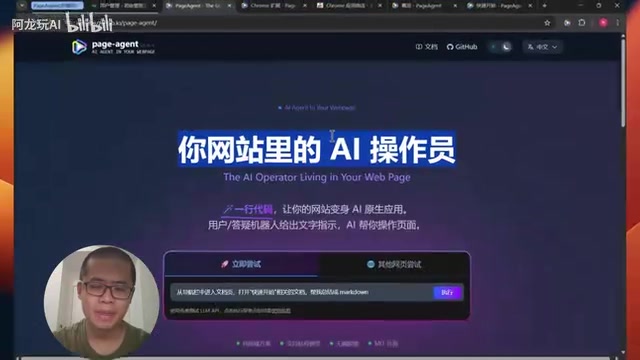
Unlike traditional RPA tools, Page Agent doesn't require pre-recorded workflows or scripts. Instead, it uses AI large language models to understand page content and user intent in real-time, dynamically planning execution steps. This means it can autonomously complete tasks even on pages it has never seen before.
On the technical level, Page Agent's core integrates several key capabilities: First, DOM parsing and semantic understanding — the extension captures the current page's DOM tree structure in real-time, converting HTML elements (input, select, button, etc.) into structured contextual information. Second, multimodal perception — some implementations also combine page screenshots, using Vision Models to identify page layouts. Finally, Chain-of-Thought reasoning — after receiving user instructions and page context, the large model progressively plans an execution chain of "where to click → what to input → what to do next." This technical approach is highly similar to OpenAI's Computer Use, Google's Project Mariner, and Anthropic's Claude Computer Use, representing an important exploration direction for AI Agents in the "embodied operation" domain.
Real-World Testing: Automated User Creation Workflow
In the hands-on demo, the author showcased a typical backend management scenario — automatically adding a new user. The entire workflow goes as follows:
- Input instruction: "Auto-fill the form, add a new user"
- AI automatically identifies form elements on the page
- Sequentially fills in name, phone number, email, gender, notes, and other fields
- No manual intervention required throughout — AI executes each step autonomously
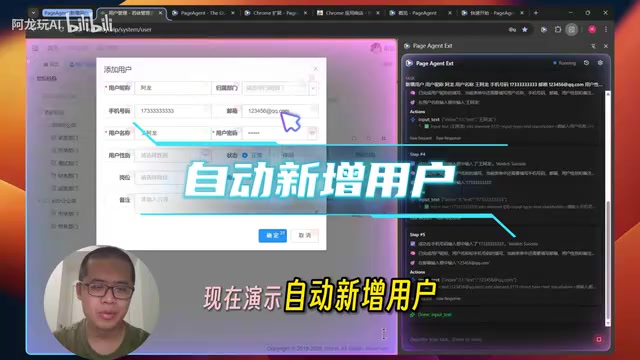
From the demo results, Page Agent accurately identifies the meaning of each form field and fills in reasonable test data. The entire process is fully automated — users only need to issue a single instruction to complete the operation.
Installation and Usage
Browser Extension Installation
Installing Page Agent is straightforward. Open the Chrome Web Store, search for "Page Agent," and it's the first result. After installation, the extension icon appears in the upper-right corner of your browser — click it to open the instruction input panel.
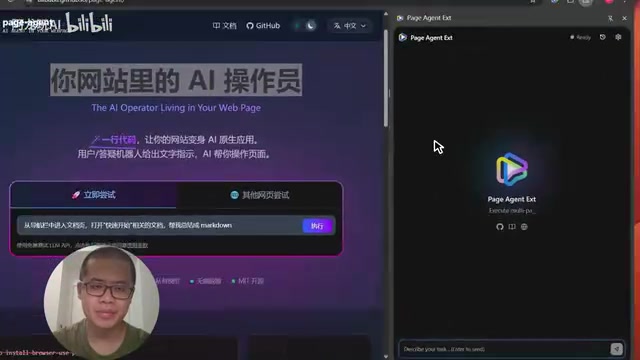
Usage is equally intuitive: describe the operation you want to perform in natural language in the input box — such as "fill out the registration form" or "auto-submit order information" — and Page Agent will begin executing automatically.
Backend System Integration
Page Agent can be used not only as a standalone browser extension but also supports deep integration with existing backend management systems. Developers simply need to import Page Agent's npm package into their project and complete the initialization configuration to embed AI automation capabilities into their system.
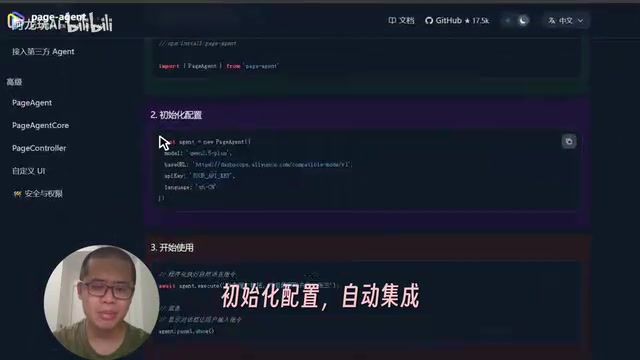
Why npm distribution? npm (Node Package Manager) is the most mainstream package management tool in the JavaScript ecosystem, with over 2 million open-source packages. Distribution via npm means developers can bring AI automation capabilities into any backend system built on Node.js or modern frontend frameworks (React, Vue, Angular) with a single command (
npm install page-agent). Compared to closed-source commercial products like Microsoft Power Automate and Salesforce Flow, the open-source approach allows small and medium enterprises to enjoy equivalent capabilities without paying hefty licensing fees. Alibaba's open-source strategy also has strategic considerations: leveraging community power for rapid iteration on one hand, and promoting its own model services through ecosystem binding on the other.
This integration approach is particularly important for enterprise applications — AI automation capabilities can be embedded directly into internal management systems, allowing all users to benefit from AI-assisted operations.
Multi-Model Support
Page Agent is highly flexible in AI model selection, supporting integration with various mainstream large models, including:
- OpenAI (GPT series)
- DeepSeek
- Other models compatible with the OpenAI API format
Users can choose the appropriate model based on their needs and budget. This involves real cost-performance tradeoffs: GPT-4o performs best on complex page understanding and multi-step reasoning, but API call costs are higher (approximately $5/million input tokens); DeepSeek-V3 and DeepSeek-R1, with their highly competitive pricing (approximately $0.14-$0.55/million input tokens), have become popular choices for Chinese users with outstanding cost-effectiveness. For relatively structured tasks like form filling, models don't need extremely strong reasoning capabilities — mid-sized models can handle the job well.
Notably, Page Agent is compatible with the OpenAI API format, meaning any model implementing this standard interface — including locally deployed options like Ollama and LM Studio — can be connected, further lowering the barrier for use in data privacy-sensitive scenarios. For users in China, DeepSeek is a cost-effective first choice.
Use Cases and Value Analysis
Page Agent's applications extend far beyond form filling — it's suitable for any scenario requiring repetitive web page operations:
- Data Entry: Batch input of customer information, product data, etc.
- Test Automation: Auto-filling test data, validating form logic
- Daily Office Work: Automating approval workflows, report filling, etc.
- E-commerce Operations: Batch product listing, price modifications, etc.
As an Alibaba open-source project, Page Agent's code is fully public, allowing developers to customize and extend it based on their needs. The open-source strategy also means the community can continuously contribute new features and fixes, driving ongoing improvement of the tool.
Summary
Page Agent represents an important direction in combining AI with browser automation. Compared to traditional RPA tools that require complex workflow configuration, Page Agent dramatically lowers the barrier to entry through natural language interaction. Compared to pure AI conversations, it can actually "take action" on pages and produce real results. As the capabilities of large models like GPT-4o and DeepSeek continue to improve, these "AI + browser operation" tools will become increasingly accurate and reliable. For users who need to perform large amounts of repetitive form-filling operations daily, this tool is worth trying.
Related articles
 Product Reviews
Qoder vs Cursor Real-World Comparison: Which $20/Month AI IDE Is Better?
Hands-on comparison of Qoder vs Cursor AI IDEs: Agent autonomy, human interaction count, and architecture decisions. Qoder needed only 2 interactions vs Cursor's 8.
 Product Reviews
Cursor Cloud Agent Demo: Eliminating Bottlenecks Across the Entire Software Development Lifecycle
Deep analysis of Cursor's Cloud Agent demo showing how cloud VMs, automated test artifacts, and a full-chain control plane systematically eliminate human bottlenecks across the software development lifecycle.
 Product Reviews
Cursor 3.0 Deep Dive: Multi-Agent Parallelism, Design Mode, and Best-of-N Model Comparison
Cursor 3.0 evolves from an AI coding assistant into an Agent fleet command center. Explore multi-agent parallelism, Design Mode, and Best-of-N model comparison.