People Who Don't Use AI to Write Code Are Becoming the 'Odd Ones Out'

AI-assisted programming is now the default — not using AI to code has become the exception.
A tweet joking about someone coding without AI at Munich airport reflects a profound shift: AI programming tools have gone from novelty to default infrastructure. Over 70% of developers now use AI coding tools daily, with significant efficiency gains. The article argues developers should embrace AI tools without abandoning foundational understanding, develop prompt engineering skills, and maintain core competencies in algorithmic thinking and architecture design.
A Tweet That Sparked Reflection
Recently, a tweet sparked widespread resonance across the developer community:
"Just saw someone at Munich airport writing code without any AI assistance. Absolute madman 🤯"
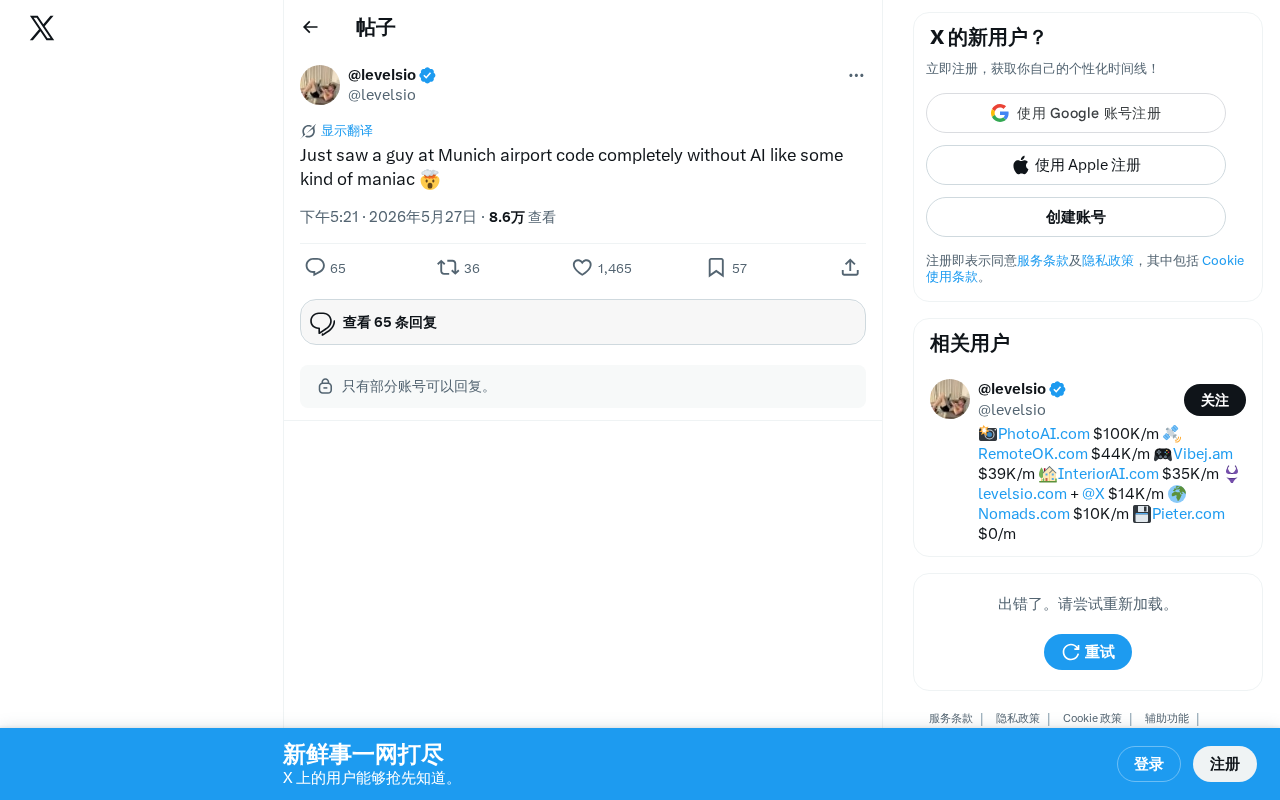
This seemingly tongue-in-cheek tweet reflects a profound shift that's already underway — AI-assisted programming has gone from 'early adopter novelty' to 'default option', and developers who insist on writing code purely by hand have become the 'odd ones out' in the crowd.
From Optional Tool to Infrastructure: The Speed of AI Programming Adoption
Just two years ago, using GitHub Copilot or ChatGPT for coding assistance was still something worth posting about on social media. Today, the situation has completely reversed. According to multiple industry surveys, over 70% of professional developers use at least one AI programming tool in their daily work.
This rate of adoption has far exceeded most people's expectations. From the rise of AI-native IDEs like Cursor and Windsurf, to the continuous breakthroughs in code generation capabilities from large models like Claude Code and GPT-4o, AI programming tools now cover virtually every stage — from code completion, bug fixing, and code review to architecture design.
Notably, AI-native IDEs like Cursor and Windsurf represent a paradigm leap in programming tools. Unlike "plugin-style" assistants like GitHub Copilot, AI-native IDEs are designed from the ground up around AI interaction — codebase indexing, multi-file context awareness, and natural language refactoring are deeply integrated into the workflow. Cursor, built on top of VS Code, supports feeding an entire code repository as context to large models, enabling AI to understand cross-file dependencies. Claude Code represents an alternative "terminal-native" path, executing complex multi-step programming tasks directly in the command-line environment. The core differentiator of these tools lies in their efficiency of context window utilization and "depth of understanding" of the codebase, rather than mere completion speed.
From a techno-sociological perspective, this transformation follows an inherent pattern. Everett Rogers' "Diffusion of Innovations" theory categorizes technology adopters into five groups: innovators, early adopters, early majority, late majority, and laggards. When adoption crosses approximately 16% (as the early majority begins to enter), a technology transforms from a "novelty" into a "social norm," and non-adopters begin to face implicit social pressure. The current 70% penetration rate of AI programming tools means they've already crossed this tipping point, entering the "default infrastructure" stage — similar to how smartphones replaced feature phones in the mid-2010s.
When a tool's adoption rate crosses a certain threshold, not using it becomes a behavior that requires explanation — much like telling a colleague today that you don't use search engines and rely purely on memory to look up API documentation.
Is 'Pure Hand-Coding' Really Obsolete?
Of course, the humor of this tweet lies precisely in its exaggeration. Not using AI to write code doesn't mean being inefficient or behind the times, but it does raise several questions worth pondering:
The Efficiency Gap Is Widening
A developer proficient with AI tools can achieve 3 to 10x efficiency gains when handling boilerplate code, unit tests, documentation, and similar tasks. This figure comes from a composite range across multiple independent studies — McKinsey's 2023 research showed AI tools save approximately 50% of time on new code writing tasks; GitHub's official data showed Copilot users completed specific tasks 55% faster. However, these numbers carry significant task-type bias: for highly patterned tasks like boilerplate code, CRUD interfaces, and unit test generation, the improvement approaches the upper limit; while for tasks requiring deep domain knowledge such as algorithm design, performance tuning, and security auditing, AI's marginal contribution drops significantly. This means that within the same time window (say, two hours waiting at an airport), an AI-assisted developer can accomplish far more than one using traditional methods.
When most people on a team are using AI programming tools, those who don't face not just a personal efficiency problem, but a disconnect from the team's collaboration rhythm.
Skill Definitions Are Being Reconstructed
In the past, "writing elegant code" was the hallmark of a top developer. Now, "precisely describing requirements to AI and efficiently reviewing AI-generated code" is becoming an equally important capability. This isn't replacement — it's augmentation. The strongest developers are often those who both understand low-level principles and are skilled at leveraging AI tools.
"Prompt Engineering" in programming contexts is far more complex than general conversation. It encompasses multiple dimensions: first, requirement decomposition — breaking down vague business requirements into precise sub-tasks that AI can execute; second, context management — deciding which code snippets, interface documentation, and constraints to provide to AI, avoiding information noise that degrades output quality; third, output verification strategy — designing test cases to systematically verify the correctness of AI-generated code rather than relying on intuition. Research shows that with the same GPT-4, experienced developers using structured prompts can achieve code quality over 40% higher than those asking casually. This explains why there's an enormous capability gap between "using AI" and "using AI well."
Fundamentals Remain Irreplaceable
It's worth noting that over-reliance on AI carries its own risks. Blindly accepting AI-generated code without understanding the underlying logic can bury hard-to-trace issues. Developers who "can write good code without AI" often possess stronger fundamentals, which remain an irreplaceable advantage when debugging complex problems or designing system architectures. In fact, it's precisely this foundational understanding that determines whether a developer can identify the boundaries of AI's limitations on high-complexity tasks — knowing when to trust AI's output and when to personally dive deep into verification is itself a high-level capability.
Survival Rules for Developers in the New Normal
The real value of this tweet isn't in mocking anyone — it's in precisely capturing the social psychology of an industry inflection point. We're in an era where the 'AI-augmented developer' is becoming the new normal.
For individual developers, the pragmatic strategy is:
- Embrace tools, but don't abandon understanding: Use AI to accelerate execution, but ensure you understand every line of adopted code
- Develop prompt engineering skills: Learning to collaborate efficiently with AI — including requirement decomposition, context management, and output verification — is itself a new skill worth systematic investment
- Maintain foundational thinking: Algorithmic thinking, system design, architecture capabilities — these are core competencies that AI still struggles to fully replace, and they form the cognitive foundation for wielding AI tools effectively
Conclusion
That person at Munich airport "writing code without AI" might be a deeply skilled veteran programmer enjoying the pure pleasure of coding, or perhaps someone who simply hadn't gotten around to setting up their tools. Either way, this scene is indeed conspicuous enough today that someone couldn't resist tweeting about it.
This is perhaps the most vivid footnote of technological change: When a new paradigm becomes as ubiquitous as the air we breathe, the old way automatically becomes a form of 'performance art.'
Related articles
 Expert Opinions
Windsurf CEO Deep Dive Interview: Speed Is the Only Moat
Windsurf CEO Varun Mohan shares insights on AI coding IDE pivots, product methodology, async Agent challenges, and differentiation strategy vs Cursor. Speed is the only moat.
 Expert Opinions
Being Underestimated Is Freedom: A Contrarian Competition Philosophy for the AI Era
Exploring the contrarian strategy of 'being underestimated is freedom' in AI. From OpenAI to DeepSeek to Cursor, why staying under the radar beats standing in the spotlight.
How the Protestant Work Ethic Was Hija…
How the Protestant Work Ethic Was Hijacked: From Protecting Workers to Oppressing Them
Philosopher Elizabeth Anderson reveals how the Protestant work ethic was twisted from a worker-protecting ideal into a tool of oppression—and what it means for the AI era.