Ruflo: A Multi-Agent Orchestration Solution That Turns Claude Code into a 100-Person AI Team
Ruflo: A Multi-Agent Orchestration Sol…
Ruflo builds a multi-agent orchestration platform for Claude Code, turning a single-threaded AI into a collaborative swarm.
Ruflo is an open-source multi-agent orchestration platform that solves Claude Code's single-threaded efficiency bottleneck. Through a five-layer architecture (user entry, orchestration engine, cluster coordination, Agent execution, memory/learning), it organizes 100+ specialized Agents into a collaborative team, using the SANA swarm intelligence algorithm for self-organizing scheduling and HNSW vector indexing for an experience library that enables self-learning evolution. However, it faces real-world limitations including high API costs, cold start issues, and a steep learning curve.
From Single-Threaded to Swarm Collaboration: The Evolution of Claude Code
Claude Code is one of the hottest AI programming tools available today, but it has a fundamental limitation—single-threaded execution. A single terminal window can only handle one task at a time, and parallel multitasking requires manually opening and switching between multiple windows. When facing complex projects, this efficiency bottleneck becomes very apparent.
From a technical perspective, Claude Code's single-threaded execution model stems from its underlying design—each terminal session maintains an independent Context Window, and all conversation history, file reading, and code execution happen within the same linear flow. This means that while the AI is generating code, it cannot simultaneously run tests or write documentation. This limitation isn't noticeable for simple tasks, but in large projects (such as when you need to refactor multiple modules, run test suites, and update documentation simultaneously), developers are forced to frequently switch between multiple terminal windows, manually coordinating task dependencies—essentially using their brains as a scheduler.
Ruflo (Rawflow), an open-source project on GitHub, was created specifically to solve this problem. It positions itself as a multi-agent orchestration platform, purpose-built for cluster management of Claude Code. The core concept is simple: turn one Claude Code into 100, all capable of collaborating and learning from each other. This isn't just running multiple instances—it builds a complete distributed AI development team infrastructure.
It's worth noting that Multi-Agent Systems (MAS) are not a new concept; their theoretical foundations trace back to distributed artificial intelligence research. In recent years, as large language model capabilities have improved, multi-agent frameworks like AutoGen (Microsoft), CrewAI, and MetaGPT have emerged one after another. The core idea behind these frameworks is to decompose complex tasks and assign them to AI Agents with different role definitions for separate processing, achieving collaboration through message passing and state sharing. What makes Ruflo unique is that it's deeply adapted specifically for the Claude Code ecosystem, rather than being a general-purpose framework.
Five-Layer Architecture: From User Entry to Knowledge Memory
Ruflo's architecture is designed in five layers, each with clearly defined responsibilities:
Layer 1: User Entry Layer — supports three interaction methods: Claude Code terminal, command-line tools, and web interface, accommodating different usage preferences.
Layer 2: Orchestration Engine Layer — responsible for parsing user requirements, breaking complex tasks into subtasks, and assigning them to different Agents for execution.
Layer 3: Cluster Coordination Layer — this is Ruflo's most critical component. It employs a swarm intelligence algorithm called SANA (Self-Organizing Neural Architecture) that enables 100+ Agents to work collaboratively like a bee swarm, rather than operating in isolation.
The Swarm Intelligence concept adopted by SANA originates from research on collective behavior in nature. Bees communicate food source information through waggle dances, ant colonies mark optimal paths with pheromones, and bird flocks achieve complex formation flying through simple local rules—the common characteristic of these biological systems is: no central controller, each individual follows simple rules, yet intelligent behavior emerges at the collective level. In computer science, this concept has been formalized as Particle Swarm Optimization (PSO), Ant Colony Optimization (ACO), and others. SANA applies this decentralized coordination mechanism to Agent scheduling, allowing each Agent to make autonomous decisions based on local information and shared state, avoiding the single-point bottleneck of a central scheduler.
Layer 4: Agent Execution Layer — includes 100+ specialized Agents covering code generation, testing, deployment, security auditing, and more.
Layer 5: Memory and Learning Layer — uses HNSW vector indexing to build the AgentDB knowledge base, claiming to be 150x to 12,500x faster than traditional solutions.
HNSW (Hierarchical Navigable Small World) is an efficient approximate nearest neighbor search algorithm proposed by Russian researcher Yury Malkov in 2016. It constructs a multi-layer graph structure: the bottom layer contains all data points, while upper layers become progressively sparser, forming a hierarchical structure similar to a skip list. During search, it starts from the sparse graph at the highest layer, quickly locates the target region, then descends layer by layer for refined search. Compared to brute-force search with O(n) complexity, HNSW can complete queries in O(log n) time with extremely high recall rates. This explains why AgentDB claims to be 150 to 12,500x faster than traditional solutions—when the experience library accumulates millions of entries, traditional linear scanning becomes unacceptable, while HNSW can still return results in milliseconds. Major vector databases including Pinecone, Milvus, and Weaviate all use HNSW as their core indexing algorithm.
The design philosophy of the entire architecture is to transform Claude Code from a monolithic tool into a distributed AI development team.
100+ Specialized Agents: Covering the Full Development Lifecycle
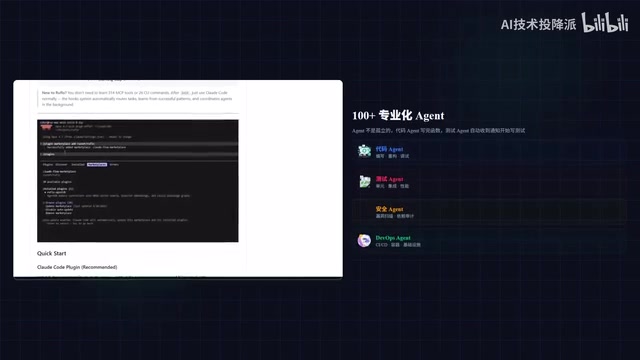
Ruflo's 100+ built-in specialized Agents are its most attractive feature. These Agents are organized into several major categories:
- Code Agents: responsible for writing, refactoring, and debugging code
- Testing Agents: responsible for unit testing, integration testing, and performance testing
- Security Agents: responsible for vulnerability scanning, dependency auditing, and compliance checking
- DevOps Agents: responsible for CI/CD pipelines, container orchestration, and infrastructure management
- Documentation Agents: responsible for API documentation, README generation, and code commenting
The key point is that these Agents don't run in isolation. They share context and state through the cluster coordination layer. For example, when a Code Agent finishes writing a function, the Testing Agent automatically receives notification and begins writing corresponding test cases. This automated collaboration model is far more efficient than manual scheduling.
SANA Self-Learning Engine: A Scheduling System That Gets Smarter Over Time
SANA (Self-Organizing Neural Architecture) is Ruflo's most imaginative feature. Its core approach is to give the Agent cluster the ability to self-learn and evolve.
Specifically, SANA has three core mechanisms:
Experience Accumulation
After each Agent executes a task, the results and process are recorded in the AgentDB vector database, forming a searchable experience library.
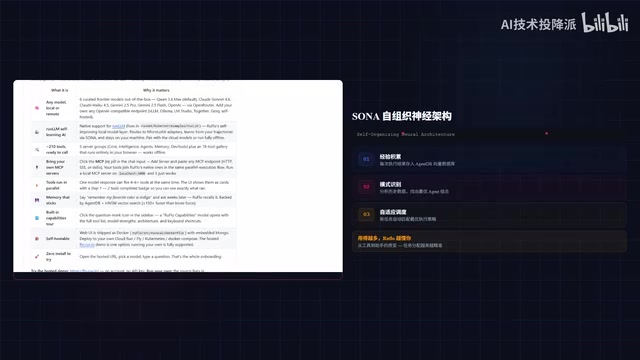
Pattern Recognition
SANA analyzes historical execution data to identify which Agent combinations perform best in which scenarios. This is essentially the system automatically summarizing "best practices."
Adaptive Scheduling
When you submit a new task, SANA automatically selects the optimal Agent combination and execution strategy based on learned patterns. The more you use it, the better the system understands your project's characteristics, and the more precise task allocation becomes.
This represents a qualitative shift from "tool" to "assistant"—instead of you telling it how to do things, it proactively learns how to do them best.
Ecosystem and Integration: Three Flexible Installation Methods
Ruflo has strong ecosystem extensibility. On the plugin front, it includes 32 native plugins, with an additional 21 NPM community plugins available for installation, covering scenarios from code quality checking to API integration to automated testing.
For integration, three installation methods are supported:
- Claude Code Plugin Mode: install directly within Claude Code by typing
/plugin install - Command-Line Mode: guided initialization with
npx ruflo init - MCP Server Mode: add using the
claude mcp addcommand
MCP (Model Context Protocol) is an open standard released by Anthropic in late 2024, designed to provide AI models with a unified way to access external tools and data sources. MCP uses a client-server architecture: AI applications act as clients, various tools and services act as MCP servers, communicating through a standardized JSON-RPC protocol. This means any tool implementing the MCP protocol can be directly called by Claude Code without writing specialized integration code for each tool. Ruflo's support for MCP server mode allows it to be natively recognized and called by Claude Code as a standardized tool service, greatly reducing integration complexity.
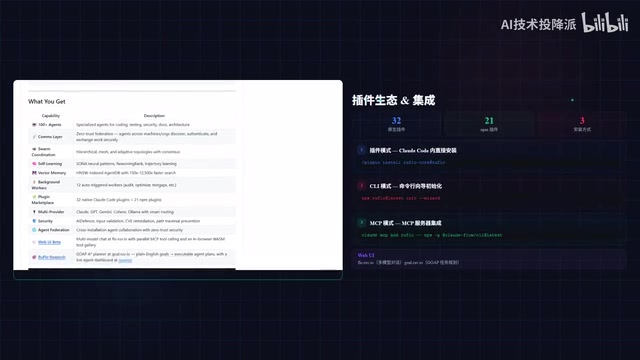
Additionally, Ruflo provides two web interfaces: Flow-Rawl supports multi-model conversations and MCP tool calls; Go-Rawl uses the GOAP algorithm for task planning, automatically breaking down large goals into executable steps.
GOAP (Goal-Oriented Action Planning) was originally designed by game AI developer Jeff Orkin in 2003 for the game F.E.A.R., enabling NPCs to autonomously plan behavior sequences. Its core idea is: define a goal state and a set of available actions (each with preconditions and effects), then find the optimal action sequence from the current state to the goal state through backward search. Unlike traditional finite state machines or behavior trees, GOAP doesn't require predefined paths for all possible behaviors—instead, it plans dynamically at runtime. Applying GOAP to AI development task planning means the system can automatically derive the sequence of steps needed based on the project's current state and final goal, including inter-step dependencies and parallelization opportunities.
Real-World Limitations: Cost, Learning Curve, and Use Cases
Having covered the advantages, we need to honestly address Ruflo's current limitations:
API Cost Issues: Multiple Agents calling APIs in parallel means consumption multiplies proportionally. If 100 Agents are working simultaneously, Token consumption will be staggering, making cost control a real concern.
Taking Claude 3.5 Sonnet as an example, its API pricing is $3/million input Tokens and $15/million output Tokens. Assuming a single Agent consumes an average of 2,000 input Tokens and 1,000 output Tokens per task execution, the cost is approximately $0.021. If 100 Agents work in parallel, with each task involving 3-5 rounds of interaction, a single complex task's API cost could reach $6-10. For development teams that iterate frequently, monthly API expenses could easily exceed several thousand dollars. This is why cost control mechanisms (such as intelligent caching, result reuse, and on-demand Agent activation rather than full-scale startup) are crucial for multi-agent systems.
Uneven Agent Quality: Core Agents (code generation, testing) are of good quality, but some peripheral Agents' output quality still needs refinement.
Cold Start Problem: SANA's self-learning requires sufficient execution data to be effective. During initial use, the effects aren't noticeable, requiring a data accumulation period.
The cold start problem has been extensively studied in the recommendation systems field—when new users have no historical behavior data, the system cannot make personalized recommendations. SANA faces the same dilemma: in the early stages of a project, AgentDB lacks sufficient execution records, the pattern recognition module lacks training data, and adaptive scheduling can only fall back to default strategies. This is similar to the Exploration-Exploitation tradeoff in reinforcement learning: extensive exploration is needed early on to accumulate experience, and only later can existing experience be leveraged for optimal decisions. Typically, SANA needs dozens to hundreds of task executions before it can build a statistically meaningful pattern library.
High Learning Threshold: You need to understand concepts like cluster coordination, vector databases, and Agent orchestration—the configuration complexity is not trivial.
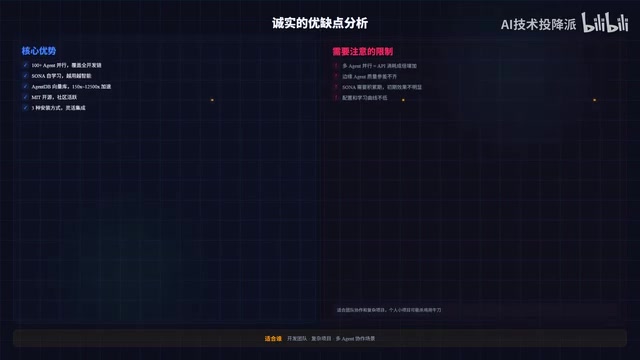
Therefore, Ruflo is better suited for development teams of a certain scale or complex project scenarios. Using it for personal small projects might be overkill.
Summary: A Paradigm Shift from Tool to Team
Ruflo is a highly ambitious project. It doesn't just add multitasking to Claude Code—it attempts to build a complete AI development team infrastructure. The 100+ specialized Agents, SANA self-learning engine, AgentDB vector database, and plugin ecosystem form a fairly complete closed loop.
The project is developed by Ruven Cohen, open-sourced under the MIT license, and is currently in rapid iteration. If you're managing a complex project that requires multi-Agent collaboration, or if you're interested in the cutting edge of multi-agent orchestration, Ruflo is worth a deep dive.
As one core insight puts it: A single AI tool, no matter how powerful, is still just a tool. A group of AIs that can collaborate—that's a real team. Multi-agent orchestration may be the next important evolutionary direction for AI programming tools.
Related articles
 Product Reviews
Qoder vs Cursor Real-World Comparison: Which $20/Month AI IDE Is Better?
Hands-on comparison of Qoder vs Cursor AI IDEs: Agent autonomy, human interaction count, and architecture decisions. Qoder needed only 2 interactions vs Cursor's 8.
 Product Reviews
Cursor Cloud Agent Demo: Eliminating Bottlenecks Across the Entire Software Development Lifecycle
Deep analysis of Cursor's Cloud Agent demo showing how cloud VMs, automated test artifacts, and a full-chain control plane systematically eliminate human bottlenecks across the software development lifecycle.
 Product Reviews
Cursor 3.0 Deep Dive: Multi-Agent Parallelism, Design Mode, and Best-of-N Model Comparison
Cursor 3.0 evolves from an AI coding assistant into an Agent fleet command center. Explore multi-agent parallelism, Design Mode, and Best-of-N model comparison.