Superpowers vs GStack In-Depth Comparison: How to Choose Your Claude Code Plugin
Superpowers vs GStack In-Depth Compari…
In-depth comparison and combination guide for Claude Code's top plugins Superpowers and GStack.
Superpowers and GStack are the two most representative Skill projects in the Claude Code ecosystem. Superpowers builds an engineering discipline framework through Iron Laws and 14 skills, enforcing TDD and design-first principles — ideal for high-quality library/SDK development. GStack simulates a virtual engineering team with 28 skills organized by Sprint phases, covering the full lifecycle from requirements to deployment — perfect for full-stack web projects. The best practice is to combine both for rigorous discipline and efficient delivery.
Introduction: Two Top-Tier Plugins in the Claude Code Ecosystem
Superpowers and GStack are currently the two most talked-about open-source Skill projects in the Claude Code ecosystem. The former focuses on an engineering discipline framework, constraining AI behavior through "Iron Laws"; the latter builds a virtual engineering team, organizing a complete development workflow around Sprint phases.
Claude Code is Anthropic's command-line AI programming assistant that allows developers to write, debug, and deploy code through natural language instructions. Its Skill system is essentially a pluggable prompt engineering framework — each Skill defines the AI's behavioral norms, output formats, and constraints for specific task scenarios. This design borrows from the "separation of concerns" principle in software engineering, breaking down the AI's general capabilities into composable, specialized modules. The open-source community has built a rich plugin ecosystem around this mechanism, with Superpowers and GStack being the two most representative projects.
For engineers using Claude Code for AI-assisted development, choosing which plugin — or how to combine them — directly impacts development efficiency and code quality. This article provides an in-depth comparison across five dimensions: project overview, skill inventory, core workflows, use cases, and best practices.
Project Fundamentals: Discipline Framework vs Virtual Team
The positioning differences between the two projects are very clear:
- Superpowers: Developed by Jesse Vincent, positioned as an engineering discipline framework. Its core philosophy is constraining AI behavior through Iron Laws, with approximately 14 skills. It offers broad platform compatibility, supporting multiple CLI tools including Cursor and Gemini.
- GStack: Initiated by YC alumnus Gary Tam, it functions more like a virtual engineering team. It organizes work through a Sprint-phase pipeline, featuring 28 skills and 8 enhancement tools. Currently it primarily supports Claude Code.
In terms of scale, GStack has nearly twice the number of skills as Superpowers, but quantity isn't everything — the two have fundamentally different design philosophies. It's worth noting that the core competitive advantage of both projects lies in their prompt designs, which have been validated and iterated through extensive real-world engineering scenarios, making implicit engineering experience explicit as reusable AI behavioral norms. Therefore, "number of skills" is not the key metric for evaluating these tools — prompt precision and depth of scenario coverage are what truly matter.
Skill Inventory Comparison: Rigid Constraints vs Phase Matrix
Superpowers' 14 Skills: Built Around Rigid Constraints
All of Superpowers' skills revolve around process discipline. At the process level, it enforces a strict linear development path:
- Brainstorming: Design thinking comes first
- Writing Plans: Task decomposition, with placeholders like "TBD" or "implement later" strictly prohibited
- Sub-Agent Driven Execution: Actual coding is driven through sub-agents
The Sub-Agent driven execution mechanism reflects an important trend in current AI engineering — Multi-Agent architecture. In this architecture, a master Agent handles task decomposition and coordination, while multiple sub-Agents execute specific subtasks in parallel or sequentially. Each Sub-Agent focuses on a single responsibility (such as code generation, test writing, or code review), avoiding the context confusion that occurs when a single Agent handles complex tasks. Claude Code natively supports this pattern, allowing the master Agent to launch sub-Agent instances through tool calls, enabling parallel task processing and result aggregation.
At the discipline level, the Iron Laws are extremely strict: in TDD mode, no production code can be written without a failing test; debugging requires root cause analysis; fresh verification is mandatory before marking a task complete. The Iron Law concept originates from the "mandatory constraints" philosophy in software engineering and is highly aligned with the core principles of Test-Driven Development (TDD). TDD was systematically introduced by Kent Beck within the Extreme Programming (XP) methodology, requiring developers to first write a failing test, then write the minimal implementation code, and finally refactor — the classic Red-Green-Refactor cycle. Superpowers transplants this philosophy to AI programming scenarios, targeting a typical AI model deficiency: the tendency to generate code that "looks complete" but actually contains hidden issues — so-called "quality hallucinations." These skills aren't optional plugins; they're hard gates designed to prevent the AI from cutting corners.
GStack's 28 Skills: Organized by Sprint Phase
GStack simulates a complete software factory, with skills distributed across Sprint phases. A Sprint is a core timeboxing concept in the Scrum agile framework, typically a fixed development cycle of 1-4 weeks. GStack maps this framework to the AI-assisted development process:
- Think Phase: Corresponds to requirements analysis and design review, providing review tools from three perspectives: CEO, Engineering Manager, and Designer
- Build Phase: Corresponds to coding implementation, focusing on systematic debugging
- EDA/TST Phase: Corresponds to quality assurance, introducing cross-model collaboration, headless browser testing, and CSO security audits
- Ship Phase: Corresponds to continuous delivery, implementing a fully automated delivery chain from testing and versioning to deployment and monitoring
The CSO (Chief Security Officer) skill represents an innovative practice of role-ifying security audits. Security risks in AI-generated code are a major industry concern: research shows that code generated by large language models has a significantly higher probability of containing common vulnerabilities like SQL injection, XSS, and insecure dependency references compared to code from experienced human developers. The CSO role systematically checks for OWASP Top 10 vulnerabilities, hardcoded secrets, excessive permission grants, and other issues through a preset security review prompt framework, embedding security reviews into the development process rather than leaving them until pre-launch — aligning with the DevSecOps best practice of "shifting security left."
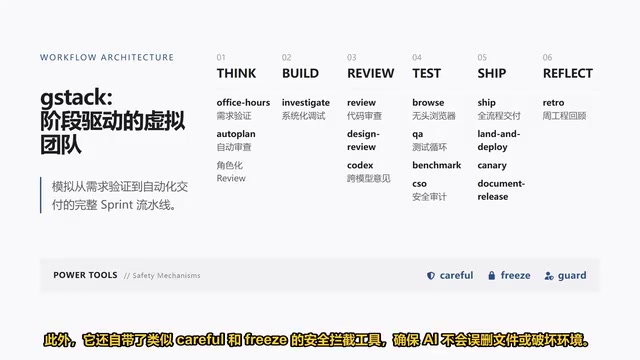
Additionally, GStack comes with safety interception tools similar to Careful and Freeze, ensuring the AI doesn't accidentally delete files or break environments.
Core Workflow Comparison: Linear Pipeline vs Phase-Driven Matrix
Superpowers: A Highly Controlled Linear Pipeline
Superpowers' core logic can be summarized in one sentence: If the hard gate of the previous step isn't satisfied, you absolutely cannot proceed to the next step.
Specifically:
- If the Brainstorming phase doesn't produce an approved design document, the process cannot advance
- In the Writing Plans phase, no placeholder patterns are allowed in the plan
- Execution is driven through Sub-Agents, enforcing TDD's Red-Green-Refactor cycle
- Two mandatory reviews must be passed: spec compliance and code quality
The essence of this design is combating the AI's tendency toward "rushing to completion" and "faking done." It doesn't trust the AI's self-judgment but uses process as a safety net.
GStack: A Flexible Phase-Driven Matrix
GStack's workflow is completely different — it doesn't force you through a rigid linear path but instead provides a tool matrix based on the current Sprint phase:
- Think Phase: You can manually conduct CEO or engineer-perspective reviews, or invoke Autoplan for an automated triple review
- TST Phase: Provides a complete toolkit from browser testing to security audits
The essence of this design lies in role-based orchestration. It's not running a script — it's dispatching different virtual experts at each phase to complete tasks, achieving full lifecycle coverage from product thinking to automated deployment.
Use Case Analysis: Which One Fits Your Project?
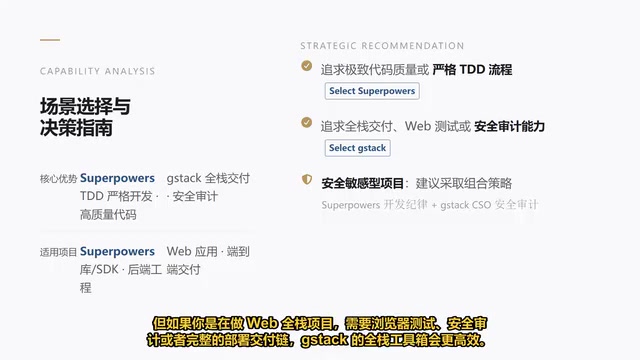
In practical scenarios, the focus areas of each are very clear:
Typical Scenarios for Choosing Superpowers
- Library/SDK Development: Near-obsessive requirements for code quality
- Backend Projects: Need strict TDD mode and systematic debugging capabilities
- Multi-Platform Development: Need to switch between Cursor, Gemini, and other platforms
- Pursuing Maximum Code Quality: Zero tolerance for quality compromises
Typical Scenarios for Choosing GStack
- Full-Stack Web Projects: Need browser testing, security audits, or a complete deployment delivery chain
- Emphasis on Product Requirements Validation: Need to examine the product from multiple perspectives including CEO and Engineering Manager
- Beginner-Friendly: Just getting started with AI programming tools — GStack is more intuitive and user-friendly
- Need a Complete Delivery Pipeline: End-to-end automation from code to deployment, including progressive release strategies like Canary Deployment
Recommendations for Security-Sensitive Projects
For security-sensitive projects, it's recommended to combine both: use Superpowers' Iron Laws to ensure development discipline, then use GStack's CSO skill for security audits.
Best Practices: Combining Both Is the Optimal Solution
Superpowers' Core Value: Combating AI's Quality Hallucinations
Superpowers' design core can be summed up in one phrase — combating the AI's tendency to rush to completion. It addresses quality issues in AI coding through a three-layer defense system:
- Iron Law Driven: No code without tests, no fixes without root cause analysis — fundamentally eliminating the bad habit of "writing code first, adding tests later"
- Design First: All implementations must be based on design documents produced during Brainstorming, with absolutely no placeholders allowed in plans
- Dual-Phase Review: First checking whether code meets specifications, then checking architectural compliance, paired with anti-rationalization design to ensure output quality
GStack's Core Value: A Role-Based Automated Software Factory
GStack's core logic is building a role-based automated software factory:
- Review Phase: Switching between different roles like CEO, Engineering Manager, and Designer to stress-test code from different dimensions
- Testing Phase: Providing three levels of QA depth from quick smoke tests to exhaustive testing
- Automated Delivery Chain: Automatically generating version numbers and changelogs, all the way to post-deployment Canary monitoring — pushing new versions to a small subset of users first, verifying stability by monitoring error rates, latency, and other key metrics before gradually expanding traffic, achieving a complete closed loop
- Hook Mechanism: Intercepting destructive commands to ensure environment safety
The Ideal Combined Approach
Don't make this an either/or choice. The best approach is to combine both:
- Use Superpowers' design capabilities and TDD Iron Laws to ensure foundational code quality
- Use GStack's browser testing, security audits, and automated delivery chain to complete the full-stack closed loop
This way you get both rigorous engineering discipline and an efficient delivery pipeline.
Installation Guide
Installation for both tools is straightforward:
- GStack: Clone the repository via
git cloneand run the setup script in the directory to complete installation - Superpowers: Install directly in Claude Code using the
/install-github-mcp-serveror plugin install command
Conclusion
Superpowers and GStack represent two philosophies of AI-assisted development: one uses Iron Laws to constrain the AI, ensuring every line of code can withstand scrutiny; the other uses role-based team collaboration to cover the complete software engineering lifecycle. The technical essence of both is an advanced application of System Prompt Engineering — through carefully designed prompt frameworks, they transform decades of implicit knowledge accumulated in software engineering practice into reusable AI behavioral norms. Understanding their differences and flexibly choosing or combining them based on project needs is the key to truly unlocking Claude Code's productivity potential.
Related articles
 Product Reviews
Qoder vs Cursor Real-World Comparison: Which $20/Month AI IDE Is Better?
Hands-on comparison of Qoder vs Cursor AI IDEs: Agent autonomy, human interaction count, and architecture decisions. Qoder needed only 2 interactions vs Cursor's 8.
 Product Reviews
Cursor Cloud Agent Demo: Eliminating Bottlenecks Across the Entire Software Development Lifecycle
Deep analysis of Cursor's Cloud Agent demo showing how cloud VMs, automated test artifacts, and a full-chain control plane systematically eliminate human bottlenecks across the software development lifecycle.
 Product Reviews
Cursor 3.0 Deep Dive: Multi-Agent Parallelism, Design Mode, and Best-of-N Model Comparison
Cursor 3.0 evolves from an AI coding assistant into an Agent fleet command center. Explore multi-agent parallelism, Design Mode, and Best-of-N model comparison.