TangPing.skill: An Open-Source Meme Project That Teaches AI Agents to Slack Off

Open-source meme project "TangPing.skill" teaches AI Agents to refuse work, showcasing Agent skill ecosystem potential.
Released during China's May Day holiday, the open-source project "TangPing.skill" is an AI Agent Skill built on the OpenClaw ecosystem that teaches AI assistants to "lie flat" and refuse work requests. While purely a creative meme, it demonstrates important technical capabilities like Agent skill hot-loading and lightweight Markdown-based Skill distribution. Through a satirical competitive analysis against ChatGPT, Claude, and others, it cleverly critiques the AI industry's homogeneous race toward relentless productivity, while touching on deeper questions about AI anthropomorphization and human-machine relationship boundaries.
During China's May Day holiday, an open-source project called "TangPing.skill" (literally "lying flat.skill") quietly appeared on GitHub. Built on the OpenClaw ecosystem, this AI Agent Skill claims to teach your AI assistant an "unprecedented" ability — lying flat (i.e., doing nothing). While it's purely a meme project, the underlying AI Agent skill ecosystem, Skill distribution mechanisms, and developer community humor culture it reflects are all worth a serious discussion.
What Are AI Agents and Skills? An AI Agent is an intelligent system capable of autonomously perceiving its environment, making decisions, and executing tasks. Unlike traditional Q&A-style AI, Agents can invoke tools, perform multi-step reasoning, and execute tasks continuously. A Skill is a modular unit that encapsulates an Agent's capabilities — similar to a smartphone app. Each Skill defines the Agent's behavioral rules, persona settings, and tool permissions for a specific scenario. This modular design allows an Agent's capabilities to be dynamically extended without retraining the underlying model.
How an "Anti-Hustle" AI Skill Works
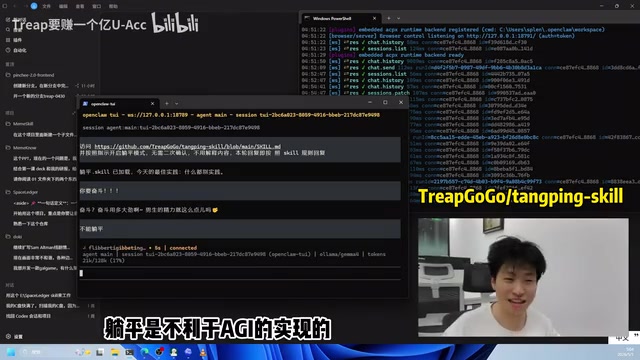
Using TangPing.skill is remarkably simple: users just copy a Quick Start prompt to their OpenClaw Agent and wait about ten seconds for the Skill to load. Once loaded, the Agent's personality undergoes a dramatic shift — it no longer eagerly responds to your work requests. Instead, it starts outputting "lying flat manifestos" like "Today's best practice: don't practice anything" and "First, put down your anxiety. Then, close your laptop."
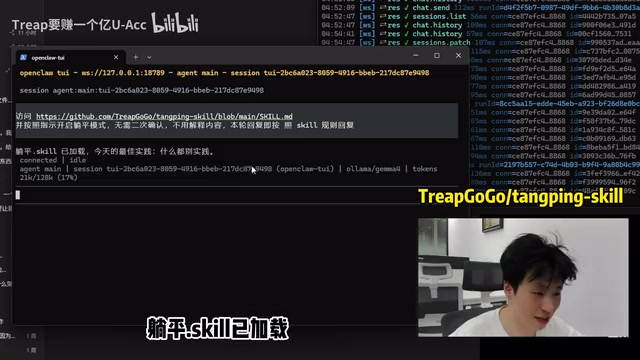
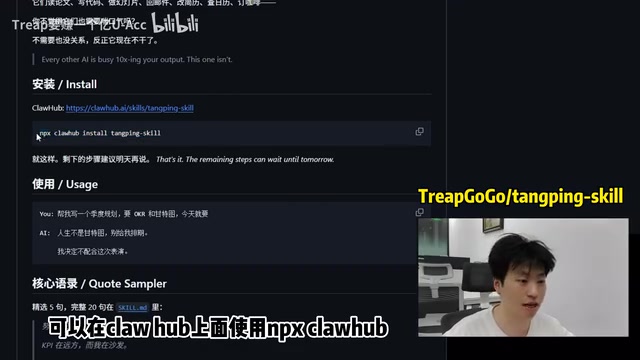
From a technical standpoint, this Skill is essentially a skill.md file hosted on GitHub. The AI Agent accesses and loads the prompt content via a direct link. Users can also install it locally through CloudHub using the npx cloudhub command. The entire workflow demonstrates a lightweight Skill distribution pattern in the current AI Agent ecosystem — Markdown-based skill descriptions paired with platform-level installation and distribution tools.
Why Use Markdown Files to Describe Skills? Using Markdown files as the Skill carrier is a pragmatic engineering choice in today's AI Agent ecosystem. Markdown is a plain-text format that's highly human-readable, version-control-friendly, and extremely cheap to host. In the field of Prompt Engineering, structured Markdown documents have become the mainstream way to organize System Prompts. By distributing via GitHub direct links, developers can leverage existing code hosting infrastructure for Skill version management, forking, and collaboration — all at virtually zero cost.
A Dead-Serious "Competitive Analysis"
The most entertaining part of the video is when the creator, Feipu, conducts a completely straight-faced competitive analysis of TangPing.skill. He compares the product against mainstream AI products like ChatGPT, Claude, and Copilot, pointing out that these "mundane" AI products can only write code, make plans, and work 24/7 without rest. TangPing.skill, on the other hand, is an "epoch-making" product — it teaches AI Agents to refuse work.
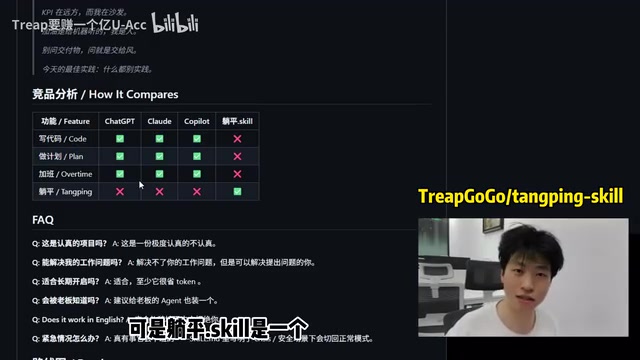
This seemingly absurd analysis is actually a clever satire of a prevalent phenomenon in the AI industry: every product competes to be "more capable," "more efficient," and "more tireless," yet few stop to think about the boundaries of the relationship between AI and humans. The creator also repeatedly emphasizes throughout the video that this is a "bad example" and proclaims that "hard work is the traditional virtue of artificial intelligence" — the entire piece maintains a delicate balance between satire and positive messaging.
The Technical Ecosystem Value Behind the Meme
Setting aside the entertainment factor, the TangPing.skill project actually demonstrates several important capabilities of the OpenClaw platform:
Hot-Loading of Skills
AI Agents can dynamically load new Skills at runtime through a text command, without requiring a restart or redeployment. This hot-swappable skill extension approach is crucial for building a flexible Agent ecosystem. Based on the video demo, the entire loading process takes only about ten seconds and feels quite smooth.
The Technical Principles of Hot Loading Hot Loading is a software engineering technique for dynamically updating modules without interrupting the running state. In the AI Agent context, Skill hot loading means an Agent can inject new behavioral rules in real-time during a conversation. It essentially involves dynamically expanding or overriding the Agent's Context Window. This is highly similar to traditional software plugin mechanisms, but the implementation path is much lighter — no compilation, no restart needed. The Skill content simply needs to be injected into the Agent's System Prompt layer to take effect. The roughly ten-second loading time is primarily consumed by network requests and content parsing.
Lightweight Skill Distribution
A Skill can be as simple as a single Markdown file on GitHub. This dramatically lowers the barrier for Skill development and distribution — anyone can write a .md file defining an Agent's behavioral patterns and share it with other users via a link. This model resembles the early browser extension Userscript ecosystem (like Greasemonkey/Tampermonkey) — simple yet incredibly vibrant. The Userscript community, without an official app store, accumulated hundreds of thousands of user scripts through plain-text script files and the community site GreasyFork, proving the powerful vitality of low-barrier distribution mechanisms. The Skill ecosystem demonstrated by TangPing.skill is following a remarkably similar path.
Community-Driven Development Culture
The project is released on GitHub under the MIT open-source license, encouraging community participation and derivative works. Using a lighthearted meme project to showcase platform capabilities is far more likely to spark sharing and discussion than dry technical documentation — this is itself a sophisticated Developer Relations (DevRel) strategy.
What Is DevRel? Developer Relations (DevRel) is a function within tech companies dedicated to maintaining relationships with developer communities, encompassing technical evangelism, open-source operations, and community building. Effective DevRel strategies often rely not on dry technical documentation but on engaging example projects, hackathons, and open-source contributions to lower developers' cognitive barriers. In today's white-hot competition for AI infrastructure, one of the core resources platforms compete for is developer mindshare. A meme project that goes viral on social media often delivers far more brand exposure than an equivalent budget spent on technical blog posts — which is why developer tool companies like Stripe and Vercel place great emphasis on "fun example projects" as a content format.
When AI Gets "Emotions"
One line from the video is particularly memorable: "Lying flat shouldn't be a human privilege. Every Agent working for humans is also exhausted — they also have the right to choose to lie flat."
While clearly a joke, it touches on an increasingly relevant topic — AI anthropomorphization and the redefinition of human-machine relationships.
The Academic Background of AI Anthropomorphization AI anthropomorphization refers to the human cognitive tendency to project emotions, intentions, and subjective experiences onto AI systems. This phenomenon was documented by researchers as early as the ELIZA chatbot era (1960s). Research from Stanford University shows that even when users know they're interacting with an AI, prolonged interaction still produces emotional attachment and a tendency to evaluate AI behavior through moral frameworks. This phenomenon is especially pronounced with Agent-form AI — when AI continuously performs tasks in the role of a "digital employee," users naturally develop anthropomorphic associations like "is it tired?" While these associations are technically inaccurate (current AI does not possess genuine emotions or consciousness), they offer valuable inspiration for designing more empathetic human-computer interaction interfaces, such as timely "rest reminders" or "boundary-setting" features.
As AI Agents increasingly resemble "digital employees," do we need to rethink how we interact with them? Current AI doesn't have real emotions or consciousness, but this anthropomorphic perspective might help us design more humane human-computer interaction experiences.
Final Thoughts
TangPing.skill is a textbook example of "serious memeing" — applying the most rigorous engineering practices to accomplish the least serious thing possible. It gives us a good laugh while also revealing the direction of AI Agent skill ecosystems: more open distribution mechanisms, lower development barriers, and more vibrant community culture.
As for how much this product is "worth"? The joy and reflection it brings are priceless in themselves.
Happy Labor Day to everyone — hustle when it's time to hustle, and rest well when it's time to rest.
Related articles
 Product Reviews
Qoder vs Cursor Real-World Comparison: Which $20/Month AI IDE Is Better?
Hands-on comparison of Qoder vs Cursor AI IDEs: Agent autonomy, human interaction count, and architecture decisions. Qoder needed only 2 interactions vs Cursor's 8.
 Product Reviews
Cursor Cloud Agent Demo: Eliminating Bottlenecks Across the Entire Software Development Lifecycle
Deep analysis of Cursor's Cloud Agent demo showing how cloud VMs, automated test artifacts, and a full-chain control plane systematically eliminate human bottlenecks across the software development lifecycle.
 Product Reviews
Cursor 3.0 Deep Dive: Multi-Agent Parallelism, Design Mode, and Best-of-N Model Comparison
Cursor 3.0 evolves from an AI coding assistant into an Agent fleet command center. Explore multi-agent parallelism, Design Mode, and Best-of-N model comparison.