Tasi Harness: Local AI Agent for Browser Automation

Tasi Harness launches: a locally deployed AI Agent tool for browser automation
Tasi Harness is a locally running browser automation AI Agent tool that lets users drive browsers through natural language instructions to complete searches, information gathering, form filling, and more. Compared to cloud-based Agent solutions, its local deployment model ensures data never leaves the device, offering clear privacy advantages. The official demo showcased a complete workflow of automatically searching for hotels on Ctrip, but the product is still in early stages, with core challenges like dynamic webpage adaptation, CAPTCHA handling, and error recovery yet to be resolved.
What is Tasi Harness?
Tasi Harness is a locally deployed AI Agent tool for browser automation, recently officially released. It runs in the user's local environment and drives the browser through natural language instructions to complete various automation tasks—from web searches and information gathering to form filling—all without manually operating the browser.
AI Agent Technical Background: An AI Agent (intelligent agent) refers to an AI system capable of perceiving its environment, autonomously planning, and executing actions to achieve goals. Unlike traditional chatbots, Agents possess "tool-calling" capabilities, enabling them to control external software, access the internet, and read/write files. Browser automation is one of the most direct paths for Agent deployment, with underlying technology typically relying on frameworks like Playwright, Puppeteer, or Selenium, using DOM parsing, visual recognition, or Accessibility Trees to locate web elements and simulate human operations.
This type of "browser automation Agent" is becoming a major direction for AI application deployment. Unlike cloud-based Agents, Tasi Harness emphasizes local deployment, meaning users' data and operational workflows don't need to be uploaded to third-party servers, offering inherent advantages in privacy protection and response speed.
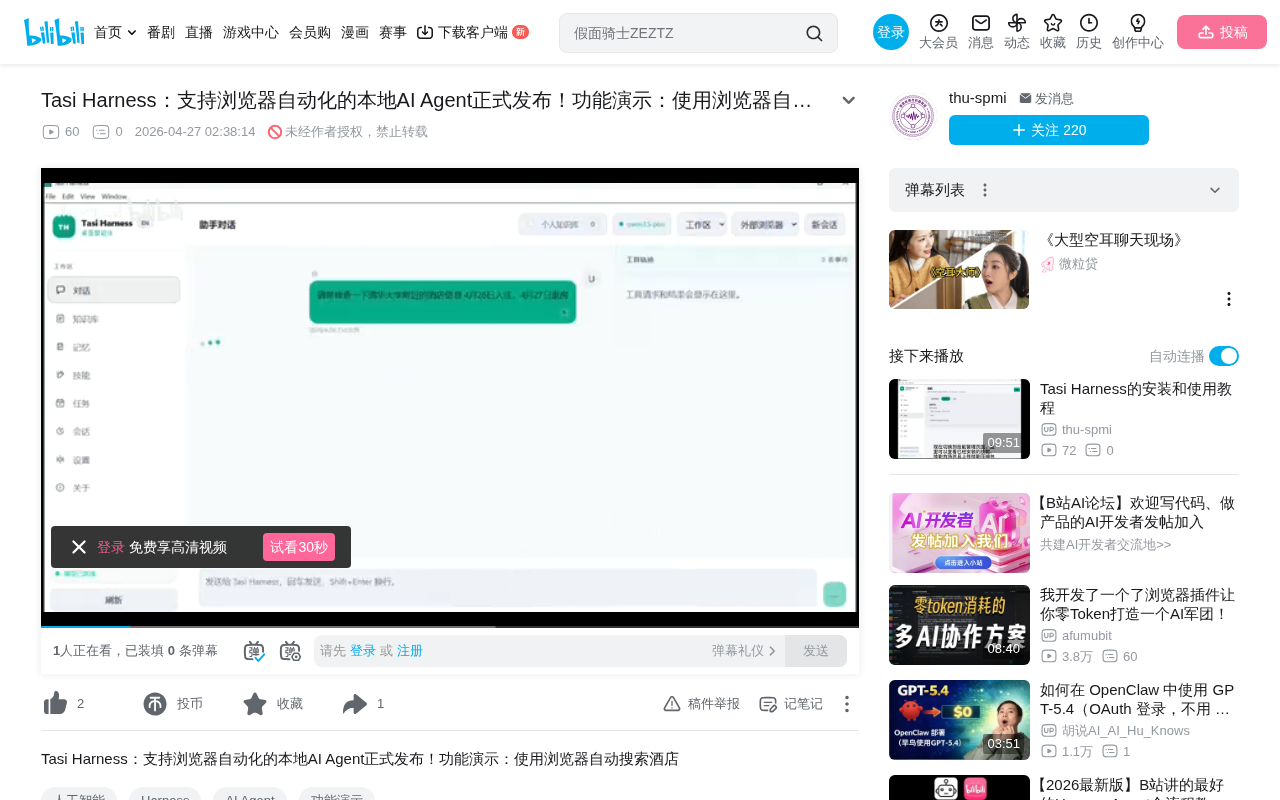
Feature Demo: Automated Hotel Search
The official team released a demo video showcasing how Tasi Harness automatically completes a full hotel search task through the browser. The entire workflow is highly intuitive:
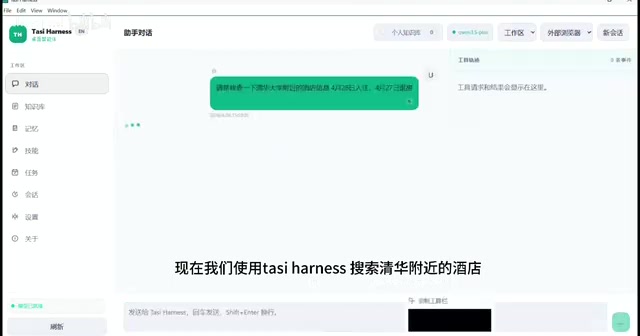
Step 1: Issue a Natural Language Instruction
Users simply issue a straightforward instruction to Tasi Harness—"Search for hotels near Tsinghua University." After receiving the instruction, the Agent automatically parses the user's intent, determining the target website to open and the search keywords. This process relies on the natural language understanding capabilities of large language models, converting vague user intent into a specific sequence of operational steps (Action Plan)—a core manifestation of the "planning" module in Agent systems.
Step 2: Automatically Open the Browser and Operate
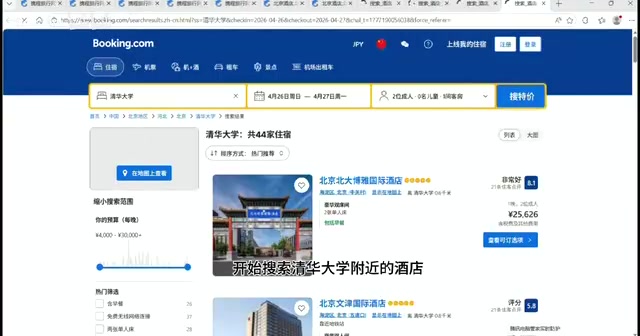
Tasi Harness then automatically launches the browser, opens the Ctrip website, and enters "hotels near Tsinghua University" in the search box. The entire process is completed autonomously by the AI Agent without any manual intervention from the user.
As shown in the demo screenshots, the Agent accurately located Ctrip's search entry point and correctly entered the search criteria.

Step 3: Return Search Results
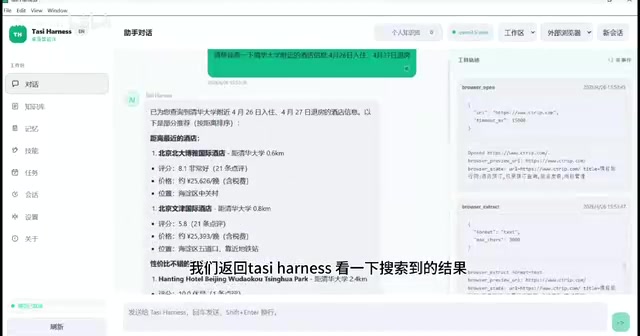
After the search is complete, users can return to the Tasi Harness interface to view the aggregated results. The Agent not only completed the browser-side operations but also organized the hotel information found and presented it to the user.
Looking at the final results, Tasi Harness successfully completed the hotel search task near Tsinghua University, with the entire workflow flowing seamlessly from instruction to results.
Technical Highlights and Value Analysis
Privacy Advantages of Local Execution
Compared to cloud-based solutions like OpenAI's Operator and Anthropic's Computer Use, Tasi Harness's local deployment model means users' browsing history, login credentials, and personal data always remain on local devices. This is particularly important for sensitive scenarios involving account logins and payment operations.
Fundamental Technical Differences Between Local and Cloud: Cloud-based Agent approaches (such as OpenAI Operator and Anthropic Computer Use) run models on the service provider's servers, remotely controlling the user's browser through screenshots or APIs, resulting in higher latency and data necessarily passing through third parties. Local deployment solutions run inference models (typically quantized open-source LLMs like Llama, Qwen, etc.) directly on the user's device, working with local browser drivers to complete operations, fundamentally eliminating data exfiltration risks—though with certain hardware computing requirements.
Practical Scenarios for Browser Automation
Based on the demo, Tasi Harness's capabilities extend beyond simple searches. Typical application scenarios for browser automation Agents include:
- Information Aggregation: Comparing prices and collecting data across multiple platforms simultaneously
- Repetitive Operations: Batch form filling, periodic webpage update checking
- Workflow Automation: Chaining multiple web operations into complete workflows
Current Stage Limitations
From the current demo, the showcased features are still relatively basic. Core challenges facing browser automation Agents include: operation failures caused by webpage structure changes, handling complex interactions (such as CAPTCHAs and dynamic loading), and error recovery mechanisms in multi-step tasks. These aspects await validation and refinement in future versions.
Deep Technical Challenge Analysis: The technical difficulties facing browser automation Agents far exceed the smoothness presented in surface-level demos. Modern websites heavily use dynamic rendering (React/Vue/Angular), with DOM structures changing frequently across version updates, making scripts based on fixed selectors highly prone to failure. CAPTCHAs, slider verification, and other anti-scraping mechanisms also pose significant obstacles. More critically, Error Recovery capability in multi-step tasks—when a particular step fails, the Agent needs to identify the abnormal state and re-plan its path rather than simply aborting the task. These challenges determine that a considerable engineering gap exists between browser Agents being "demo-ready" and "production-reliable."
Summary
Browser automation is a critical step for AI Agents evolving from "conversational assistants" to "action executors." Tasi Harness has chosen a differentiated local deployment approach, with clear advantages in privacy and controllability. While the currently demonstrated features are still in early stages, it represents a direction worth watching—enabling AI to truly become users' "agents" in the digital world, completing tedious browser operations on their behalf.
Related articles
 Product Reviews
Qoder vs Cursor Real-World Comparison: Which $20/Month AI IDE Is Better?
Hands-on comparison of Qoder vs Cursor AI IDEs: Agent autonomy, human interaction count, and architecture decisions. Qoder needed only 2 interactions vs Cursor's 8.
 Product Reviews
Cursor Cloud Agent Demo: Eliminating Bottlenecks Across the Entire Software Development Lifecycle
Deep analysis of Cursor's Cloud Agent demo showing how cloud VMs, automated test artifacts, and a full-chain control plane systematically eliminate human bottlenecks across the software development lifecycle.
 Product Reviews
Cursor 3.0 Deep Dive: Multi-Agent Parallelism, Design Mode, and Best-of-N Model Comparison
Cursor 3.0 evolves from an AI coding assistant into an Agent fleet command center. Explore multi-agent parallelism, Design Mode, and Best-of-N model comparison.