Tencent WorkBuddy Hands-On Review: Mass-Producing Healing Pet Videos with AI Expert Teams — Full Workflow

Tencent WorkBuddy uses multi-AI expert team collaboration to automate healing pet video creation
Tencent's AI Agent tool WorkBuddy employs a Multi-Agent System approach, assembling pre-configured roles like Creative Director and Video Generation Specialist into teams that automate the healing pet video creation workflow (viral analysis → graphic generation → video synthesis). With WeChat Mini Program integration, it lowers the barrier for ordinary creators to enter AI content production, though content homogenization risks and actual output quality remain concerns.
The Viral Case Study: 220K Followers from Just 17 Videos
AI-generated healing pet videos are becoming the traffic goldmine of short-video platforms. One creator achieved an astonishing 200K new followers with just 17 posts, with a single video garnering over 230K likes. This type of content — warm visuals, emotionally soothing — naturally possesses high shareability.
The reason healing pet content tends to go viral is closely tied to the recommendation algorithms of short-video platforms. Platforms like Douyin (TikTok China) and Kuaishou use a "traffic pool escalation" mechanism: newly published videos are first pushed to a small audience (typically 200-500 users), and the system evaluates content quality based on metrics like completion rate, like rate, comment rate, and share rate. Videos that perform well get pushed into larger traffic pools. Healing pet content has the characteristics of "low cognitive barrier + high emotional value" — viewers need zero background knowledge to be moved by cute visuals, resulting in naturally high completion and engagement rates that easily trigger the algorithm's positive recommendation cycle.
However, the traditional production workflow — analyzing viral videos, writing scripts, generating AI assets, editing and compositing — requires creators to handle every step personally, which effectively deters 99% of ordinary people who want to enter this space. Now, Tencent's AI Agent productivity tool WorkBuddy aims to lower this barrier with its "Expert Team" approach.
AI Agents represent an important development direction in artificial intelligence, fundamentally different from traditional AI chat tools. Traditional AI tools like ChatGPT are passively responsive — users ask, AI answers. AI Agents, however, possess capabilities for autonomous planning, task decomposition, tool invocation, and multi-step execution, enabling them to proactively complete complex tasks like a real assistant. Since 2024, major tech companies have been racing into the AI Agent space: OpenAI launched GPTs and the Assistants API, Google released Gemini Agent, and Microsoft deeply integrated Copilot into the Office suite. Tencent's WorkBuddy chose the "multi-Agent collaboration" technical approach — having multiple AI Agents with different specializations form a team that completes complex tasks through role division and information passing, known in academia as a Multi-Agent System.
WorkBuddy's Core Differentiator: How the Expert Team Collaboration Mode Works
Not a Single AI Chat, But a Complete Team
Unlike most AI tools on the market, WorkBuddy's core selling point lies in its "Expert Team" mechanism. It comes with pre-configured professional roles that operate in a team collaboration format — with a team leader coordinating and team members handling specialized tasks, simulating a real content creation team.
Users simply describe their needs to the "team leader," and the system automatically assigns roles including Creative Director, Video Generation Specialist, Graphic Content Specialist, Editing Specialist, and more, forming a complete production pipeline. The advantage of this design: users don't need to understand the technical details of each step, nor do they need to switch between multiple tools.
From a technical implementation perspective, the core challenge of this multi-Agent collaboration mode is "task orchestration" — how to make different AI Agents execute tasks in the correct sequence, how to pass contextual information between Agents, and how to handle fallback logic when a particular step fails. WorkBuddy solves the orchestration problem through the "team leader" as a central hub role, responsible for understanding user intent, decomposing sub-tasks, assigning them to corresponding specialist Agents, and aggregating final results. This architecture design presents users with a unified conversational interface, while behind the scenes multiple specialized models are actually working in coordination.
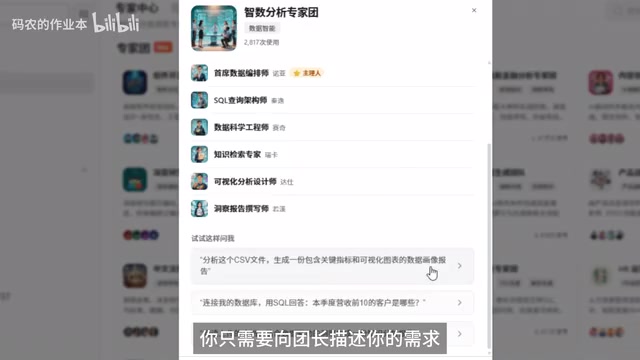
One-Click Launch of the AI Video Creation Pipeline
For AI healing pet video production specifically, the workflow is as follows:
- Open WorkBuddy and find the "Content Creation Expert Team" in the left sidebar
- Paste a viral video link and tell the expert team: "Help me use AI to generate a similar viral short video"
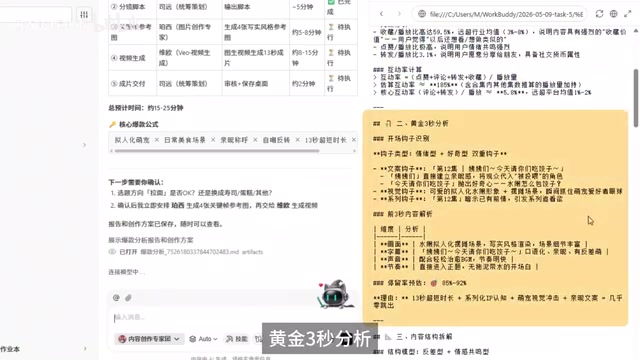
- Automatic viral video analysis: The system analyzes the video's basic metrics, golden-3-seconds design, content structure, etc.
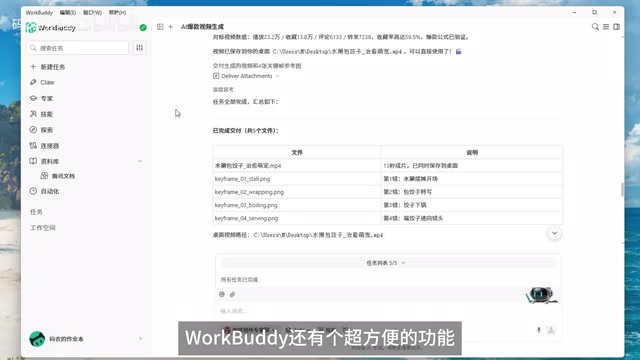
- Graphic Content Specialist generates keyframes: Automatically produces the core visuals needed for the video
- Video Generation Specialist completes image-to-video conversion: Transforms static images into dynamic video
The "golden 3 seconds" refers to the retention rate during the first 3 seconds of a video — a critical metric that determines whether a video can enter the next traffic pool tier. Platform algorithms heavily monitor whether users swipe away within the first 3 seconds, so viral videos typically feature strong visual impact, suspense, or emotional hooks at the opening.
On the technical level, "Image-to-Video" is one of the mainstream approaches in current AI video generation. Compared to generating video directly from text descriptions (Text-to-Video), Image-to-Video offers the advantage of precise control over composition and style, resulting in more controllable outputs. The underlying technology is mostly based on Diffusion Models — trained on massive video datasets, these models learn to "extend" static images into coherent dynamic footage. Representative products include Runway's Gen-3 Alpha, Pika Labs, and Stability AI's Stable Video Diffusion. WorkBuddy's choice of the "generate keyframe images first, then convert to video" technical route is precisely aimed at improving controllability while maintaining visual quality.
Throughout the entire process, users can monitor progress at each stage in real-time, with the team automatically coordinating — no manual tool switching required.
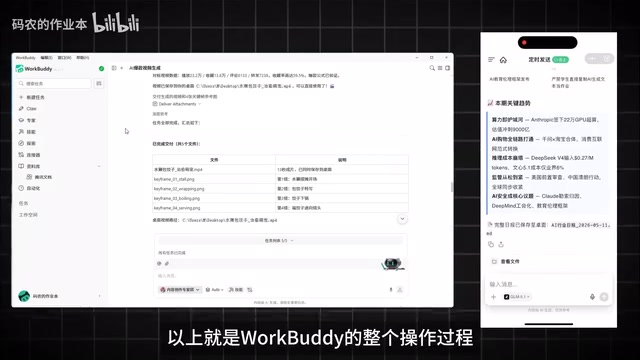
Mobile Integration: Command Your Expert Team Anytime via WeChat Mini Program
WorkBuddy also offers a WeChat Mini Program entry point, addressing the "away from computer" use case. Once linked, users can communicate with the expert team anytime, anywhere.
Practical scenarios include:
- Inspiration collection: When you come across an interesting pet video while scrolling, just send the link to the expert team — it will automatically organize your inspiration into documents ready for review when you're back at your computer
- Scheduled tasks: Set up daily automated collection and push notifications of the latest AI news, helping creators continuously track industry developments
This multi-device integration design philosophy essentially extends AI Agent capabilities from desktop to mobile, converting users' fragmented time into productivity. The advantage of using WeChat Mini Program as the carrier is that no additional app download is needed, and it can leverage WeChat's ecosystem push notification capabilities for proactive outreach, reducing usage friction.
Honest Assessment: WorkBuddy's Strengths and Limitations
Based on the demonstration, WorkBuddy has indeed made a valuable attempt at lowering the barrier to AI video creation. The "Expert Team" product design aligns better with actual content creation workflows than single-conversation AI. However, several points require rational consideration:
Strengths:
- Zero-experience users don't need to configure complex tool chains
- Viral video analysis features help beginners understand content logic
- Multi-device integration improves utilization of fragmented time
- 2,000 credits gifted upon registration, keeping trial-and-error costs low
Points of concern:
- Whether AI-generated video quality can reach viral standards still depends on underlying model capabilities
- The "replicate viral content" approach easily leads to content homogenization, and platform algorithms may downrank such content
- The credit consumption mechanism means ongoing usage has costs
- There may be a gap between demo results and actual batch production output
Regarding the risk of content homogenization, this deserves special elaboration. Major short-video platforms deploy content deduplication systems that detect highly similar content through video fingerprinting (such as perceptual hashing and frame feature extraction) and text semantic analysis. When platforms detect a flood of similar videos, they activate "content downranking" mechanisms that reduce recommendation weight for such content. Between 2023-2024, AIGC (AI-Generated Content) labeling requirements have been progressively tightening — Douyin, Kuaishou, and other platforms now require creators to label AI-generated content, with potential traffic restrictions for non-compliance. Therefore, a pure "replicate viral content" strategy carries diminishing marginal returns, and creators still need to inject personal creativity and differentiated elements on top of AI assistance.
Conclusion: AI Content Creation Tools Are Evolving from Point Solutions to Process Automation
WorkBuddy represents a trend: AI tools are evolving from "point capabilities" to "process automation." Previously, you needed to separately use ChatGPT for scripts, Midjourney for images, Runway for video, and CapCut for editing — now a single platform attempts to chain all of these together.
This evolution from point tools to process automation reflects the broader software industry trend of "Workflow Orchestration." Before the AI era, similar concepts had already been validated in RPA (Robotic Process Automation), low-code platforms, and other domains. Now, as large language models have gained the ability to understand natural language instructions and invoke external tools, "AI-native workflow automation" has become possible. Representative products include Zapier AI, Make.com, Dify, and Coze (ByteDance). WorkBuddy's differentiation lies in its focus on the content creation vertical, combined with a "personified team" interaction design that lowers the learning curve, enabling non-technical creators to harness complex multi-step AI workflows.
For ordinary people looking to try AI content creation, tools like this genuinely lower the entry barrier. But creators who can consistently produce viral content will ultimately compete on their understanding of content, audience insights, and creative differentiation capabilities with AI assistance. Tools are the lever, but the fulcrum is always the person.
Key Takeaways
- Tencent WorkBuddy uses an AI Expert Team collaboration mode (Multi-Agent System) to automate the video creation workflow into a pipeline: viral analysis → graphic generation → video synthesis
- The product's core differentiator is pre-configured professional role team collaboration, eliminating the need to switch between multiple AI tools
- Supports WeChat Mini Program mobile integration for on-the-go inspiration collection and scheduled tasks
- The AI healing pet video niche already has creators achieving 220K followers from 17 posts, thanks to the category's naturally high completion and engagement rates
- While the tool lowers the entry barrier, content homogenization risks, tightening platform AIGC labeling requirements, and actual output quality remain concerns to watch
Related articles
 Product Reviews
Qoder vs Cursor Real-World Comparison: Which $20/Month AI IDE Is Better?
Hands-on comparison of Qoder vs Cursor AI IDEs: Agent autonomy, human interaction count, and architecture decisions. Qoder needed only 2 interactions vs Cursor's 8.
 Product Reviews
Cursor Cloud Agent Demo: Eliminating Bottlenecks Across the Entire Software Development Lifecycle
Deep analysis of Cursor's Cloud Agent demo showing how cloud VMs, automated test artifacts, and a full-chain control plane systematically eliminate human bottlenecks across the software development lifecycle.
 Product Reviews
Cursor 3.0 Deep Dive: Multi-Agent Parallelism, Design Mode, and Best-of-N Model Comparison
Cursor 3.0 evolves from an AI coding assistant into an Agent fleet command center. Explore multi-agent parallelism, Design Mode, and Best-of-N model comparison.