The Truth Behind Windsurf's "Unlimited Credits" Hack: Shared Account Pool Rotation Mechanism and Risk Analysis
The Truth Behind Windsurf's "Unlimited…
Windsurf's "unlimited credits" is actually shared account pool rotation via third-party plugins, posing serious security and compliance risks.
The recently circulating Windsurf "credits increasing with usage" method is not an official bug, but an account rotation mechanism implemented by a third-party plugin called "Spark" that maintains a shared account pool and automatically switches authentication Tokens. While effective short-term, it carries serious risks including code leakage, illegal account sourcing, Terms of Service violations, and account bans, with no long-term sustainability. Users are advised to adopt legitimate subscriptions, multi-tool combinations, or open-source solutions with their own API Keys.
Event Overview
As one of today's hottest AI coding tools, Windsurf's paid credit limits have always been a focal point for users. Windsurf, developed by Codeium, is built on the VS Code core and integrates deep context-aware AI code completion, multi-file editing (Cascade feature), and other capabilities, emphasizing a "Flow"-style programming experience. Its quota system uses a "Credits" model where different models consume credits at significantly different rates—this is the fundamental reason users seek "credit extension" solutions. Recently, some users have shared a method to achieve "unlimited credits" through a third-party plugin—using a shared account pool to automatically switch accounts, making credits appear to "recover" rapidly after consumption. While this approach seems tempting, the underlying mechanism and risks deserve in-depth analysis.
Mechanism Analysis
Shared Account Pool and Auto-Switching
Based on the demonstration content, this is not an official Windsurf bug, but rather a feature provided by a third-party plugin called "Spark" (星火). The plugin's core logic is: maintaining a shared pool containing multiple Windsurf accounts, and when the current account's credits are consumed to a certain level, automatically switching to another account with sufficient credits—creating the visual effect of "credits increasing the more you use them."
From a technical implementation perspective, a shared account pool is a resource reuse technique commonly found in gray markets. Its core architecture typically includes three layers: an account management layer (storing authentication credentials for multiple accounts), a proxy middleware layer (handling request forwarding and session isolation), and a client plugin layer (handling local state synchronization and UI display). The "Spark" plugin likely intercepts Windsurf's local API calls and, upon detecting credits below a threshold, automatically replaces the locally stored authentication Token (such as JWT or OAuth tokens) to achieve seamless switching—this is highly similar to how "proxy pools" work in web scraping, essentially aggregating multiple accounts' credits into a virtual "super account" for the user.
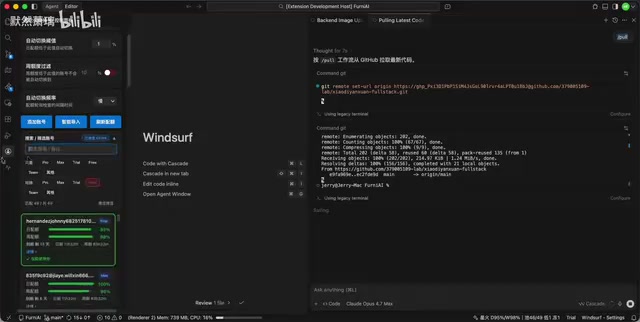
The plugin provides account filtering functionality, allowing users to filter specific accounts based on credit values (e.g., 835) or exclude so-called "welfare accounts." This indicates that the account pool contains accounts of different tiers and types.
Credit Consumption and Refresh Process
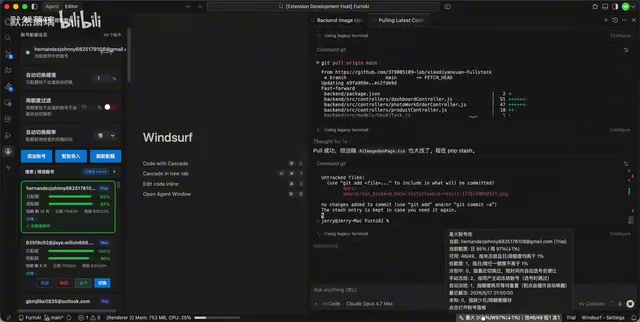
In the actual demonstration, the user engaged in conversation using the Claude 4.7 Max model, with credits gradually dropping from 95% to 87%—a consumption of approximately 8%. Then, through the plugin's "refresh account" function, credits instantly returned to 95%.
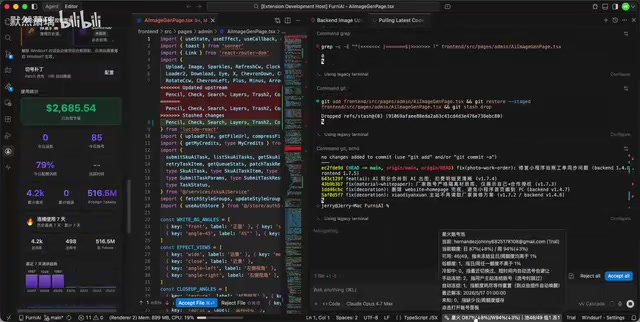
Notably, Claude 4.7 Max is Anthropic's top-tier model and falls into the high-consumption category in Windsurf's credit system. Different models in Windsurf correspond to different "credit multipliers": basic models consume approximately 1x credits, mainstream models (such as Claude 3.5 Sonnet, GPT-4o) consume approximately 3-5x, while top-tier models like Claude 4.7 Max may consume 10x or more—this explains why a single conversation consumed approximately 8% of credits.
This process is essentially just switching to another account with sufficient credits, rather than the current account's credits actually recovering. The so-called "unlimited usage" depends entirely on the number of available accounts in the pool and their total credit balance.
Usage Details and Considerations
The demonstration mentioned several key operational details:
- Fast mode is not recommended: Fast mode (Priority mode) invokes faster but more expensive inference resources, adding an additional consumption coefficient on top of the base credit multiplier, significantly shortening the usable time per account
- Supports cloning and auto-continue features: The plugin provides various auxiliary functions to optimize the user experience
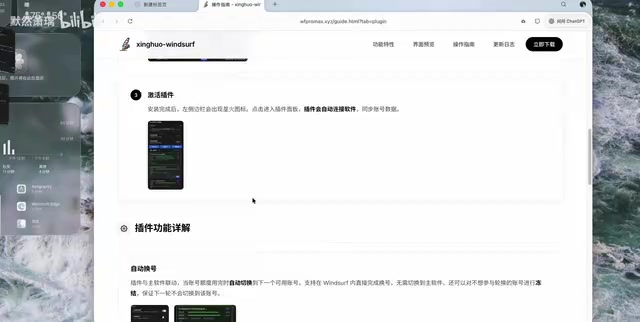
- Built-in usage tutorial: The plugin provides detailed import and usage guides
Risk and Compliance Analysis
Account Security Risks
Using a shared account pool means your code and conversation content may be routed through third-party servers. For development work involving trade secrets or sensitive information, this is a serious security concern. You cannot determine:
- Whether the third-party plugin logs your code content
- Whether the shared accounts are legitimately sourced (potentially involving stolen accounts, credit card fraud registrations, etc.)
- Whether your usage behavior can be traced back to you
The source of accounts in the shared pool is the core risk point. Common illegal account acquisition methods include: bulk registration using virtual or stolen credit cards (Card Fraud), bulk applications for student discount accounts through educational emails, purchasing leaked account credentials on the dark web, and using scripts to bulk-register free trial accounts. These activities not only violate Windsurf's Terms of Service but may also violate the Computer Fraud and Abuse Act (CFAA, US) or similar cybercrime regulations in multiple jurisdictions. For users, even without subjective knowledge, using accounts of unknown origin may constitute "conspiracy" or "knowing use of stolen goods" at the legal level, especially in commercial use scenarios.
Terms of Service Violations
Windsurf's user agreement explicitly prohibits account sharing and transfer. Using such tools carries the risk of account bans. Major AI tool vendors have established multi-dimensional anomaly detection systems to combat account abuse. Common detection dimensions include: IP geolocation consistency checks against account registration information, Device Fingerprint identification (including browser characteristics, hardware information, etc.), usage behavior pattern analysis (such as request frequency, time distribution, code similarity clustering), and inter-account association graph analysis (multi-account behavior under the same IP). Once Windsurf strengthens its detection mechanisms, the entire account pool could be banned in bulk.
Questionable Sustainability
These "free-riding" methods typically lack long-term sustainability. Windsurf's parent company Codeium, as a heavily funded commercial company, has a comprehensive security team and technical capabilities to continuously iterate its risk control systems. The video title's mention of "comeback again" itself confirms this point—such methods have been blocked before, demonstrating that vendors' risk control systems are indeed continuously upgrading. Gray-market tools typically have lifecycles measured in weeks or months, and as AI tool vendors continue to improve their risk control systems, the survival space for gray-market operations will only shrink.
More Rational Alternatives
Rather than risking security and compliance issues with shared accounts, consider these legitimate approaches:
- Make good use of free credits: Windsurf provides a certain amount of free usage credits; planning your use cases wisely can meet light-duty needs
- Subscribe to official paid plans: For heavy users, official subscriptions are the most stable and reliable choice
- Use multiple tools in combination: Combine Windsurf, Cursor, GitHub Copilot, and other tools to distribute credit pressure
- Try open-source alternatives: Open-source AI coding plugins like Continue and Cline, paired with your own API Key, offer controllable costs and data security
Among these, the "bring your own API Key" model deserves special attention. Continue is an open-source VS Code/JetBrains plugin that supports connecting to OpenAI, Anthropic, local Ollama, and various other model backends—users directly use their own API Keys, with data never passing through third-party servers. Cline (formerly Claude Dev) focuses on autonomous task execution, supporting tool calls and multi-step code modifications. The cost model for these solutions is more transparent: taking Claude 3.5 Sonnet as an example, API call pricing is approximately $3/million tokens for input and $15/million tokens for output, with average monthly costs for daily programming use typically ranging from $5-20, completely avoiding the legal and security risks of account sharing. For enterprise users who prioritize data security, deploying local models (such as CodeLlama, DeepSeek Coder) for fully offline AI programming assistance is also an option.
Conclusion
The so-called "credits increasing the more you use them" is not a Windsurf bug, but rather an account rotation mechanism implemented by a third-party plugin through a shared account pool—its technical essence is automatically replacing authentication Tokens when insufficient credits are detected, aggregating multiple accounts' credits into a virtual "super account." While it does achieve "unlimited usage" in the short term, the underlying security risks (code leakage, illegal account sources), compliance issues (Terms of Service violations, potential legal liability), and sustainability concerns (vendors continuously upgrading risk controls) are all worrying. As AI coding tools increasingly become core productivity tools for developers, choosing safe, stable, and compliant usage methods is the long-term strategy.
Key Takeaways
- The so-called unlimited credits is not an official bug, but an account rotation effect achieved by a third-party plugin automatically switching authentication Tokens through a shared account pool
- Accounts in the shared pool may originate from credit card fraud, stolen accounts, and other illegal activities, exposing users to legal liability risks
- Using shared account pools carries serious security and compliance risks including code leakage and account bans
- The plugin offers account filtering, welfare account exclusion, auto-refresh, and other features, but Fast mode is not recommended to slow credit consumption
- Such gray-market operations lack long-term sustainability; legitimate subscriptions, multi-tool combinations, or "bring your own API Key" open-source solutions are recommended alternatives
Related articles
 Product Reviews
Qoder vs Cursor Real-World Comparison: Which $20/Month AI IDE Is Better?
Hands-on comparison of Qoder vs Cursor AI IDEs: Agent autonomy, human interaction count, and architecture decisions. Qoder needed only 2 interactions vs Cursor's 8.
 Product Reviews
Cursor Cloud Agent Demo: Eliminating Bottlenecks Across the Entire Software Development Lifecycle
Deep analysis of Cursor's Cloud Agent demo showing how cloud VMs, automated test artifacts, and a full-chain control plane systematically eliminate human bottlenecks across the software development lifecycle.
 Product Reviews
Cursor 3.0 Deep Dive: Multi-Agent Parallelism, Design Mode, and Best-of-N Model Comparison
Cursor 3.0 evolves from an AI coding assistant into an Agent fleet command center. Explore multi-agent parallelism, Design Mode, and Best-of-N model comparison.