Three AI Coding Tool Alternatives After Cursor Restrictions

Three AI coding tools to replace Cursor after regional restrictions hit Chinese users
Due to regional restrictions from model providers like Anthropic, Cursor has become difficult to use in China. This article introduces three alternatives: Augment Code ($50/month) excels at automatic prompt optimization and memory systems; Trae ($10/month) offers the best value with Cursor-like UX and domestic model support including Kimi K2; Amazon Kilo ($19/month) features a unique process-driven Space mode that integrates requirements analysis, design docs, and task breakdown into the AI development workflow, ideal for complex projects.
Background: Cursor Restricted for Users in China
Recently, a large number of users have reported that when selecting Claude, OpenAI, or GPT models in Cursor, they receive a message stating "this model is not supported in your region." The official explanation is that third-party model companies (such as Anthropic) have imposed regional restrictions. The root cause lies in the fact that both Anthropic and OpenAI explicitly restrict API access from certain regions in their terms of service, typically enforced through multiple mechanisms including IP geolocation detection, billing address verification, and payment method identification. While the community has offered some temporary workarounds—such as switching the HTTP type to 1.1 in settings—this is essentially a bypass rather than a solution, as the HTTP protocol version difference only affects how certain proxies handle traffic. From a technical architecture perspective, Cursor as a frontend IDE layer relies entirely on third-party APIs for model calls, and this strong dependency leaves it with virtually no autonomy when facing upstream service providers' regional policies.
Given this context, finding AI coding tools that can replace Cursor has become particularly important. This article introduces three alternatives that have been validated through actual projects, two of which have already been used to complete multiple full projects.
Augment Code — AI Coding Plugin with Intelligent Prompt Optimization
Basic Information
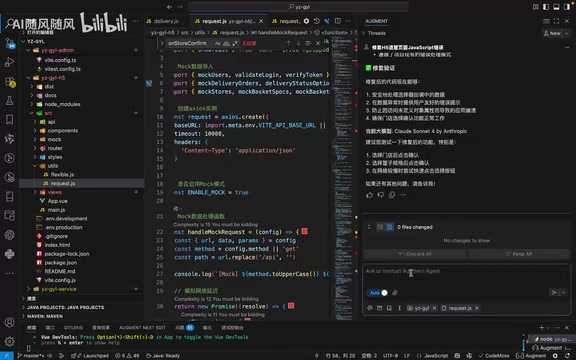
Augment Code exists as a plugin for VS Code or IntelliJ IDEA, not as standalone software. Free users receive 300 uses upon registration, while the paid version at $50/month provides 600 requests. Its core advantage lies in the extremely high efficiency per request—a single request can accomplish a substantial amount of work.
Core Advantages
Automatic Prompt Optimization: This is Augment's most outstanding feature. Behind it is a Meta-Prompt engineering mechanism—Augment inserts a dedicated prompt-rewriting model between user input and the underlying model. It analyzes user intent, combines code repository context, references historical preferences from the memory bank, and transforms vague instructions into structured, precise prompts. This technique is known in academia as "Prompt Augmentation," and research shows that high-quality prompts can improve model output accuracy by 30%-50%. When you input a simple fix instruction, its built-in optimization model combines the current conversation context and memory information to refine your requirements into precise descriptions. For example, if you simply say "fix this UI issue," it will automatically supplement the fix requirements, scope of impact, and other detailed information.
Memories System: Augment proactively remembers key information from conversations. When you say "please remember" a certain requirement, it stores it in the memory bank. These memories are project-level and remain effective across subsequent conversations. Unlike Cursor's "context compression" strategy (which distills conversation history into summaries before passing them to new sessions), Augment's Memories system explicitly stores important information as structured memories, independent of conversation history—similar to the separation between human long-term memory and working memory, offering clear advantages in cross-session long-term project development.
Task Splitting (To-Do List): Augment introduced task splitting functionality earlier than Cursor, allowing complex features to be broken down into multiple subtasks with support for dynamically editing, adding, or deleting tasks during development.
Shortcomings
- Model opacity—no ability to select the underlying model
- Context inheritance in new conversations is not as good as Cursor (Cursor compresses the previous conversation's context and passes it to new conversations)
- Noticeable lag when dealing with large codebases in IntelliJ IDEA; switching to VS Code is recommended
Real-World Experience
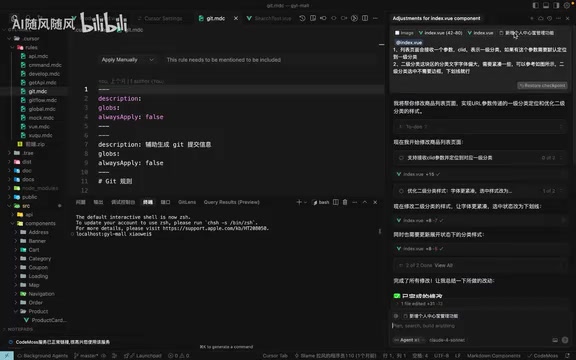
The author used Augment Code to complete a small supply chain system, including a backend management interface, mobile H5 pages, and Java backend services. Overall code quality was solid, with essentially no serious issues encountered.
Trae — The Best Value Cursor Alternative
Pricing & Models
Trae's pricing is extremely competitive: $10/month for 600 requests, with manual top-up at just $3/600 requests. It supports the Claude 4 Sonnet model with no queue currently required.
User Experience
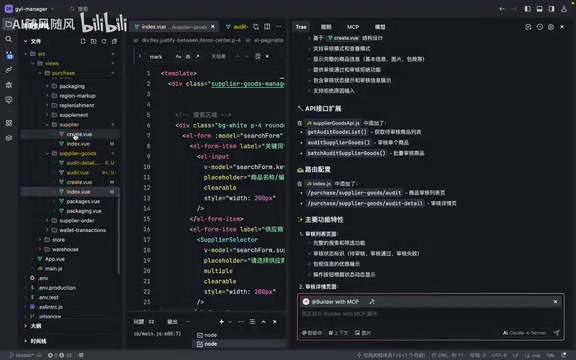
Trae's interaction design is highly similar to Cursor, covering roughly 70-80% of Cursor's features. Rule configuration, model switching, MCP, and other functions all have dedicated entry points. Notably, Trae supports MCP (Model Context Protocol)—an open standard protocol proposed by Anthropic in late 2024 that defines a unified communication specification between AI models and external tools (such as file systems, databases, browser control), enabling AI coding tools to break beyond single-application boundaries and tap into a rich ecosystem of external capabilities. When context length is exceeded, it prompts users to choose between continuing or opening a new conversation window.
In terms of actual results, Trae achieves approximately 70% of Cursor's experience level. The author has completed three projects with it, with a single conversation generally producing complete results.
Key Advantages
- Priced at one-fifth of Augment Code, making it one of the most cost-effective AI coding tools available
- Quick support for domestic models, already supporting Kimi K2 API integration. Kimi K2 is a code-generation-focused large language model from Moonshot AI, using a Mixture of Experts (MoE) architecture that demonstrates competitiveness comparable to Claude 3.5 Sonnet across multiple programming benchmarks, with domestic server deployment meaning no regional access restrictions
- Operational logic consistent with Cursor, resulting in extremely low migration costs
- Expected to deploy K2 and other models independently in the future, further reducing costs
Current Shortcomings
- Lacks prompt optimization and task splitting features (expected to be added later)
- Only supports the base version of Claude 4, with no Thinking or Max mode available yet
Amazon Kilo — A Fresh Approach to Process-Driven Development
Product Positioning
Amazon Kilo is Amazon's latest standalone IDE, offering free users 50 uses/month, with $19/month providing 1000 requests and Claude model support.
Dual-Mode Design
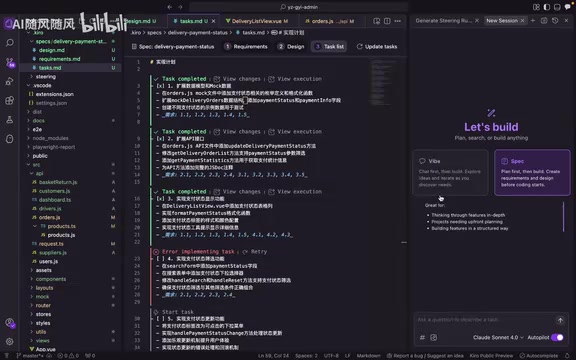
Kilo's most unique design feature is offering two development modes:
Web Mode: Immersive programming through conversation or direct coding, suitable for simple and quick modifications.
Space Mode: Follows a complete software development workflow—requirements analysis → requirements document → design document → task breakdown → execution. This design stems from the industry's systematic response to the "AI hallucination" problem: research has found that error rates increase exponentially with requirement complexity when directly asking LLMs to generate complex feature code; however, when tasks are decomposed into multiple sub-steps with clear acceptance criteria, accuracy at each step can be significantly improved. Even for a simple requirement like "add a status field to the list page," Space mode generates complete requirements documents and technical design documents, analyzes the scope of impact, and then breaks down tasks for execution—equivalent to enforcing a lightweight architecture review before each development cycle, reducing rework probability from the source.
Applicable Scenarios
Space mode is particularly suitable for complex feature development or system initialization phases, essentially integrating the collaborative effects of multiple LLMs and MCP tools into a standardized workflow. This approach of deeply fusing traditional software engineering methodologies (requirements analysis, design documents, task decomposition) with AI generation capabilities aligns with "user story splitting" in Agile development and "phase reviews" in the Waterfall model, significantly improving accuracy for complex requirements.
Comparison Summary & Selection Guide
| Tool | Form Factor | Monthly Fee | Requests | Core Advantage |
|---|---|---|---|---|
| Augment Code | VS Code/IDEA Plugin | $50 | 600 | Prompt optimization, memory system |
| Trae | Standalone Tool | $10 | 600 | Best value, domestic model support |
| Amazon Kilo | Standalone IDE | $19 | 1000 | Process-driven development, dual modes |
It's reported that 30% of Cursor's users are from China, indicating enormous opportunity in the Chinese AI coding tools market. As domestic programming models like Kimi K2, DeepSeek, and Tongyi Lingma continue to iterate—these models generally adopt Mixture of Experts architectures to reduce inference costs and face no regional access restrictions—if domestic vendors can keep pace, users will have more high-quality localized options. The gap between domestic models and international state-of-the-art is narrowing rapidly, and competition will ultimately drive the entire industry forward.
Key Takeaways
- Cursor's inability to serve Chinese users with Claude and other models stems from third-party model companies' regional restrictions—an inherent limitation of upstream API-dependent architecture
- Augment Code provides intelligent prompt optimization (meta-prompt engineering) and a memory system as a plugin, at $50/month for 600 requests, suitable for developers pursuing precision
- Trae costs only $10/month for 600 requests with exceptional value, highly similar operational logic to Cursor, supports domestic models like Kimi K2, and has minimal migration costs
- Amazon Kilo offers a unique dual-mode design where Space mode fuses traditional software engineering methodology with AI capabilities, executing along a complete development workflow, ideal for complex projects
- The Chinese AI coding market has enormous potential, and as domestic models like K2 mature and the MCP ecosystem opens up, localized tools are poised for rapid growth
Related articles
 Product Reviews
Qoder vs Cursor Real-World Comparison: Which $20/Month AI IDE Is Better?
Hands-on comparison of Qoder vs Cursor AI IDEs: Agent autonomy, human interaction count, and architecture decisions. Qoder needed only 2 interactions vs Cursor's 8.
 Product Reviews
Cursor Cloud Agent Demo: Eliminating Bottlenecks Across the Entire Software Development Lifecycle
Deep analysis of Cursor's Cloud Agent demo showing how cloud VMs, automated test artifacts, and a full-chain control plane systematically eliminate human bottlenecks across the software development lifecycle.
 Product Reviews
Cursor 3.0 Deep Dive: Multi-Agent Parallelism, Design Mode, and Best-of-N Model Comparison
Cursor 3.0 evolves from an AI coding assistant into an Agent fleet command center. Explore multi-agent parallelism, Design Mode, and Best-of-N model comparison.