Trae Solo In-Depth Review: Is ByteDance's Free AI Coding Tool Actually Usable?
Trae Solo In-Depth Review: Is ByteDanc…
ByteDance's Trae Solo offers fully free AI coding with cross-platform sync and high concurrency for Chinese users.
ByteDance's AI coding tool Trae Solo provides domestic individual users with both free software and free tokens, with quotas possibly exceeding 100 million tokens. Its core competitive advantage lies in complete integration across web, desktop, and mobile platforms, enabling phone-controlled coding on desktop. Testing showed 6 concurrent projects without rate limiting, and the included Zhipu 5.1 coding model delivers excellent results, making it currently the most worthwhile free AI coding tool for individual developers in China.
Introduction
ByteDance's AI coding tool Trae Solo offers domestic individual users a dual benefit: free software plus free tokens. This stands out remarkably in China's AI tool market, where most products charge fees. After a full day of intensive testing, I've conducted a comprehensive evaluation of this product across multiple dimensions including concurrency capabilities, token quotas, and cross-platform synchronization.
Trae Solo's Reverse Pricing Strategy: Free Domestically, Paid Internationally
A common phenomenon in China's AI product market is that products are free for overseas users but charge domestic users. Trae Solo does exactly the opposite — the domestic individual version is completely free, while the international version has free quota limits.
Looking at the enterprise pricing: 49 yuan corresponds to 10M tokens, 99 yuan to 20M tokens, and 1,199 yuan to 40M tokens (approximately 40 million). However, during my testing, I found that the free personal account's token usage is at least 100 million tokens or more, far exceeding the highest enterprise tier, and possibly has no upper limit at all.
Token Economics Background: Tokens are the basic unit of measurement for how large language models process text. In English, one token corresponds to approximately 0.75 words; in Chinese, one character typically corresponds to 1-2 tokens. Token consumption directly determines the cost of using AI tools, making it the core variable in vendors' pricing strategies. Taking GPT-4o as an example, its API pricing is approximately $5 per million input tokens and $15 per million output tokens. For complex programming projects, a single complete development iteration often requires millions or even tens of millions of tokens, making token quotas a key battleground for AI coding tool competition. ByteDance providing potentially over 100 million free tokens for domestic individual users translates to hundreds or even thousands of yuan in market value — a subsidy intensity extremely rare in the industry, driven by a long-term strategic logic of trading traffic for ecosystem lock-in.

This pricing strategy is truly rare among domestic AI tools and represents a noteworthy product decision for individual developers and learners.
Cross-Platform Integration: Mobile Is Trae Solo's Core Competitive Advantage
Trae Solo provides three entry points: web, desktop, and mobile. In my view, the real differentiating advantage lies in the complete integration between the mobile app and the other two platforms.
Practical Value of the Mobile Client
Today's AI programming no longer requires manually writing code — development can be completed through conversation. This paradigm is known in the industry as Vibe Coding, formally proposed by OpenAI co-founder Andrej Karpathy in early 2025. Its core concept is: developers no longer write code line by line, but describe requirements in natural language, with AI handling code generation, debugging, and iteration, while humans only verify results. The rise of this paradigm is enabled by breakthrough advances in large language models' code understanding and generation capabilities, allowing non-professional programmers to build complex applications. This means you can use voice conversation on your phone to have the desktop execute code-writing tasks. But the prerequisite is — the mobile client must be able to see and operate on desktop projects.
I previously used a similar product from Tencent, whose mobile client was implemented via a WeChat Mini Program, with two serious problems: first, WeChat itself couldn't function normally while using the Mini Program; second, desktop projects were completely invisible in the Mini Program, rendering the mobile client useless. This architectural choice inherently limited its capability ceiling — the Mini Program's sandbox mechanism and resource constraints make it difficult to carry complete development environment state.
Additionally, I tested multiple overseas products including OpenAI Codex desktop version and Google's coding tools — none of them achieved cross-platform integration. Trae Solo is the first AI coding product I've found that truly achieves complete data and operation synchronization across all three platforms.
Technical Challenges of Cross-Platform Integration: Achieving true data interoperability between web, desktop, and mobile faces multiple technical challenges. First is the project state synchronization problem: the desktop's file system, runtime environment, dependency packages, and other states need real-time mapping to the cloud so the mobile client can see a consistent project view. This typically requires Cloud Sandbox technology to fully containerize the development environment and host it on servers, with local clients serving only as display and interaction layers. Second is mobile interaction adaptation: reconstructing the experience of code editing, file tree browsing, terminal operations, and other typical development scenarios on small-screen touch devices requires substantial UI/UX engineering investment. Trae Solo's choice of a standalone app over a Mini Program represents a clear trade-off between user acquisition cost and functional completeness, and is the fundamental prerequisite that enables its cross-platform integration.
Integrated Cloud Deployment
Through cloud services, users can complete the entire workflow from development to deployment on their phone: write code → preview on phone → confirm satisfaction → one-click publish. Trae Solo integrates with GitHub and other code hosting platforms, supporting automatic publishing, with the entire development-to-deployment process completable on mobile.
Trae Solo's Model Selection and Work Modes
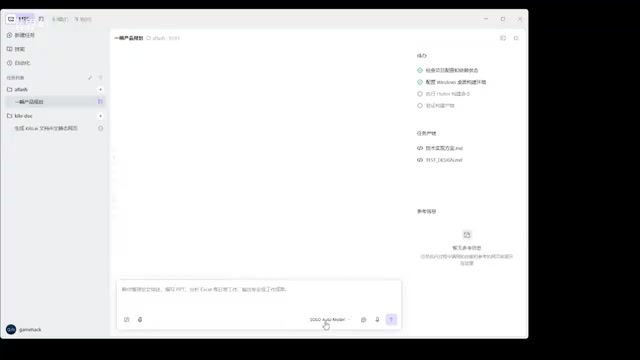
Trae Solo's upper-left corner provides two mode switches:
- Office Mode: Only one built-in model. Based on my experience, office tasks don't demand much from models, and a single model actually reduces decision fatigue.
- Coder Mode: Multiple coding models available, all free to use.
I currently primarily use the Zhipu 5.1 coding model in Coder mode. Zhipu AI is a technology commercialization enterprise from Tsinghua University. Its GLM (General Language Model) architecture differs from GPT's autoregressive Decoder-only structure, employing an autoregressive blank-filling pre-training objective that offers certain advantages in bidirectional understanding. Its latest GLM-4 series shows significant improvements in code completion, cross-language translation, and complex logical reasoning. This model is priced at approximately one dollar per million tokens in overseas markets, already in the low-to-mid price range among mainstream coding models, while ByteDance offers it for free — essentially trading traffic for user data and ecosystem lock-in. In terms of actual usage experience, this model is significantly better than many free coding models I've used before.
Concurrency Capabilities and Rate Limiting Test Results
Six Projects Running Concurrently Without Throttling
I conducted a stress test: running 6 projects concurrently, including translating Cline's official documentation, translating Hagenfish's official documentation, and several other tasks. All six projects worked simultaneously with no rate limiting triggered.
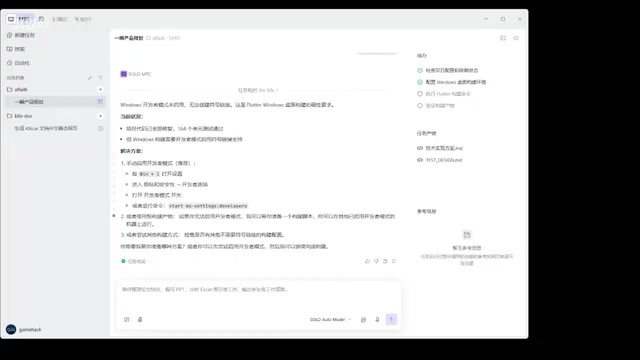
While I didn't reach the rate-limiting boundary, I can confirm that the free account's concurrency ceiling is far higher than other free platforms like ModelScope.
Token Consumption Comparison for Complex Projects
I tested token consumption with two complex projects:
Project One: Kia Photo Album Management Tool Rewrite
This is a complex project requiring multi-container deployment, originally needing multiple containers running under Linux. I asked Trae Solo to re-implement it as a Windows desktop application. The AI completed the code writing in approximately 1-2 hours, then wrote over 160 unit tests, with another half hour to pass all tests.
A noteworthy phenomenon: the time AI spent fixing unit test bugs was several times longer than writing the code, requiring repeated modifications. This phenomenon has deep technical reasons: unit tests are essentially formalized constraints on code behavior, requiring code to meet expectations under all boundary conditions. AI can typically cover the main path during initial code generation, but tends to overlook boundary cases (null handling, concurrency races, type conversions, etc.). More critically, when tests fail, the AI must judge between "modifying implementation code" and "modifying test cases," which involves deep understanding of requirement semantics rather than mere syntax correction. Additionally, test fixes often have cascading effects — fixing one test may break another, causing the AI to fall into repetitive iteration loops. This is the core bottleneck that current AI coding tools must overcome in moving from "code generation" to "reliable software delivery." The total token consumption for this project is estimated at tens of millions.
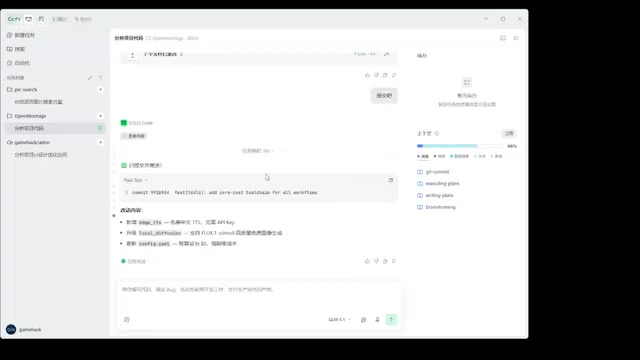
Project Two: Video Studio Tool Localization to Chinese
This is a complex video production project using workflow tools to drive 11 pipelines, involving multiple roles collaborating on storyboards, voice segmentation, and more. Previously on another platform, just adding Chinese support to this project consumed over 50 million tokens, and with paid API interface replacements, the total exceeded 100 million tokens. Completing the same functionality on Trae Solo consumed noticeably fewer tokens, primarily thanks to the Zhipu coding model's higher efficiency.
Conclusion: Is Trae Solo Worth Using?
Based on comprehensive testing, Trae Solo has clear advantages among free AI coding tools:
- Truly Free: Free software + free tokens, with personal account quotas possibly unlimited
- Cross-Platform Integration: Currently the only AI coding tool on the market that achieves complete interoperability between web, desktop, and mobile, leveraging cloud sandbox technology for fully containerized development environment hosting
- Reliable Model Quality: Free coding models like Zhipu 5.1 deliver excellent results, with the GLM architecture specifically optimized for code understanding and generation tasks
- High Concurrency Tolerance: 6 projects running concurrently without triggering rate limits
Of course, since I haven't reached the actual limits of tokens and concurrency, the real boundaries remain to be verified. But based on current usage experience, for domestic individual developers, Trae Solo is very likely the most worthwhile free AI coding tool to try right now.
Key Takeaways
- Trae Solo is completely free for domestic individual users (software + tokens), with free quotas possibly exceeding 100 million tokens — far surpassing paid enterprise tiers and worth hundreds to thousands of yuan at market prices
- It is currently the only AI coding tool on the market with complete cross-platform integration across web, desktop, and mobile, supporting voice-controlled coding from phone to computer, built on cloud sandbox containerization technology
- Testing showed 6 concurrent projects without triggering rate limits, with concurrency tolerance far exceeding other free platforms like ModelScope
- Free access to high-quality coding models like Zhipu 5.1 (from Tsinghua's GLM architecture), with actual coding efficiency superior to multiple previously used free tools
- AI time spent writing unit tests and fixing bugs far exceeds code writing time, rooted in boundary condition handling and test cascading effects — a universal characteristic of current AI coding
Related articles
 Product Reviews
Qoder vs Cursor Real-World Comparison: Which $20/Month AI IDE Is Better?
Hands-on comparison of Qoder vs Cursor AI IDEs: Agent autonomy, human interaction count, and architecture decisions. Qoder needed only 2 interactions vs Cursor's 8.
 Product Reviews
Cursor Cloud Agent Demo: Eliminating Bottlenecks Across the Entire Software Development Lifecycle
Deep analysis of Cursor's Cloud Agent demo showing how cloud VMs, automated test artifacts, and a full-chain control plane systematically eliminate human bottlenecks across the software development lifecycle.
 Product Reviews
Cursor 3.0 Deep Dive: Multi-Agent Parallelism, Design Mode, and Best-of-N Model Comparison
Cursor 3.0 evolves from an AI coding assistant into an Agent fleet command center. Explore multi-agent parallelism, Design Mode, and Best-of-N model comparison.