Using GPT-5.2 and Gemini 3.0 Without a VPN: Hands-On Review of an Aggregated AI Platform
A Chinese AI aggregation platform offers free access to top global models but carries security and stability risks.
This article reviews an AI aggregation platform targeting Chinese users that claims to offer zero-barrier free access to GPT-5.2, Gemini 3.0, Grok 4.1, Claude 4.5, and other top global models, with cross-model context retention and multi-device support. However, it also highlights significant risks including data security concerns, questionable service stability, and difficulty verifying model version authenticity, recommending official channels for professional use and domestic alternatives for everyday scenarios.
Background: AI Giants in Fierce Competition — How Can Chinese Users Keep Up?
The AI landscape has recently entered an unprecedented phase of intense competition. Google just released Gemini 3.0 Pro, and OpenAI followed immediately with GPT-5.2, with each company racing to outperform the other on various capability benchmarks and continuously breaking global AI performance records.
In 2024-2025, the global AI model competition has shifted from a pure parameter-scale race to a multi-dimensional capability contest. OpenAI maintains its leading position through continuous iteration of the GPT series, Google DeepMind has consolidated resources to launch the Gemini series in hot pursuit, Anthropic has differentiated itself with safety alignment as a core focus through the Claude series, and Elon Musk's xAI has entered the market with the Grok series. This multipolar competitive landscape has driven rapid improvements in model capabilities, but it also means users need to switch between multiple platforms to get the best experience.
However, for users in China, directly accessing these top-tier models often faces the dual barriers of network access restrictions and paid subscriptions. Due to network environment and policy factors, Chinese users face multiple obstacles when trying to directly access OpenAI, Anthropic, Google AI, and similar services — including IP region restrictions, phone number verification requirements, and international payment method barriers (requiring overseas credit cards or PayPal). This has spawned a large number of intermediary service providers and aggregation platforms, forming a gray-area ecosystem. It's estimated that the number of Chinese users accessing overseas AI models through unofficial channels has reached the millions.
A Bilibili content creator shared an aggregated AI platform that claims to offer zero-barrier, free access to mainstream global AI models, including the full GPT series, Grok, Gemini, Claude, and more. This article analyzes the features and usage considerations of such aggregation platforms based on that video content.

Core Platform Features: Multi-Model Free Aggregation
Supported AI Models Overview
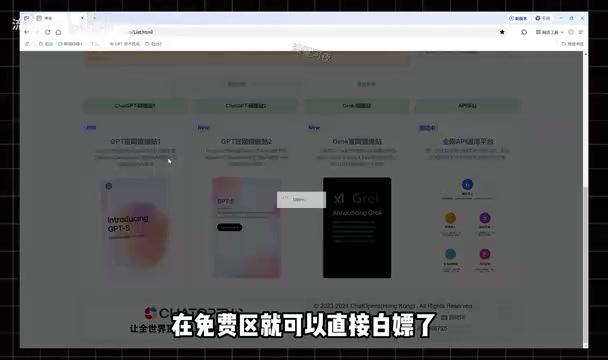
As shown in the video, the platform's core selling point is consolidating the world's top AI models into a single interface, eliminating the need for users to register separately with each service. AI aggregation platforms typically employ several technical approaches: one is compliant forwarding through official API keys, where the platform purchases API quotas from each model provider and distributes them to users; another is reverse engineering to simulate official client requests, bypassing official restrictions to access model capabilities; and a third uses shared account pools with round-robin calling. Different implementation methods vary enormously in stability, compliance, and response quality, and users often cannot determine which specific technical approach a platform uses.
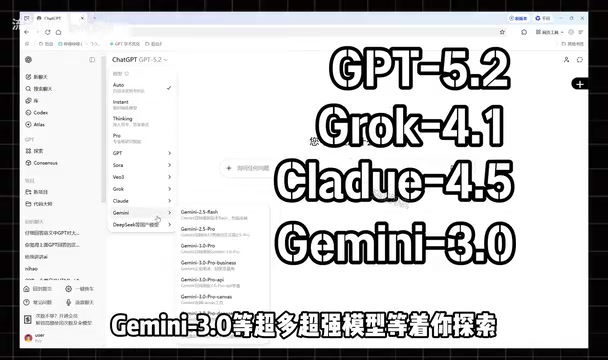
In the platform's free section on the homepage, users can directly access the following models:
- GPT-5.2: OpenAI's latest flagship model, claiming unlimited free usage
- Grok 4.1: The latest model from Elon Musk's xAI
- Claude 4.5: Anthropic's flagship model
- Gemini 3.0: Google's latest large language model
Cross-Model Context Retention
One noteworthy feature of this platform is cross-model context retention during conversations. The video demonstrated an interesting use case: first generating a response with GPT-5.2, then switching to Grok 4.1 to evaluate the reasonableness of GPT's previous answer. After switching models, the previous conversation history was preserved, enabling seamless transitions.
In traditional usage scenarios, each AI model operates as an independent conversation system, and switching models means starting a conversation from scratch. Cross-model context retention essentially means the platform maintains a unified conversation history on the server side, passing the complete dialogue record as context when calling different model APIs. This design draws from the concept of "ensemble learning" — different models vary in knowledge reserves, reasoning styles, and areas of expertise, and cross-verification can effectively reduce the hallucination risk of any single model, improving output reliability. "Hallucination" refers to AI models generating information that appears plausible but is actually incorrect or fabricated — one of the core challenges facing current large language models.
This design does have practical value — users can leverage the strengths of different models for cross-verification, such as using one model to generate content and another to review and supplement it.
How Does It Actually Perform?
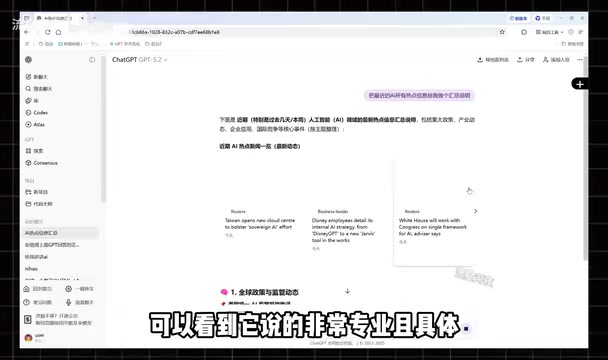
The video showcased a specific use case: asking the AI to summarize all recent AI hot topics. Based on the screenshots, the model's response was highly professional and specific, listing various aspects in detail. This indicates that the models called by the platform do possess strong information synthesis capabilities.
The platform supports both mobile and desktop use, further lowering the device barrier and allowing users to access AI capabilities anytime, anywhere.
Risks and Considerations: Must-Read Before Using
While these VPN-free AI aggregation platforms may seem appealing, users need to maintain rational awareness:
Data Security Concerns
Using AI models through a third-party platform means your conversation content passes through intermediary servers. Sensitive information and trade secrets should not be entered on such platforms.
The data security risks of third-party AI aggregation platforms extend beyond conversation content leakage. Deeper concerns include: platforms may record user behavior patterns and preference data for commercial monetization; conversation content may be used to train other models; user data may be exposed in bulk if the platform is attacked; some platforms may even inject advertisements or misleading information into responses. Furthermore, since these platforms are typically not effectively governed by mainstream privacy regulations (such as GDPR), users have extremely limited recourse for rights protection.
Questionable Service Stability
The sustainability of free services is a concern. These platforms typically rely on API forwarding or reverse engineering and may experience service interruptions at any time due to upstream policy changes. From a business model perspective, providing free access to high-cost AI API calls is inherently unsustainable in the long term — taking GPT-4-level models as an example, a single complex conversation's API cost can reach several cents, and providing this at scale for free means the platform needs to cover costs through other means (such as data monetization, ad insertion, or subsequent paid conversion).
Model Version Authenticity Is Hard to Verify
Whether the so-called "full-powered version" is truly the latest official version is difficult for users to verify. Some platforms may use lower-tier API endpoints, resulting in an actual experience that differs from the official version. Technically, users can roughly assess model versions through specific benchmark test questions, but this requires certain expertise. Some platforms may even use open-source models (such as the Llama series) to impersonate commercial closed-source models, which ordinary users can barely distinguish.
Conclusion: Who Should and Shouldn't Use This
In an era where AI models are flourishing, aggregation platforms do address the pain point of Chinese users who "want to try but can't access" these models. For light usage and learning/exploration scenarios, these VPN-free AI tools have their place. However, for professional work or privacy-sensitive scenarios, it's recommended to use GPT-5.2 or Gemini 3.0 through official channels to ensure data security and service quality.
In the long run, China's domestic AI ecosystem is also developing rapidly. Chinese-made large models such as Baidu's ERNIE Bot, Alibaba's Tongyi Qianwen, and ByteDance's Doubao already perform impressively in Chinese-language scenarios, with no access barriers or data cross-border risks. For most everyday use cases, domestic models can already meet user needs, and there's no need to excessively chase the "halo effect" of overseas models.
Related articles
 Product Reviews
Qoder vs Cursor Real-World Comparison: Which $20/Month AI IDE Is Better?
Hands-on comparison of Qoder vs Cursor AI IDEs: Agent autonomy, human interaction count, and architecture decisions. Qoder needed only 2 interactions vs Cursor's 8.
 Product Reviews
Cursor Cloud Agent Demo: Eliminating Bottlenecks Across the Entire Software Development Lifecycle
Deep analysis of Cursor's Cloud Agent demo showing how cloud VMs, automated test artifacts, and a full-chain control plane systematically eliminate human bottlenecks across the software development lifecycle.
 Product Reviews
Cursor 3.0 Deep Dive: Multi-Agent Parallelism, Design Mode, and Best-of-N Model Comparison
Cursor 3.0 evolves from an AI coding assistant into an Agent fleet command center. Explore multi-agent parallelism, Design Mode, and Best-of-N model comparison.