Warp AI Coding Tool In-Depth Review: Can It Replace Cursor?

Warp: A new AI coding tool built by a heavy Cursor user, offering more generous free credits.
Warp is an AI coding tool created by a former heavy Cursor user, evolved from a well-known Rust terminal emulator. It covers mainstream features including Agent mode, MCP protocol, and Rules configuration, while supporting the latest models like Claude Opus 4.5 with 150 free credits for new users. Compared to Cursor, Warp offers a more generous free tier and unique features like voice input, though its long-term sustainability remains to be seen.
An AI Coding Tool Born Out of Frustration with Cursor
The AI coding tool arena has welcomed another strong contender — Warp. Based on a two-week in-depth test by a Bilibili content creator, this tool demonstrates the ability to compete head-to-head with Cursor across multiple dimensions. What's even more noteworthy is that Warp currently offers quite generous free credits for new users and supports mainstream large language models including Claude Opus 4.5, making it a worthwhile option for developers searching for an AI coding tool.
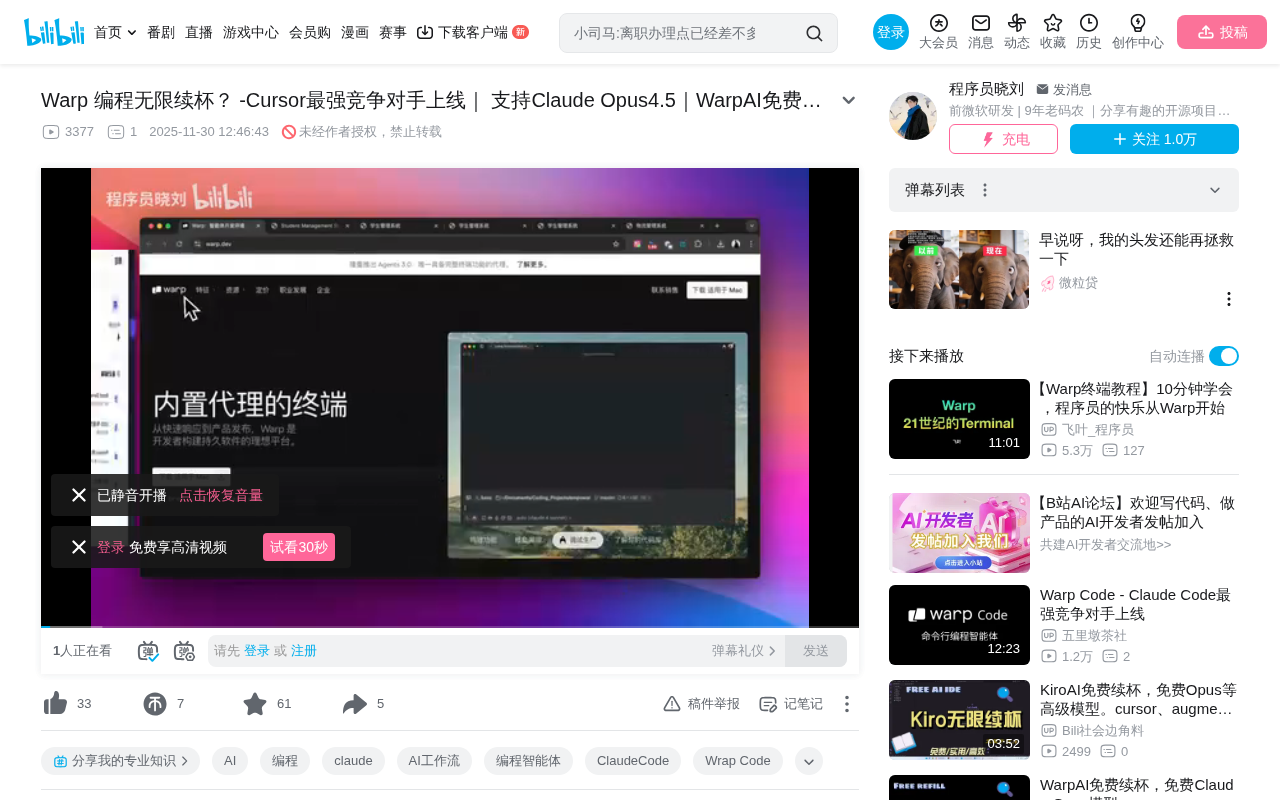
Warp's origin story is quite interesting: its CEO was a heavy Cursor user who discovered numerous pain points during extended use, feeling that Cursor didn't quite align with developer workflows in certain areas. So he decided to build a better AI coding tool himself. Warp's official website even features a side-by-side comparison animation with Cursor — Cursor on the left, with copy implying "if you're still using Cursor, you're already behind." While this marketing approach is somewhat aggressive, it reflects the team's confidence in their product.
It's worth noting that Warp isn't a brand-new product starting from scratch. Back in 2022, Warp entered the developer scene as a "modern terminal emulator," aiming to replace macOS's built-in Terminal and the popular iTerm2. Written in Rust with GPU-accelerated rendering as its selling point, it offered innovative features like block-based command output, intelligent autocompletion, and team collaboration, building a strong reputation in the terminal tool space. As the AI coding wave surged in 2023-2024, the Warp team decided to expand from a terminal tool into a full-fledged AI coding IDE. This pivot gave them a natural advantage in deep command-line understanding — something many competitors that started as editors simply don't have.
Comprehensive Breakdown of Warp's Core Features
Project Creation and Management
Warp's initial screen offers three classic options: create a new project, open a repository, and clone a repository — consistent with tools like Cursor, Windsurf, and Kilo. However, the "create new project" flow in Warp first asks what type of project you want to build (e.g., a React project). This guided creation approach is a matter of preference — it's beginner-friendly, but developers who prefer to simply open a folder and start working may find it slightly redundant.
During actual testing, the content creator used Warp to develop several small projects, including a student management system, a logistics management system prototype, and a warehouse management system. The overall development experience was smooth — from UI optimization to feature iteration, Warp consistently understood requirements and generated code quickly. For example, when developing the student management system, a simple command of "switch to Chinese" completed the localization, and a few more conversation rounds achieved dashboard and status bar UI improvements.
Model Support and Free Usage Credits
Warp is quite generous with model support. The conversation panel on the left lets you choose from current mainstream AI models, with the most notable being support for the newly released Claude Opus 4.5. Each new user receives 150 free usage credits, but note that each conversation using Opus 4.5 consumes double credits (counts as two), meaning if you exclusively use Opus 4.5, you'll get approximately 75 actual uses.
Claude Opus 4.5 is Anthropic's flagship large language model released in 2025, representing the most capable version in the Claude series. Compared to its predecessors, Opus 4.5 shows significant improvements in code generation, complex reasoning, and long-context understanding — particularly excelling at cross-file references in large codebases and architecture-level refactoring tasks. Anthropic's Claude series employs training methods like RLHF (Reinforcement Learning from Human Feedback) and Constitutional AI, setting industry benchmarks in safety and instruction following. The reason Opus 4.5 consumes double credits is primarily because its inference computation far exceeds that of standard models, with correspondingly higher API call costs — a tiered pricing strategy commonly adopted across platforms for top-tier models.
This stands in stark contrast to Cursor. Cursor's free credits have become increasingly restrictive, while Warp appears much more generous during the new user experience phase — sign up and start using it with no obvious barriers.
Voice Input and Multimodal Interaction
Warp also supports voice input, capable of recognizing mixed Chinese-English speech. During testing, the content creator tried saying technical terms like "Spring Cloud, Spring Boot, this is working" in English before switching to Chinese, and the system correctly recognized everything. While recognition accuracy still has room for improvement, this feature opens up possibilities for hands-free coding scenarios.
Warp's Agent Mode and Advanced Features
Agentic Mode: Autonomous Coding
Warp offers an Agentic Mode similar to Cursor's Agent. Once enabled, the AI automatically plans tasks, invokes tools, and executes operations. During testing, the content creator generated a complete warehouse management prototype with just a single sentence, including various interactive features — "just one sentence and it generated everything, which was quite impressive." The system also clearly displays how many calls each request used and which tools were invoked, offering high transparency.
Agent mode is the core competitive differentiator of current AI coding tools. Unlike traditional "Q&A-style" AI assistants, AI in Agent mode possesses autonomous planning and execution capabilities: it breaks down the user's high-level requirements into multiple subtasks, sequentially invoking code generation, file read/write, terminal command execution, browser preview, and other tools to complete the entire workflow. This relies on the ReAct (Reasoning + Acting) framework — at each step, the model first reasons (thinks about what to do next), then acts (invokes the corresponding tool), and decides subsequent steps based on execution results. This loop enables AI to handle complex development tasks requiring multi-step coordination, rather than merely generating isolated code snippets.
MCP Protocol and Rules Configuration
Warp fully supports MCP (Model Context Protocol) and Rules:
- MCP Configuration: You can directly add various MCP services in Settings, such as Context Key, GitHub integration, automation tools, etc. Just click the plus button for one-click addition — extremely convenient.
- Rules: Supports both global and project-level rules. For example, you can set a global rule like "always respond and think in Chinese," which takes effect across all projects once saved. You can also flexibly choose which rules to enable during conversations.
MCP (Model Context Protocol) is an open standard protocol introduced by Anthropic in late 2024, designed to solve the connection problem between AI models and external tools and data sources. Before MCP, every AI application needed custom integration code for each external service, creating an M×N complexity problem. MCP simplifies this to M+N by defining a unified communication protocol — AI applications only need to implement an MCP client, and external services only need to implement an MCP server, enabling automatic interoperability. This is similar to how the USB protocol standardized hardware device connections. MCP has already gained support from major AI vendors including OpenAI and Google, and is becoming the de facto standard for the AI tool ecosystem. Warp and Cursor's MCP support means developers can easily integrate GitHub, databases, CI/CD pipelines, and other development toolchains, greatly expanding the capability boundaries of AI coding tools.
Prompt Template Mode
Warp also offers a Prompt Mode, allowing users to create their own plans (similar to preset Prompt templates). This helps developers pre-configure workflows for different project types, further boosting coding efficiency.
Warp vs. Cursor: Feature Comparison
Based on two weeks of actual use, Warp and Cursor are very close in feature coverage:
| Feature | Warp | Cursor |
|---|---|---|
| Agent Mode | ✅ Supported | ✅ Supported |
| MCP Support | ✅ Supported | ✅ Supported |
| Rules | ✅ Supported | ✅ Supported |
| Voice Input | ✅ Supported | ❌ Not Supported |
| Free Credits | 150 uses (generous) | Limited (restrictive) |
| Opus 4.5 | ✅ Supported | Partial Support |
Warp's main advantages lie in: a more generous free usage policy, rapid adoption of the latest models, and voice interaction capabilities. Cursor, having iterated over many years, still holds the edge in ecosystem maturity, plugin richness, and community size.
Looking at the broader landscape, the AI coding tool market in 2024-2025 has entered a phase of intense competition. Beyond Cursor and Warp, GitHub Copilot commands the largest user base through the GitHub ecosystem; Windsurf (formerly Codeium) has attracted significant attention with its Cascade streaming Agent experience; Augment Code focuses on enterprise-grade large codebase scenarios; and Kilo Code and Cline attract community developers with open-source strategies. Competition in this space essentially plays out across three dimensions: underlying model capability (who can access the strongest models), context engineering (who can better understand the entire project's code structure), and user experience (who can make the developer workflow smoother). Coming from a terminal tool background, Warp has a unique advantage in command-line integration and development workflow understanding — a key differentiator in its competitive strategy.
Conclusion: Is Warp Worth Trying?
As a newcomer to the AI coding tool arena, Warp demonstrates impressive product strength. It covers virtually all core features of current AI coding tools while offering a genuinely generous package in terms of free credits and model support. For developers frustrated by Cursor's quota limitations, or users wanting to experience Claude Opus 4.5's coding capabilities, Warp is definitely worth a try.
Of course, as a relatively young product, whether Warp can sustain its current generous policies and maintain service quality as its user base grows remains to be seen. As the content creator hoped — "I hope it doesn't go down the same path as Cursor" — let's hope Warp can find a better balance between monetization and user experience.
Related articles
 Product Reviews
Qoder vs Cursor Real-World Comparison: Which $20/Month AI IDE Is Better?
Hands-on comparison of Qoder vs Cursor AI IDEs: Agent autonomy, human interaction count, and architecture decisions. Qoder needed only 2 interactions vs Cursor's 8.
 Product Reviews
Cursor Cloud Agent Demo: Eliminating Bottlenecks Across the Entire Software Development Lifecycle
Deep analysis of Cursor's Cloud Agent demo showing how cloud VMs, automated test artifacts, and a full-chain control plane systematically eliminate human bottlenecks across the software development lifecycle.
 Product Reviews
Cursor 3.0 Deep Dive: Multi-Agent Parallelism, Design Mode, and Best-of-N Model Comparison
Cursor 3.0 evolves from an AI coding assistant into an Agent fleet command center. Explore multi-agent parallelism, Design Mode, and Best-of-N model comparison.