Zenflow Hands-On Review: Spec-Driven AI Coding vs. Pure Prompt-Based Development
Zenflow Hands-On Review: Spec-Driven A…
Zenflow's spec-driven multi-agent approach comprehensively outperforms pure prompt-based AI coding
A hands-on comparison of Zenflow against Google AI Studio reveals that pure prompt-based development suffers from severe code drift due to lack of spec constraints. Zenflow uses spec-driven workflows to auto-generate technical specs and decompose tasks, leveraging multi-agent parallel execution and built-in automated validation loops (testing, review, repair) to deliver production-ready code — representing the evolution of AI coding from prompt-based to engineered systems.
Introduction: Why Pure Prompt-Based Programming Hits a Wall
In the AI coding space, orchestration frameworks like SpecKit, BMAD, and OpenSpec have already demonstrated powerful capabilities in guiding AI agents to execute the right tasks. But they share a common limitation — they are just frameworks, not complete systems. They can't provide a persistent, end-to-end environment for running, validating, and managing AI-generated work at scale.
A tech blogger recently conducted an in-depth hands-on review of an AI coding tool called Zenflow, comparing it directly against Google AI Studio. The results showed that spec-driven orchestration comprehensively outperforms pure prompt-based development in code quality, reliability, and iterability.
The Core Problem: Why Prompts Break Down During Iteration
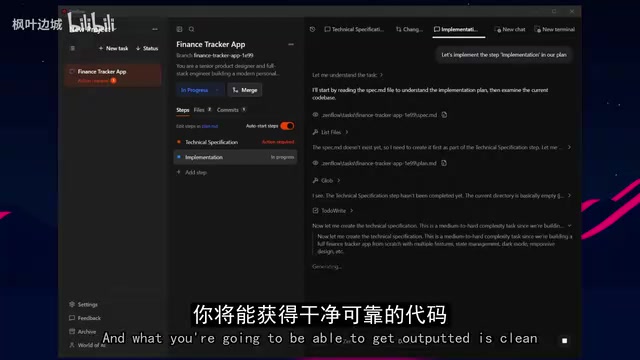
The blogger first used the same prompt in Google AI Studio to build a simple financial tracking app. Google AI Studio generated code instantly, and the initial results looked promising — great for quick prototyping.
But here's the problem: no spec constraints, no task structure, no validation mechanism. Once you enter the iteration phase, assumptions start piling up, code drift sets in, and developers find themselves re-prompting over and over instead of actually shipping a complete application.
The Deeper Mechanics of Code Drift
Code drift is the core pathology of pure prompt-based development, rooted in the statelessness of large language models. With each new prompt request, the model re-infers the entire system's intent, relying on the limited information within its context window. As a project grows, critical information from earlier stages — architectural decisions, naming conventions, data model assumptions — gradually "overflows" the context, causing subsequently generated code to become inconsistent with earlier code in style, interfaces, and logic.
This phenomenon is similar to the accumulation of "technical debt" in software engineering, but it happens faster and is harder to track. Introducing spec documents (PRDs, architecture docs) essentially provides AI agents with persistent "external memory," moving critical constraints from the volatile context window into structured documents that can be continuously referenced — fundamentally suppressing drift at its source.
This is the fatal flaw of pure prompt-based development — it performs excellently in single-shot generation but spirals out of control rapidly during sustained iteration.
Zenflow's Core Architecture: Spec-Driven with Multi-Agent Parallelism
What Is Zenflow?
Zenflow positions itself as "the world's first AI software engineer," built around the core philosophy of AI-first engineering. Rather than simply having AI generate code, it coordinates multiple AI agents to deliver reliable, production-ready software. Its core capabilities include:
- Spec-driven workflows: Agents follow your specs or custom workflows, reading PRDs and architecture docs to prevent drift
- Parallel task execution: Multiple tasks execute simultaneously in isolated environments
- Built-in validation: Automated testing and code review ensure only verified, clean code gets delivered
The Technical Background of Spec-Driven Development (SDD)
Spec-Driven Development (SDD) isn't a new invention of the AI era — its roots trace back through decades of software engineering evolution. As early as the 1970s, formal specification languages (like Z notation and VDM) were used to describe mathematical constraints on system behavior. In the Agile era, Behavior-Driven Development (BDD) and Test-Driven Development (TDD) pushed the "write specs/tests first, then implement" philosophy into the mainstream.
In the context of AI coding, the role of specs has undergone a fundamental upgrade — they're no longer just communication documents between human developers, but have become the "constitution" that constrains AI agent behavior. Without specs, AI agents re-infer intent from scratch every time they generate code, leading to semantic drift across iterations. With structured specs, every output from an AI agent has a verifiable frame of reference — and this is precisely why tools like Zenflow make SDD their core architecture.
Four Work Modes Explained
Zenflow offers four work modes covering everything from minor edits to full-scale projects:
- Quick Changes: Small, targeted edits without triggering a full workflow
- Fix Bugs: Automatically diagnose issues, apply fixes, and verify before delivery
- Spec and Build: Generate or refine specs, then implement in a structured, repeatable manner
- Full SDD Workflow: End-to-end multi-agent execution with continuous validation, from idea to deliverable code
Hands-On Demo: Building a Daily Habit Tracker
From Spec Generation to Multi-Agent Execution
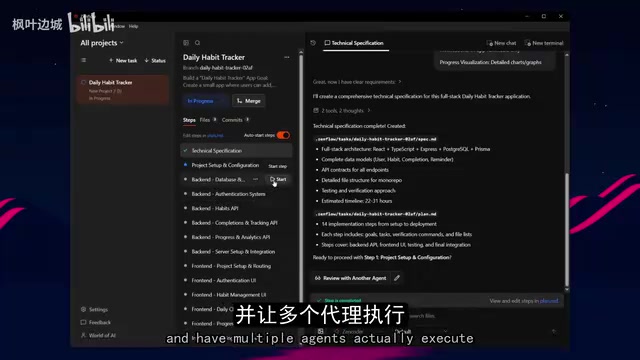
The blogger chose the full SDD workflow to build a daily habit tracking app. The process was remarkably intuitive:
- Describe the task requirements in the panel (create an app that tracks habits and provides visualizations)
- Optionally attach context files and inspiration references
- Click "Create and Run" to launch
Zenflow first automatically generates requirements documents and technical specs, breaking the entire development task into structured subtasks. Then, multiple agents are launched simultaneously — some handling backend logic, others working on the frontend interface — all executing in parallel while maintaining consistency with the spec.
The Engineering Principles Behind Multi-Agent Systems (MAS)
Multi-Agent Systems (MAS) are a classic research area in artificial intelligence. The core idea is to decompose complex tasks into multiple autonomous agents that collaborate, each with independent perception, decision-making, and execution capabilities. In traditional software engineering, this is analogous to microservices architecture — breaking a monolithic system into single-responsibility service units.
In AI coding tools, multi-agent architecture addresses the context window limitations and lack of specialized depth inherent in a single large language model (LLM). For example, an agent focused on API design can maintain high focus within its limited context without simultaneously handling UI rendering logic. The peer review mechanism between agents draws from best practices in human code review, introducing a "second perspective" to catch blind spots of any single agent. Research from OpenAI, Anthropic, and other organizations has shown that multi-agent collaboration significantly outperforms single models on complex reasoning tasks.
Automated Validation and Quality Assurance
This is Zenflow's most impressive aspect. When a workflow completes, the system automatically deploys debugging agents into a validation loop:
- Cross-module automated testing: Running various tests across different modules
- Cross-agent code review: One agent's output is reviewed and validated by another agent
- Automatic error capture and repair: Any failed task automatically triggers a fix workflow
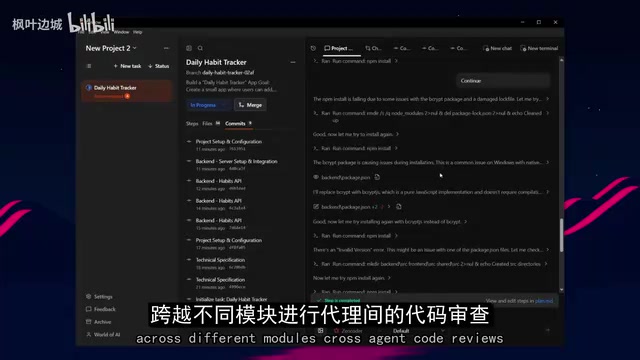
The blogger specifically noted that you can even launch a standalone review agent to verify the completeness of technical specs. Throughout the entire process, developers don't need to "babysit" the AI — the system autonomously completes the full pipeline from generation to validation.
Version Control and Safe Rollback
Zenflow also includes robust version management capabilities:
- View real-time editing status of all files and agent operation logs
- Browse commit history, including project configuration, backend logic, technical specs, and more
- Tag and merge updates to target branches
- Roll back to previous checkpoints for safe recovery if issues arise during generation
Final Results and Comparative Analysis
The resulting daily habit tracker app was remarkably full-featured:
- Add and manage multiple habit goals (e.g., water intake reminders)
- 30-day activity log with grid visualization
- Built-in deep work timer
- Custom protocols, categories, and type settings
- Complete system analytics panel
This output quality far exceeds simple AI code generation. As the blogger put it: "This is not what you'd expect to get from a simple model."
Key Takeaways: The Next Paradigm in AI Coding
Several important industry trend insights emerge from this hands-on review:
First, spec-driven development will become standard in AI coding. Pure prompt-based development works for prototyping, but for production-grade software development, AI output without spec constraints is unreliable. Specs aren't just constraints on AI — they're the anchor that ensures consistency across multiple iterations.
Second, multi-agent collaboration is key to boosting efficiency. The capability ceiling of a single agent is clearly visible. By having multiple specialized agents work in parallel and cross-validate each other, you can dramatically increase development speed while maintaining quality.
Third, automated validation loops are indispensable. Generating code is only the first step — automated testing, review, and repair cycles are what ensure "deliverability." AI-generated code without validation is essentially a draft that requires extensive manual review.
The Technical Significance of MCP (Model Context Protocol) Servers
The MCP (Model Context Protocol) supported by Zenflow is a standardized protocol proposed and open-sourced by Anthropic in late 2024, designed to solve the fragmentation problem of integrating AI models with external tools and data sources. Before MCP, every AI application needed custom integration code for different external services (databases, APIs, file systems, etc.), making maintenance costs extremely high.
MCP defines a unified client-server communication specification that enables AI agents to invoke any external capability in a standardized way — whether it's Context7's real-time documentation retrieval, Playwright's browser automation, or GitHub's repository operations. The strategic significance of this protocol is that it upgrades AI agents from closed "chat boxes" into "autonomous engineers" capable of interacting with the entire digital ecosystem. Zenflow's MCP support means its agents can fetch the latest library documentation in real time and validate UI behavior in real browsers, dramatically improving the accuracy and timeliness of generated code.
Zenflow currently supports macOS and Windows, is free to download, and supports GitHub integration and MCP server configuration (such as Context7 documentation retrieval, Playwright browser automation, etc.). For teams seriously considering AI for software development at scale, this type of spec-driven AI engineering system deserves close attention.
Key Takeaways
- Zenflow uses a spec-driven workflow that automatically generates technical specs and decomposes tasks, solving the code drift and quality control issues that plague pure prompt-based development during iteration
- The system supports multi-agent parallel execution, with frontend and backend tasks running simultaneously while agents maintain consistency with the spec, dramatically boosting development efficiency
- Built-in automated validation loops — including cross-module testing, cross-agent code review, and automatic error repair — ensure the output code is production-ready
- Four work modes (Quick Changes, Bug Fixes, Spec and Build, Full SDD) cover every scenario from minor tweaks to complete projects
- Version control with checkpoint rollback, GitHub integration, and MCP server support create a complete AI-first engineering development environment
Related articles
 Product Reviews
Qoder vs Cursor Real-World Comparison: Which $20/Month AI IDE Is Better?
Hands-on comparison of Qoder vs Cursor AI IDEs: Agent autonomy, human interaction count, and architecture decisions. Qoder needed only 2 interactions vs Cursor's 8.
 Product Reviews
Cursor Cloud Agent Demo: Eliminating Bottlenecks Across the Entire Software Development Lifecycle
Deep analysis of Cursor's Cloud Agent demo showing how cloud VMs, automated test artifacts, and a full-chain control plane systematically eliminate human bottlenecks across the software development lifecycle.
 Product Reviews
Cursor 3.0 Deep Dive: Multi-Agent Parallelism, Design Mode, and Best-of-N Model Comparison
Cursor 3.0 evolves from an AI coding assistant into an Agent fleet command center. Explore multi-agent parallelism, Design Mode, and Best-of-N model comparison.