ZenFlow Hands-On: Testing the Spec-Driven Fully Autonomous AI Software Engineer

ZenFlow achieves fully autonomous AI software engineering through spec-driven workflows and multi-agent orchestration.
ZenFlow bills itself as the world's first fully autonomous AI software engineer, built on the core concept of using specifications—rather than prompts—to drive the development process. The system decomposes tasks into structured subtasks executed in parallel by multiple specialized agents, with built-in automated verification and repair mechanisms ensuring production-ready code output. It offers four work modes covering every scenario, supports MCP integration and version control, and represents a paradigm shift in AI programming from "conversational code generation" to "spec-driven autonomous engineering."
From Prompts to Specs: A Paradigm Shift in AI Programming
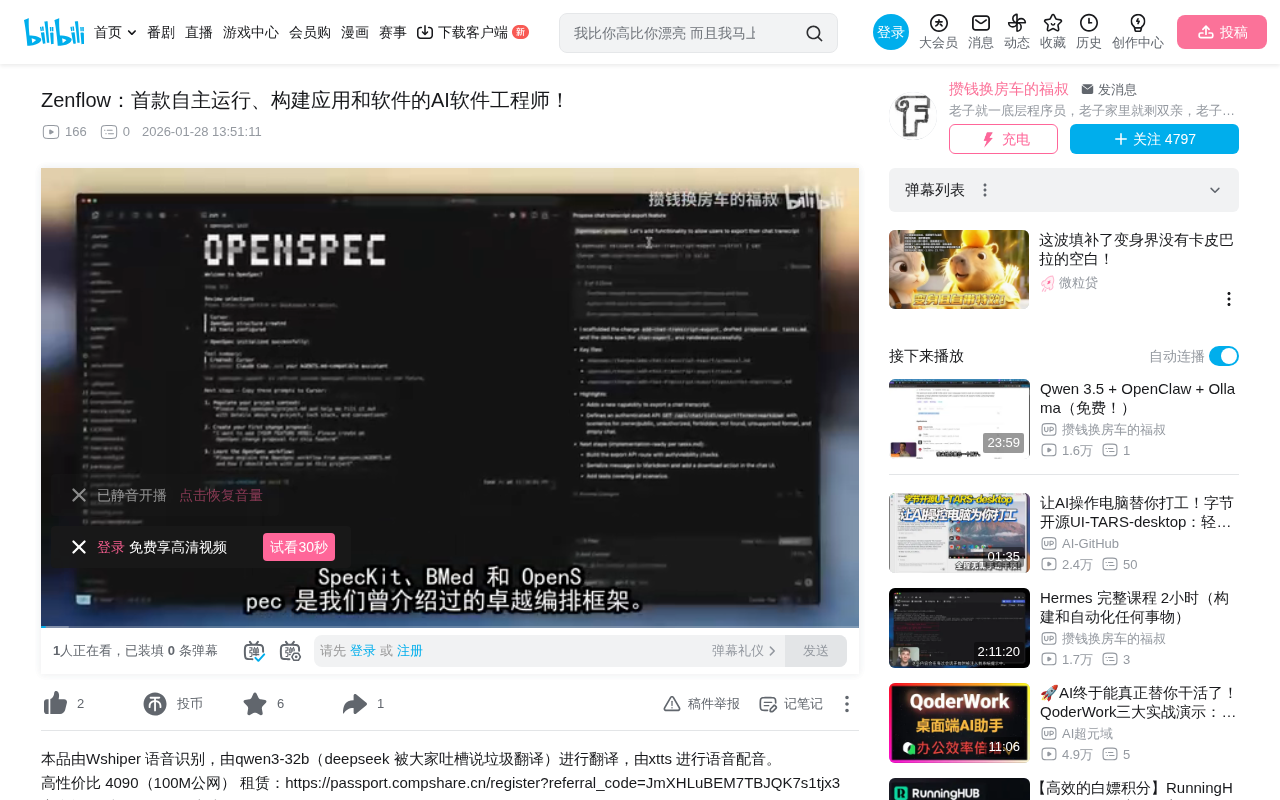
We've already seen plenty of excellent AI orchestration frameworks—SpecKit, Bmed, OpenSpec, and others—capable of dispatching AI agents to execute specific tasks. But these tools are typically just frameworks, lacking a complete end-to-end environment to run, verify, and manage AI work at scale.
ZenFlow aims to change this. It bills itself as the world's first fully autonomous AI software engineer, built around the core concept of spec-driven workflows that orchestrate multiple AI agents to deliver reliable, production-ready software code.
The Prompt Iteration Trap: Why Orchestration Is Essential
To illustrate ZenFlow's value, consider a comparison experiment: using the same prompt to build a financial tracking app in both Google AI Studio and ZenFlow.
In Google AI Studio, you get instant code output and can put together a decent-looking prototype. But here's the problem—once you start iterating, assumptions pile up and the project gradually drifts off course. You get trapped in an endless loop of prompt revisions, never quite delivering a complete application. This is the fundamental flaw of pure prompt-driven development: no specification constraints, no task structure, and no verification mechanisms.
This dilemma is hardly new in software engineering history. Spec-driven Development as a concept dates back to the 1980s—Bertrand Meyer proposed "Design by Contract" while developing the Eiffel language, arguing that software modules should define behavioral contracts through explicit preconditions, postconditions, and invariants rather than relying on implicit assumptions. This idea later evolved into modern interface description languages like OpenAPI specifications and JSON Schema. In the AI programming context, specifications serve as "requirement anchors"—they transform natural language intent into structured constraints, preventing semantic drift across multiple iterations. A prompt is a one-time instruction; a specification is a persistently valid constraint document. This is the essential difference between the two paradigms.
When you run the same prompt in ZenFlow, the system starts with a specification, breaks the work into structured tasks, executes multiple agents in parallel, and uses built-in verification to ensure output consistency. Issues are caught automatically, and the final output is clean, reliable code that's genuinely ready for delivery.
ZenFlow Core Architecture Breakdown
Four Work Modes Covering Every Scenario
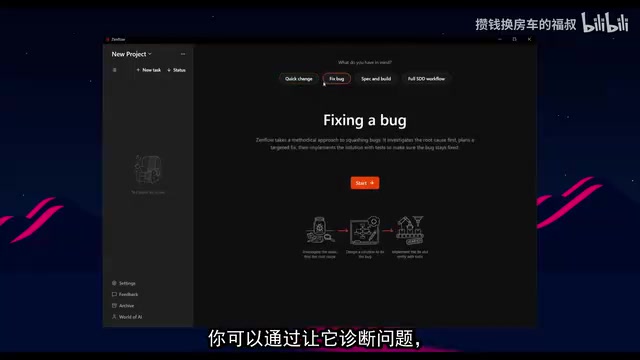
ZenFlow offers four work modes covering everything from minor fixes to full-scale development:
- Quick Edit: Make small, precise edits without triggering the full workflow
- Debug: Automatically diagnose issues, apply fixes, and verify before deployment
- Spec & Build: Generate or refine specifications, then implement development in a structured, repeatable manner
- Full A2D Workflow: End-to-end spec-driven development with multi-agent collaboration and continuous verification from ideation to code delivery
Notably, the A2D (Autonomous-to-Delivery) workflow represents the third generation of AI-assisted development paradigms. The first generation was the "code completion" model exemplified by GitHub Copilot, where AI serves as an intelligent autocomplete tool embedded in the IDE. The second generation is the "conversational programming" model represented by Cursor and Windsurf, where developers drive code generation through natural language dialogue but still require continuous human intervention and course correction. The third generation is the "autonomous engineering" model that ZenFlow represents, where the system can independently complete the full loop from task decomposition and parallel execution to verification and repair—all under specification constraints. This evolutionary path closely mirrors the L1-to-L4 levels of autonomous driving—from assisting human decisions to fully autonomous execution under specific conditions.
Multi-Agent Parallel Collaboration
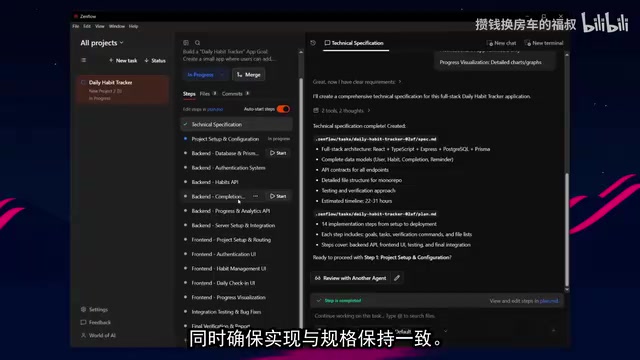
ZenFlow's most critical capability lies in its multi-agent orchestration mechanism. When you submit a development task, the system first analyzes requirements and formulates technical specifications, then splits the task across multiple agents working in parallel—for example, one handling backend logic while another handles the frontend interface.
Multi-Agent Systems (MAS) are an important branch of distributed artificial intelligence, with core advantages on three levels: Parallelism—frontend and backend agents can work simultaneously, dramatically shortening development cycles; Specialization—each agent can be optimized for a specific domain (such as database design, API development, or UI rendering), avoiding the capability dilution that general-purpose models suffer on complex tasks; Fault tolerance—a single agent's failure doesn't crash the entire task, as the system can isolate errors and trigger repair workflows. This aligns closely with the design philosophy of microservices architecture—decomposing monolithic complexity into independently manageable functional units.
You can track and manage each agent's progress through tabs, and even open new conversations to clarify specific matters. All agents' work stays aligned with the specification, ensuring no directional drift.
Built-in Verification and Auto-Repair
Once a workflow completes, ZenFlow deploys debug agents to execute verification loops. The system automatically runs various module tests, performs inter-agent code reviews, and catches errors. Any failed task automatically triggers a repair workflow until the final output is functionally complete, cleanly coded, and tested production-ready code.
This continuous verification mechanism is what fundamentally distinguishes ZenFlow from ordinary AI coding tools. It doesn't simply generate code and hand it off for you to check—it completes multiple rounds of automated quality assurance before delivery.
Practical Demo: Building a Daily Habit Tracker
In a hands-on demonstration, ZenFlow's full spec-driven development workflow was used to build a daily habit tracking application. The process showcased several noteworthy features:
- File Management: View all files being generated in real-time and preview agents' edits
- Version Control: Tag specific updates and merge them to target branches, or even roll back to previous checkpoints
- Flexible Extension: Insert quick edits or bug fix requests at any time while the main task is in progress
- MCP Integration: Configure MCP servers like Context7 for up-to-date documentation, and Playwright for browser automation
MCP (Model Context Protocol) is an open protocol released by Anthropic in late 2024, designed to standardize interactions between AI models and external tools and data sources. Previously, every AI application needed custom integration code for different external services, creating massive duplication of effort. MCP's emergence is analogous to what the USB interface meant for the hardware ecosystem—providing a unified connection standard. The Context7 MCP server supported by ZenFlow provides AI agents with real-time updated technical documentation, solving the fundamental problem of large language models having a knowledge cutoff in their training data. Playwright MCP allows agents to directly control browsers for end-to-end testing, extending verification capabilities from the code level to the user interaction level. This integration capability signals that AI programming tools are evolving from "code generators" to "complete engineering environments."
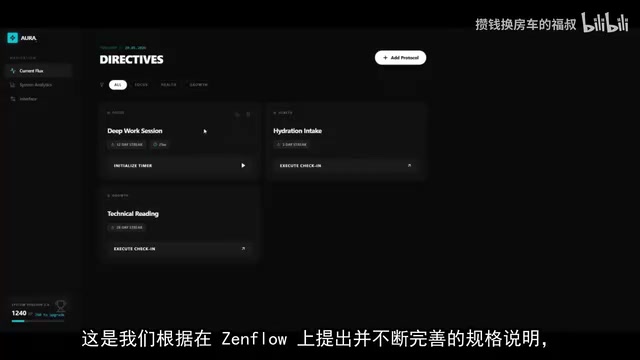
The final habit tracking application included goal management, a 30-day activity log grid, a deep work timer, custom protocols, and more—all verified and production-ready without requiring the developer to constantly monitor the AI's output.
The Next Evolution in the AI Programming Tool Landscape
ZenFlow represents an important evolutionary direction for AI programming tools: from "conversational code generation" to "spec-driven autonomous engineering."
Current mainstream AI coding assistants (like Cursor, GitHub Copilot, etc.) are still fundamentally prompt-driven—developers must continuously converse with the AI and correct its direction. ZenFlow attempts to systematize this process: first define the specification, then decompose tasks, then let multiple agents execute in parallel with automatic verification.
As a commercial product from ZenCoda, ZenFlow's real-world performance still needs validation from more developers on actual projects. Just as L4 autonomous driving still faces challenges in edge cases, a fully autonomous AI engineer's reliability when handling highly ambiguous requirements and complex legacy systems remains to be proven through large-scale real-world testing. However, its proposed three-layer architecture of "spec-driven + multi-agent orchestration + automated verification" does offer a more structured and reliable approach to AI-assisted software development.
It's worth noting that ZenFlow supports local installation and is free to get started, compatible with both Mac and Windows platforms, lowering the barrier to entry. For teams exploring how to more deeply integrate AI into their software development workflows, this is a tool direction worth watching.
Key Takeaways
- ZenFlow uses spec-driven workflows to decompose development tasks into structured subtasks, solving the problems of project drift and assumption accumulation inherent in pure prompt iteration
- Supports multi-agent parallel collaboration where different agents can simultaneously handle frontend, backend, and other task types while maintaining consistency through specifications
- Built-in automated verification and repair mechanisms automatically run tests, code reviews, and catch errors, with failed tasks automatically triggering repair workflows
- Offers four work modes (Quick Edit, Debug, Spec & Build, Full A2D Workflow) covering the complete spectrum from minor fixes to end-to-end development
- Supports MCP integration, GitHub sync, version rollback, and other enterprise-grade features, with local installation and a free starting tier
Related articles
 Product Reviews
Qoder vs Cursor Real-World Comparison: Which $20/Month AI IDE Is Better?
Hands-on comparison of Qoder vs Cursor AI IDEs: Agent autonomy, human interaction count, and architecture decisions. Qoder needed only 2 interactions vs Cursor's 8.
 Product Reviews
Cursor Cloud Agent Demo: Eliminating Bottlenecks Across the Entire Software Development Lifecycle
Deep analysis of Cursor's Cloud Agent demo showing how cloud VMs, automated test artifacts, and a full-chain control plane systematically eliminate human bottlenecks across the software development lifecycle.
 Product Reviews
Cursor 3.0 Deep Dive: Multi-Agent Parallelism, Design Mode, and Best-of-N Model Comparison
Cursor 3.0 evolves from an AI coding assistant into an Agent fleet command center. Explore multi-agent parallelism, Design Mode, and Best-of-N model comparison.