ZhiHu AI Digital Human Live Streaming Review: Dual-Person Co-Frame and Full-Posture Features Tested

ZhiHu AI launches new digital human streaming version featuring dual co-frame and full-posture support.
ZhiHu AI's latest digital human streaming software brings major upgrades: support for 14 mainstream platforms, timed host switching and smart script rewriting to combat platform throttling, full-posture multi-scene digital humans that break traditional talking-head limitations, and dual digital human co-frame streaming as the core differentiator enabling conversational interaction to boost conversion rates. The business model supports both self-use and OEM white-labeling, though the industry still faces common challenges including AIGC regulatory compliance.
The AI digital human live streaming space is becoming increasingly competitive, with vendors racing to improve avatar realism, interactivity, and feature richness. Recently, ZhiHu AI released the latest version of its digital human live streaming software, introducing several noteworthy upgrades—most notably dual digital human co-frame live streaming and full-posture multi-scene support, creating clear differentiation among similar products.
Technical Background: AI digital human live streaming technology integrates multiple cutting-edge fields including computer vision, deep learning, text-to-speech (TTS), and natural language processing (NLP). The core technical approaches generally fall into two categories: first, "video-splicing" digital humans driven by pre-recorded video, which stitch together pre-recorded real human motion segments with real-time speech synthesis to achieve low-latency, high-stability streaming; second, "generative" digital humans based on 3D modeling and real-time rendering, leveraging technologies like Neural Radiance Fields (NeRF) or diffusion models to generate frames in real time—more flexible in appearance but far more demanding on compute resources. Most commercially available digital human streaming products currently adopt the former approach for stability, while full-posture motion support typically requires skeletal driving or motion capture datasets to expand the action library.
Interface Upgrade and Multi-Platform Support
The new version features a comprehensive interface overhaul, making the overall workflow significantly more intuitive. In practice, when users create a new streaming task, they can choose from 14 mainstream platforms both domestic and international. Whether it's Douyin, Kuaishou, or overseas streaming channels, everything can be managed through a single unified system.
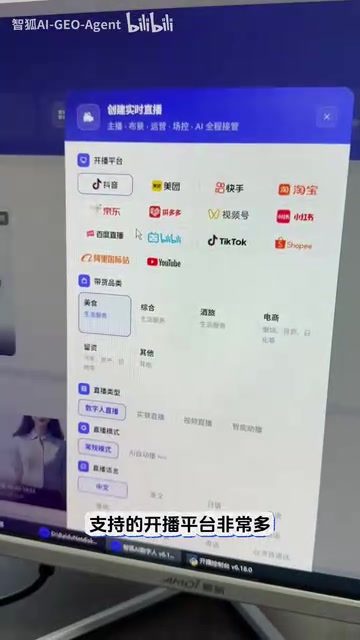
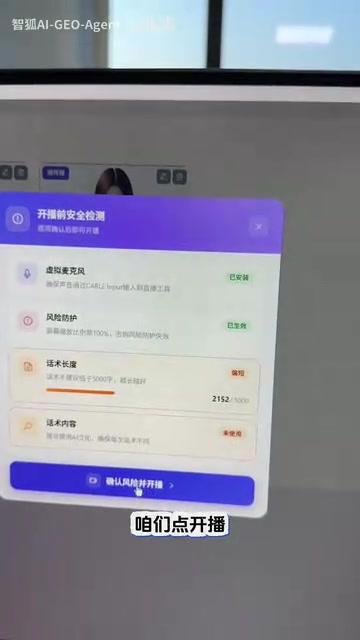
In terms of streaming categories, the system covers scenarios ranging from local services and e-commerce to knowledge-based content, essentially meeting the needs of users across different industries. After clicking "Go Live," the system automatically performs an environment check, confirms all configurations are correct, and enables one-click streaming—significantly lowering the barrier to entry.
Timed Host Switching and Smart Script Rewriting
One of the biggest pain points in digital human live streaming is content repetition leading to viewer churn and platform traffic throttling. ZhiHu AI addresses this with two targeted solutions in this version.
Platform Throttling Mechanism Explained: Major platforms (such as Douyin and Kuaishou) widely deploy content detection systems based on audio fingerprinting and semantic similarity, capable of identifying highly repetitive script segments and reducing traffic distribution weight for affected streams. This mechanism was originally designed to combat "pre-recorded content disguised as live streaming" violations, but it also impacts digital human live streams as collateral. The technical principle behind real-time script rewriting typically involves using large language models (LLMs) to perform synonym substitution, sentence restructuring, and word order adjustment on preset scripts, generating semantically equivalent but differently expressed script variants while preserving core sales messaging—thereby reducing the probability of being flagged as duplicate content by algorithms.
Multi-Host Timed Switching
Through the "Timed Host Switch" feature, users can preset multiple digital human hosts with different appearances to automatically rotate at scheduled intervals during a single stream. This design simulates the shift-change mechanism in real live streaming rooms, helping alleviate viewer visual fatigue while adding more depth to the content.
Real-Time Script Rewriting
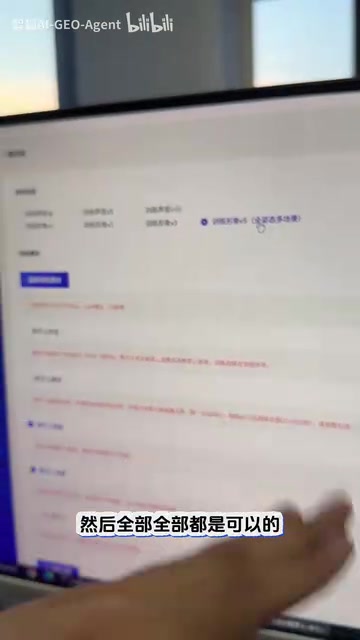
The system includes a built-in real-time script rewriting function that dynamically adjusts preset scripts during the stream to avoid word-for-word repetition. This is particularly important for extended streams—platform algorithms typically throttle highly repetitive content, and the script rewriting feature helps mitigate this risk to maintain stable traffic flow to the streaming room.
Full-Posture Multi-Scene Digital Humans
Traditional digital human live streaming is often limited to simple upper-body talking-head motions, resulting in a stiff appearance. ZhiHu AI's "full-posture" concept enables digital humans to perform a much richer range of body movements—including jumping, drinking water, hand gestures, and other everyday actions—dramatically improving the realism and viewer trust in the stream.
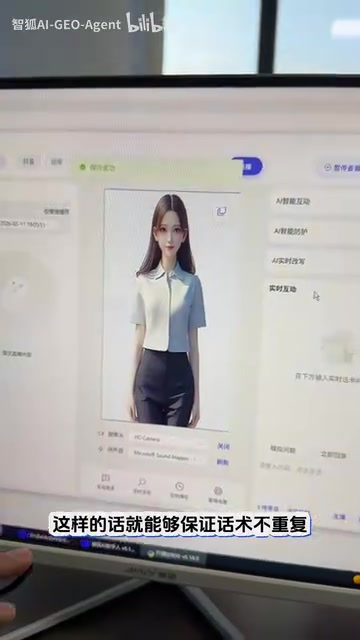
Multi-scene support means digital humans are no longer confined to a single background and can switch between different scene environments based on streaming content. For e-commerce live streaming, this feature allows digital humans to transition naturally between different product display areas, significantly enhancing the viewing experience.
Dual Digital Human Live Streaming: The Core Differentiator
Among all the new features, dual digital human co-frame live streaming is undoubtedly the standout highlight. According to the company, this capability is relatively rare among similar AI streaming software, enabling two digital human hosts to appear simultaneously in the same stream and interact with each other.
Technical Challenges of Dual Digital Humans: Dual digital human co-frame streaming is far more technically complex than single-person streaming. First, the system must simultaneously maintain two independent rendering pipelines, nearly doubling the hardware demands on GPU memory and CPU scheduling. Second, the dialogue logic between the two digital humans requires careful orchestration—including speech timing control, gaze direction interaction, and body language coordination—any misstep creates an obvious "mechanical" feel. The deeper challenge lies in real-time dialogue content generation: if using preset scripts played in alternation, interactivity is limited; if introducing LLM-generated real-time dialogue, both latency control and content safety review pressures must be addressed simultaneously. The current industry-standard approach is a "semi-preset + dynamic fill" hybrid architecture, where the dialogue framework is preset and AI dynamically fills in specific expression details.
The core value of dual-person streaming is reflected in several aspects:
- Conversational Interaction: Two digital humans can simulate real dialogue scenarios, making streams more engaging and watchable than single-person monologues
- Role Division: One handles product explanation while the other manages interactive Q&A, effectively improving stream conversion rates
- Enhanced Viewing Experience: Dual-person scenes more closely resemble the atmosphere of real live streaming rooms, helping increase viewer retention time and interaction rates
Of course, dual-person streaming places higher demands on system rendering performance and dialogue logic orchestration, and actual results still need further validation in real streaming scenarios.
Business Model: Self-Use and OEM White-Label in Parallel
Beyond end-user self-use scenarios, ZhiHu AI also offers OEM white-label services, allowing partners to rebrand and operate the system as their own platform.
Business Logic of the OEM White-Label Model: The OEM (Original Equipment Manufacturer) white-label model has formed a mature business ecosystem in the AI SaaS space. For technology providers, OEM partnerships enable rapid market coverage replication at extremely low marginal costs—partners handle localized operations, customer acquisition, and after-sales service, while the technology provider focuses on product iteration, creating a complementary division of labor. For white-label operators, compared to self-developed technology, the OEM model can compress time-to-market from months to weeks with controllable initial investment. In the digital human streaming space, this model is particularly prevalent—many digital human streaming platforms appearing under different brand names often share the same underlying technology from one or a handful of core technology suppliers. This "technology middle platform + brand distribution" structure is essentially a channel leverage strategy, though it also raises concerns about intensifying homogeneous competition.
This B2B2C business model has become the mainstream approach in the digital human streaming SaaS space, enabling rapid market expansion while reducing customer acquisition costs through channel partnerships. For entrepreneurs with agency distribution needs, this represents a partnership direction worth exploring.
Summary and Reflections
From a feature completeness perspective, ZhiHu AI's update delivers substantive improvements across several key dimensions:
- 14-platform coverage solves multi-channel distribution challenges
- Smart script rewriting addresses content compliance and throttling risks
- Full-posture digital humans break through the expressiveness bottleneck of traditional talking-head formats
- Dual co-frame streaming creates meaningful distance from competitors at the user experience level
However, the digital human streaming industry still faces several common challenges:
Regulatory Trends: Globally, regulatory frameworks targeting AI-generated content (AIGC) are taking shape at an accelerating pace. In China, the Cyberspace Administration of China issued the "Interim Measures for the Management of Generative Artificial Intelligence Services" in 2023, explicitly requiring prominent labeling of AI-generated images, videos, and other content. In live streaming scenarios, some platforms have begun piloting AI host identification mechanisms, requiring digital human streams to display "AI Virtual Host" labels in prominent positions. In the long run, as regulations tighten, compliance costs for digital human streaming will increase, but this will also push the industry toward greater transparency and standardization. For those entering the space, understanding and adapting to compliance requirements early will be an important prerequisite for sustained operations.
Some platforms have already begun requiring AI-generated content labels, and the policy direction is not yet fully clear. Meanwhile, digital humans' facial expression naturalness and real-time interaction capabilities still have significant room for improvement. For those considering entering AI digital human live streaming, it's recommended to thoroughly evaluate actual results through free trials before committing to full adoption.
Key Takeaways
- ZhiHu AI's digital human streaming software supports streaming on 14 domestic and international platforms, covering e-commerce, local services, and other category scenarios
- The timed host switching feature enables multiple digital human hosts to rotate during a single stream, while real-time script rewriting (based on LLM synonym substitution technology) prevents content repetition from triggering platform throttling
- Full-posture multi-scene support enables digital humans to perform rich actions like jumping and drinking, enhancing stream realism
- Dual digital human co-frame streaming is the core differentiating feature, simulating conversational interaction scenarios, though it places higher demands on rendering performance and dialogue orchestration
- The business model supports both self-use and OEM white-labeling, allowing the system to be rebranded as a proprietary platform; entrants should also monitor AIGC regulatory compliance requirements
Related articles
 Product Reviews
Qoder vs Cursor Real-World Comparison: Which $20/Month AI IDE Is Better?
Hands-on comparison of Qoder vs Cursor AI IDEs: Agent autonomy, human interaction count, and architecture decisions. Qoder needed only 2 interactions vs Cursor's 8.
 Product Reviews
Cursor Cloud Agent Demo: Eliminating Bottlenecks Across the Entire Software Development Lifecycle
Deep analysis of Cursor's Cloud Agent demo showing how cloud VMs, automated test artifacts, and a full-chain control plane systematically eliminate human bottlenecks across the software development lifecycle.
 Product Reviews
Cursor 3.0 Deep Dive: Multi-Agent Parallelism, Design Mode, and Best-of-N Model Comparison
Cursor 3.0 evolves from an AI coding assistant into an Agent fleet command center. Explore multi-agent parallelism, Design Mode, and Best-of-N model comparison.