$20,000 Voxel Robot: Helps You Find Misplaced Items at Home
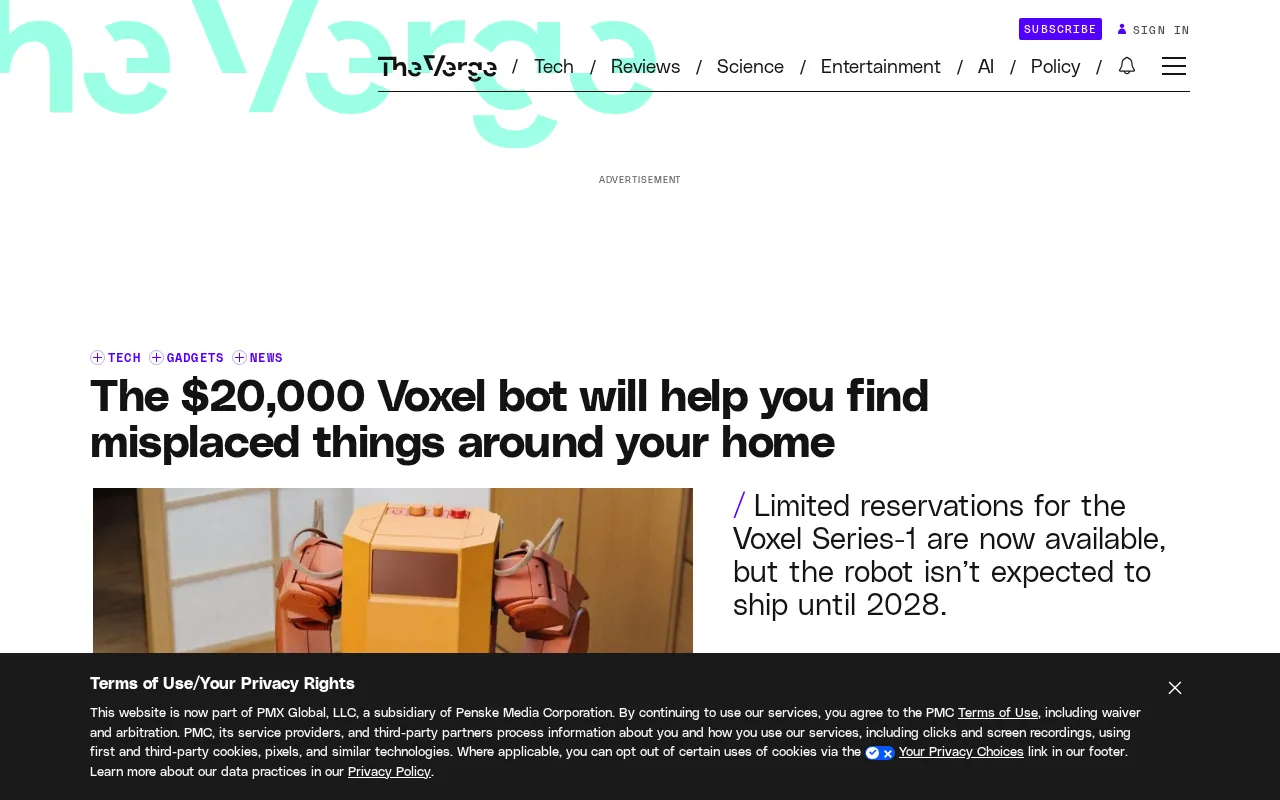
Tuesday Labs opens pre-orders for the $20,000 bipedal household robot Voxel, focused on learning chores and finding items.
Tuesday Labs has opened pre-orders for Voxel, a bipedal robot priced at $20,000. Unlike single-function devices like robot vacuums, Voxel focuses on "learning" household chores through continuous interaction, with the most typical scenario being helping users find misplaced items. This requires perception, navigation, and object recognition in cluttered, varied home environments, and while the bipedal form offers theoretical advantages for thresholds and stairs, technical difficulty is significantly higher. The $20,000 price targets early adopters, positioning it more as an evolving robot platform than an off-the-shelf appliance. The article places Voxel alongside Weave Robotics' Issac 1 as a signal of home robots evolving from cleaning tools to general-purpose assistants, while noting safety, privacy, and price remain barriers to adoption.
From Vacuuming to Finding Things: Home Robots Are Going "General-Purpose"
When people think of home robots, most picture robot vacuums or window cleaners—devices that can only perform single, repetitive tasks. But Tuesday Labs, a New York-based robotics lab and design studio, is trying to break that boundary. The company recently opened pre-orders for Voxel, a bipedal robot designed to learn and take over everyday household chores.
Similar to Weave Robotics' Issac 1, Voxel targets a broader range of household scenarios beyond mopping and vacuuming. The emergence of such products signals that home robots are evolving from "specialized tools" to "general-purpose assistants."
What Can Voxel Do?
According to Tuesday Labs, Voxel's core capability lies in "learning"—it doesn't ship with fixed functions, but adapts to the home environment through continuous interaction, gradually mastering different tasks. The most typical use case is helping users find items that have been misplaced around the house.
That sounds simple, but it actually places high demands on the robot's perception, navigation, and object recognition capabilities. In a cluttered home environment with varying layouts, accurately identifying and locating an item that was casually set down is far more complex than walking through an open space.
Voxel uses a bipedal design, which means it needs to be able to walk stably and avoid obstacles in home spaces. Compared to wheeled bases, bipedal forms are theoretically advantageous for stepping over thresholds and climbing stairs, but the technical difficulty is also higher.
The main challenges of bipedal walking in home environments lie in dynamic balance and real-time adaptation to unstructured terrain. Wheeled bases rely on continuous flat surfaces and use relatively simple control models; bipedal robots, by contrast, must adjust in real time based on ground reaction forces, center-of-mass shifts, and joint torques at every step to stay stable on uneven floors, carpet edges, or before thresholds. Home environments are precisely full of low obstacles, soft surfaces, and unpredictable human movement, imposing millisecond-level requirements on the robot's perception-decision-execution loop. In addition, climbing stairs requires precise footfall estimation and gait planning, while stepping over thresholds involves coordinated control of leg-lift height and body posture. So while the bipedal form expands the reachable space, it also raises control complexity by an order of magnitude—which is the fundamental reason its reliability still needs time to be validated.
The task of "helping users find misplaced items" is technically an intersection of semantic navigation and object search. The robot must not only build a geometric map of the home environment but also associate semantic labels like "keys," "remote control," and "charging cable" with specific object instances, and remember where they were last seen. When the user issues a search command, the system needs to plan a search path within the known map while using visual recognition to confirm the target within its field of view. The difficulty lies in the enormous intra-class variation of household items—the same category of object may have different colors, shapes, and orientations, and is often partially occluded or stacked. Moreover, object locations change constantly with human activity, so the robot must continuously update its memory rather than relying on one-time mapping. This requires tight coupling of perception, memory, and navigation modules—far beyond what a simple "walk over and take a look" can capture.
What the $20,000 Price Tag Means
Voxel is priced at $20,000, which means it won't become a mass-market consumer product anytime soon. It's more of a "pioneer product" aimed at early adopters and tech enthusiasts, similar to early humanoid robots or high-end smart home devices.
The pricing also reveals Tuesday Labs' positioning: rather than selling a home appliance, it's selling a robot platform that is still evolving. What users buy is not just the current functionality, but future capabilities gained through software updates and machine learning.
Comparing Voxel to a "robot platform" corresponds to the platformized hardware approach that has become popular in the robotics industry in recent years: vendors first deliver a general-purpose body with basic mobility and perception, then gradually expand functional boundaries through software updates, skill packs, and third-party development. This model has precedents in early humanoid robots and research-grade mobile manipulators—a considerable portion of the high premium buyers pay is for the "option" on future capabilities, not immediate usable value. For Tuesday Labs, platformization also reduces the risk of failure in any single function: even if "finding things" isn't reliable yet, the robot can continue to iterate as a development and data-collection vehicle. But platformization also means users must accept a lengthy capability ramp-up period and the uncertainty of whether the software ecosystem can keep pace.
The Segmentation of the Home Robot Track
Voxel and Issac 1 represent a new direction in home robotics: no longer limited to floor cleaning, but moving into tasks like tidying and finding items that are closer to the essence of "housework."
This track is still in its early stages. Technical maturity, safety, privacy protection, and price are all barriers between ordinary households and such products. In particular, how bipedal robots can operate safely in homes with children or pets remains an open question.
Still, the direction is clear: home robots are transforming from "cleaning tools" into "home assistants." The opening of Voxel pre-orders is a footnote to this trend. Whether it can truly deliver on the promise of "helping you find misplaced things" will depend on its actual performance down the road.
A Few Points Worth Watching
For ordinary users, Voxel is currently more of an observation window than a purchase option. The $20,000 price, the reliability of the bipedal form, and just how far the "learning" capability can go all need time to be validated.
But for the industry, Tuesday Labs' entry shows that competition is heating up. As more companies begin attempting general-purpose household robots, the pace of technical iteration and cost reduction may exceed expectations. What sells for $20,000 today may well enter ordinary households within a few years.
One-line Summary
Tuesday Labs opens pre-orders for the $20,000 bipedal household robot Voxel, focused on learning chores and finding items.
Paragraph Summary
Tuesday Labs has opened pre-orders for Voxel, a bipedal robot priced at $20,000. Unlike single-function devices such as robot vacuums, Voxel focuses on "learning" household chores through continuous interaction, with the most typical scenario being helping users find misplaced items around the home. This requires the robot to perform perception, navigation, and object recognition in cluttered home environments with varying layouts, and while the bipedal form offers theoretical advantages for stepping over thresholds and climbing stairs, the technical difficulty is significantly higher. The $20,000 price tag means it targets early adopters and tech enthusiasts in the short term, positioning it more as a continuously evolving robot platform than an off-the-shelf appliance. The article places Voxel alongside Weave Robotics' Issac 1 as a signal of home robots evolving from "cleaning tools" to "general-purpose assistants," while noting that safety, privacy, and price remain barriers to adoption.
Related articles

Vibe Coding Full-Stack in Practice: AI Programming from Beginner to Enterprise Deployment
From Cursor to Claude Code, this Bilibili AI programming course uses four progressive projects to cover full-stack development, open-source secondary development, and team collaboration. The article analyzes the shock to frontend roles, the efficiency shift from 50 people to 5, and the methodology required for enterprise-grade projects.

David Blaine's Global Quest for Real Magic: From South Africa to Japan and India
David Blaine travels to South Africa, Japan, and India in his Do Not Attempt special, documenting Spinning drivers, black mamba rescuers, iaijutsu masters, and ascetics—exploring the boundary between magic and real human极限 challenges.

Is a Touchscreen MacBook Coming? Vergecast Reveals Apple Executive's Response
Vergecast podcast reveals a conversation between a reporter and Apple executive John Ternus about a touchscreen MacBook and Apple Pencil support. Ternus says iPad is the best device for a stylus, while the reporter bets MacBook will eventually support Apple Pencil.