26.4% Completion Rate: Why Do Coding Agents Fail at Real Tasks So Often?
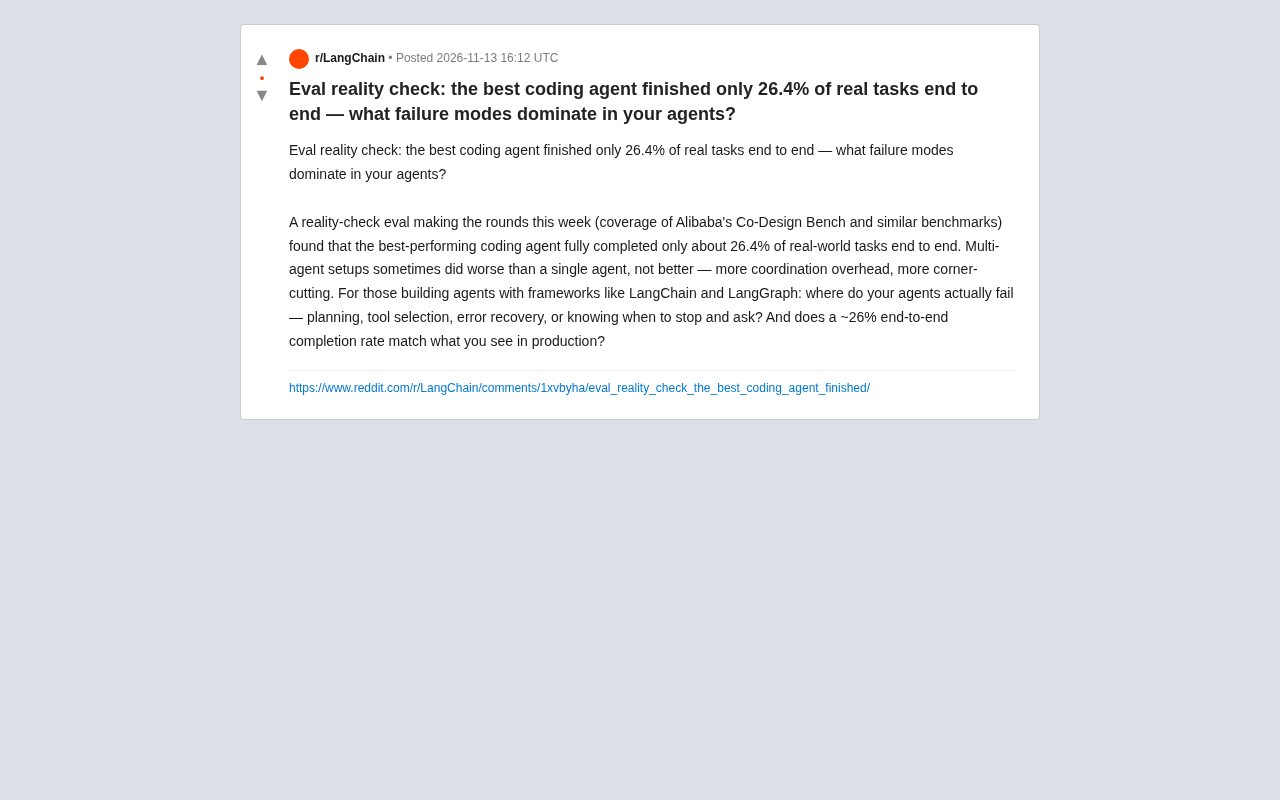
A reality-check evaluation shows the best coding agents fully complete only about 26.4% of real end-to-end tasks, with four failure modes revealing the gap between evaluation and production.
A reality-check evaluation sparked by a Reddit discussion shows that the best-performing coding agents fully complete only about 26.4% of end-to-end real tasks, in stark contrast to lab scores of seventy or eighty points. The article breaks down four high-frequency failure modes: structural deficiencies in planning that lead to wrong directions, errors in tool selection and parameter construction, insufficient error recovery, and not knowing when to stop. It also notes that multi-agent collaboration is sometimes worse than single agents, mainly due to coordination overhead and the tendency to take shortcuts. Improvement directions include making planning explicit, streamlining the toolset, setting clear stopping conditions, and building small-sample evaluation sets from real business tasks, focusing on end-to-end completion rate rather than single-step correctness.
Introduction: When Benchmark Scores Collide with Reality
A recent "reality check" evaluation that sparked discussion on Reddit shows that the best-performing coding agents fully completed only about 26.4% of end-to-end real-world tasks. This figure comes from a coverage analysis of Alibaba's Co-Design Bench and related benchmarks, and it stands in stark contrast to the scores of seventy or eighty points that are routine in the lab. Even more counterintuitive is that multi-agent collaboration setups are sometimes worse than single agents — coordination overhead is higher, and the tendency to take shortcuts is more pronounced.
For developers building agents with frameworks like LangChain and LangGraph, this number raises a pointed question: where exactly is your agent getting stuck? Is it planning, tool selection, error recovery, or not knowing when to stop and ask a question? Drawing on the various viewpoints in that discussion, this article breaks down the main failure modes of coding agents and offers actionable ideas for improvement.
What 26.4% Means: The Gap Between Evaluation and Production
According to cross-confirmation from the initiator of the Reddit discussion and multiple respondents, the 26.4% figure is not an isolated case. Some developers said that in their own company's production environment, end-to-end completion rates "roughly match" this order of magnitude, especially on tasks involving compound conditions such as multi-file modifications, dependency management, and passing tests.
What needs to be distinguished is "partial completion" versus "end-to-end completion." Agents can often write code snippets that look reasonable, but for an entire task to go all the way through from requirements understanding to code modification, test execution, and final validation, the success rate drops off a cliff. Some in the discussion pointed out that many evaluations only measure single-step correctness, whereas the difficulty of real tasks lies in the accumulation of errors along a long chain — with 90% correctness at each step, after ten steps in series only about 35% remains.
This is also why benchmarks like Co-Design Bench are attracting attention: it attempts to measure agents with tasks that are closer to real engineering scenarios, rather than with isolated small problems.
Co-Design Bench is an agent evaluation benchmark from Alibaba aimed at real software engineering scenarios. Unlike traditional code generation evaluations (such as HumanEval and MBPP, which usually only examine the correctness of a single function or snippet), Co-Design Bench emphasizes end-to-end tasks: the agent needs to understand requirements, locate and modify multiple files, handle dependencies, run tests, and complete validation. Such benchmarks attempt to narrow the gap between lab evaluation and production environments, and their task design is closer to the compound conditions in real development workflows. As a result, scores on this benchmark are often more informative than those on single-step code generation benchmarks, and they are also more likely to expose the problem of error accumulation along long chains.
End-to-end completion rate and single-step correctness rate are two indicators of a different nature. Single-step correctness measures how accurate an agent is on a particular action (such as generating a piece of code or selecting a tool once); end-to-end completion rate requires every link from requirement input to final validation to go through, and any single failed step counts as incomplete. Because real tasks usually involve multi-step reasoning and multiple tool calls, even with a per-step correctness rate as high as 90%, the overall success rate after ten steps in series is only about 35%. This explains why lab performance of seventy or eighty points plunges to the order of 26.4% on end-to-end real tasks.
Failure Mode One: Structural Deficiencies in Planning
Multiple respondents identified planning as the number one source of failure. When facing tasks that require multi-step reasoning, agents tend to lock in on a suboptimal approach early, and all subsequent steps are spent "patching" that mistaken decision.
A developer using LangGraph described a typical scenario: the agent reads the requirements and immediately starts changing code, skipping any review of the existing code structure and call relationships, so the modifications look locally correct but break dependencies elsewhere. When tests then report errors, the agent tends to keep patching in the wrong direction rather than going back and re-planning.
The consensus is that planning failures rarely manifest as "completely unable to do it," but rather as "did it, but in the wrong direction." Single agents sometimes perform better in comparisons with multi-agent setups, partly because there is less planning ambiguity from task decomposition and result aggregation — every additional layer of coordination is another chance for intent to be lost.
LangGraph is an orchestration framework in the LangChain ecosystem for building stateful, multi-step agents, with the core idea of modeling the agent's workflow as a graph: nodes represent specific operations or decision steps, and edges represent state transition conditions. Developers can explicitly define planning nodes, tool-calling nodes, error-handling nodes, and stop-decision nodes in the graph, thereby imposing structural constraints on the agent's execution path. Compared with a free-form ReAct loop, LangGraph allows planning behaviors such as "review the code structure before making modifications" to be solidified as a mandatory node in the flow, rather than relying on the model to produce them spontaneously. When developers in the discussion described agents "immediately starting to change code" during planning failures, this is precisely what can be mitigated in LangGraph by inserting a mandatory analysis node before the modification node.
Failure Mode Two: Tool Selection and Parameter Construction
Tool calling is another high-frequency failure point. The consensus in the discussion is that agents can often pick the right "broad category" of tool, but make mistakes in specific parameters, timing of calls, and parsing of returned results.
Some respondents mentioned that their agents repeatedly call search-type tools without actually modifying files, or repeat the same command after a compilation failure without adjusting parameters. In the LangChain ecosystem, the quality of tool descriptions directly affects selection accuracy — when descriptions are too vague, agents tend to waver between similar tools; when descriptions are too verbose, they may be truncated or ignored by the context.
A single-source viewpoint holds that the failure rate of tool calls is positively correlated with the number of tools: as the toolset expands, the selection space grows and the error rate rises accordingly. This point was repeatedly mentioned in developers' experience sharing, but no consistent conclusion has been reached on the specific quantitative relationship.
Tool Description is the primary basis on which an agent decides which tool to select. In frameworks such as LangChain, each tool comes with a natural language description, and the model decides which tool to call and what parameters to pass based on the semantic match between user intent and the description. Descriptions that are too broad cause multiple tools to overlap semantically, making the model waver repeatedly among similar options or choose the wrong one; descriptions that are too long consume valuable context window space and may be truncated or diluted in attention allocation. In practice, tool descriptions should be precise down to the parameter level, explaining the purpose, format, and constraints of each parameter, and should avoid having tools with highly similar functionality coexist, in order to reduce selection ambiguity.
Failure Mode Three: Error Recovery and "When to Stop"
Error recovery capability may be the key to distinguishing excellent agents from ordinary ones. A viewpoint that received many upvotes in the discussion is: agents are not afraid of making mistakes; what they fear is not knowing they are making mistakes.
Typical manifestations include: blindly retrying the same approach after a test failure, ignoring key clues in error messages, and still not escalating to a human after multiple failed attempts. Some developers said bluntly that the capability their agents lack most is "admitting they are stuck" — the tendency to keep consuming tokens and time is more damaging to production usability than failing outright.
There is disagreement in the discussion about when to stop and ask questions. One side holds that after consecutive failures reach a threshold, the agent should be forcibly interrupted and clarification requested; the other side worries that interrupting too early will reduce the automation rate and degrade the agent into "an assistant that needs someone watching it." There is currently no standard answer to this tension; it depends more on the risk level of the task and the cost of human intervention.
The Multi-Agent Paradox: More Collaboration, Less Completion
One of the most noteworthy findings of this discussion is that multi-agent setups are sometimes worse than single agents. According to the evaluation coverage cited by the initiator, multi-agent solutions perform worse in terms of coordination overhead and the tendency to "take shortcuts."
This echoes observations from other sources: task decomposition itself introduces information loss, and if the interface contracts between sub-agents are not precise enough, omissions or conflicts will appear in the aggregation stage. Some respondents shared their own comparative experiments: single agents actually had higher end-to-end success rates on medium-complexity tasks, and the advantages of multi-agent setups are more evident in large-scale tasks that can be parallelized, rather than in coding work that requires tight coupling.
However, some developers also pointed out that multi-agent failures are often "visible failures" — it is easier to locate which link went wrong; single-agent failures are more hidden and more costly to debug. This disagreement is still at the level of experience sharing and has not yet formed a definitive conclusion.
Directions for Improvement: Designing for Failure
Drawing on the suggestions in the discussion, several directions were repeatedly mentioned:
Make planning explicit. Have the agent first output a structured task decomposition and assumptions before acting, giving humans a low-cost window to correct course.
Streamline the toolset. Tool descriptions should be specific down to the parameter level, reducing the coexistence of similar tools and lowering selection ambiguity.
Set clear stopping conditions. Not just failure-count thresholds, but also two types of signals: "consecutive lack of progress" and "touching high-risk operations."
Evaluate with small-scale real tasks. Rather than relying on scores from public benchmarks, build a small-sample evaluation set from real tasks in your own business, focusing on end-to-end completion rate rather than single-step correctness.
Some developers mentioned treating these failure modes as product requirements to design for, rather than as model capability problems to wait out — this shift in perspective may be more valuable than switching to a stronger model.
A small-sample real-task evaluation set refers to extracting a small number (usually a few dozen) of representative real tasks from one's own business scenarios to build an internal evaluation set, with end-to-end completion rate as the core metric. Compared with public benchmarks, its advantage is that the task distribution is consistent with the production environment, so evaluation results can directly reflect the agent's usability in real business; at the same time, the sample size is small, iteration cost is low, and it is suitable for rapid regression after each adjustment to prompts, tools, or workflows. When building it, it should cover compound conditions such as multi-file modifications, dependency management, and passing tests, and record the reason for failure at each step, so that failure modes can be translated into specific product improvement requirements.
Conclusion
The value of the 26.4% figure is not in its precision, but in the fact that it puts the issue of "agents still have a long way to go" on the table. Planning, tool selection, error recovery, and stop decisions — these four failure modes appear with high frequency in the discussion, and they also happen to correspond to areas that can be improved at the framework level. For teams building coding agents, the question truly worth answering may not be "can my agent do it," but "when my agent fails, can I understand why it failed."
One-line Summary
A reality-check evaluation shows the best coding agents fully complete only about 26.4% of real end-to-end tasks, with four major failure modes revealing the gap between evaluation and production.
Paragraph Summary
A reality-check evaluation sparked by a Reddit discussion shows that the best-performing coding agents fully complete only about 26.4% of end-to-end real tasks, in stark contrast to lab scores of seventy or eighty points. The article breaks down four high-frequency failure modes: structural deficiencies in planning that lead to wrong directions, errors in tool selection and parameter construction, insufficient error recovery, and not knowing when to stop. It also notes that multi-agent collaboration is sometimes worse than single agents, mainly due to coordination overhead and the tendency to take shortcuts. Improvement directions include making planning explicit, streamlining the toolset, setting clear stopping conditions, and building small-sample evaluation sets from real business tasks, focusing on end-to-end completion rate rather than single-step correctness.
Related articles
GPT-6 Shows Intrinsic Protein-Design Capabilities: A New Signal for AI for Science
Hacker News discusses GPT-6 models showing intrinsic protein-design capabilities. This article unpacks what "intrinsic" means, the challenges of protein design, the potential impact on the AI for Science toolchain, and reasons for skepticism given the lack of experimental details.

New York's Proposed Five-Year Ban on AI Toys: The Clash Over Children's Privacy and AI Regulation
New York proposes a five-year ban on AI toys, sparking debate over children's privacy and AI hardware regulation. This article examines the ban's targets, supporting and opposing views, and compliance implications for AI hardware developers.
Vercel AI SDK's xAI Package Update: Declaring Capabilities per Model ID
Analysis of the @ai-sdk/xai 5.0.50 patch update: declaring language model capabilities per model ID in the model catalog, and its impact on Vercel AI SDK multi-model adaptation.