341 Code Animation Style Prompts Released Free and Open Source — DeepSeek Can Do It Too
Bilibili creator open-sources 341 code animation prompts; DeepSeek tested to approach Opus 5.5 results.
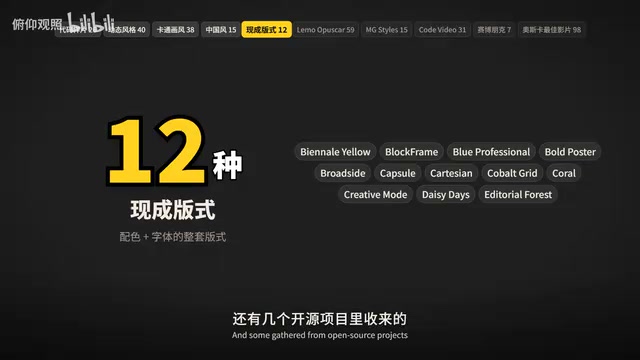
A Bilibili creator released 341 code animation style prompts free and open source, organized into 10 categories such as self-developed samples, camera movement and editing approaches, cartoon, Chinese-style, color and font sets, MG Styles, Code Video, and 98 Oscar Best Picture art styles. Everything is packaged into an offline webpage with category filtering, intuitive search, one-click copy, and checklist export. The creator's controlled test showed DeepSeek producing results nearly identical to Opus 5.5, with a one-sentence prompt yielding a fairly complete comic newspaper animation at about one yuan and 20 minutes per segment. Users must specify whether music and sound effects are needed, and the author forbids repackaging the resource into paid courses.
Creating animations with code is becoming a hot direction in AI creativity. The visuals generated by Opus 5.5 are stunning, but the high barrier to entry keeps many people out. A Bilibili creator has released all 341 code animation style prompts they curated completely free and open source, and demonstrated through hands-on testing that DeepSeek can also produce results close to Opus 5.5.
341 Styles Across 10 Major Categories
This prompt library isn't a simple pile of internet material. According to the creator, a significant portion comes from their own organization, creation, and summarization, divided into 10 categories by art style and use case:
- 26 self-developed code samples
- 40 camera movement and editing approaches for full videos
- 38 cartoon styles
- 15 Chinese-style (Guofeng) styles
- 12 complete color scheme and font pairing sets
- 59 from the open-source project Limo Opus Car
- 15 MG Styles
- 31 Code Video
- 7 cyberpunk styles where AI learns from reference works
- 98 Best Picture Oscar winners, each corresponding to one art style
From explainers and narratives to intros, transitions, and emotional segments, creators can find a corresponding style starting point for different needs. For beginners who aren't good at writing prompts, this is essentially a ready-made "visual dictionary."
MG stands for Motion Graphics — dynamic graphics commonly seen in intros, infographic animations, brand promotional videos, and transitions. Its characteristics are graphic-driven, strong rhythm, and primarily geometric and typographic motion rather than live-action or character narrative. The MG Styles mentioned here is a collection of style prompts aimed at this kind of need. In contrast, Code Video leans more toward using code to directly drive the visuals and camera movement of an entire video. Understanding the difference between these two helps creators quickly locate the right style category for their project type.
Offline Webpage: Double-Click to Use, with Search and List Export
All styles are packaged into a local webpage that opens with a double-click after download — no internet required. The top of the page shows the total number of styles and counts per category; clicking a category shows only that category's content, and you can further filter by subcategory. The search box supports intuitive retrieval — for example, typing "ink wash" (水墨) takes you directly to the corresponding styles.
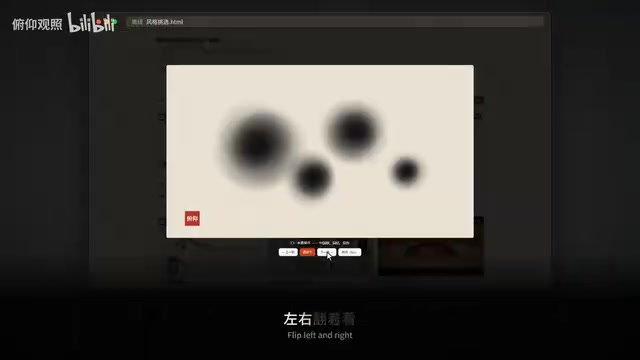
Clicking any style reveals the complete prompt, some available in both Chinese and English versions, with one-click copy. Users can check styles they like to add them to a "selection list" and finally export all the prompts they've picked at once. This design is very practical for creators who need to batch-compare and combine styles.
Hands-On Comparison: How Big Is the Gap Between DeepSeek and Opus 5.5?
The creator ran a controlled test with the same prompt. With a very detailed prompt, they gave it to Opus 5.5 and DeepSeekAd respectively: a light-speed shuttle passing through five halos in succession, being sucked into the center, exploding, and fragments rotating and converging into text. From the results shown, the two were almost identical.
The more critical test was giving just one sentence. The creator picked a comic-style prompt from the library and threw the original one-liner directly at DeepSeek, which generated a full-page comic newspaper effect — background texture, halftone dots, narration boxes, speech bubbles, explosive large text, and finally the title slamming down — with quite high completion.
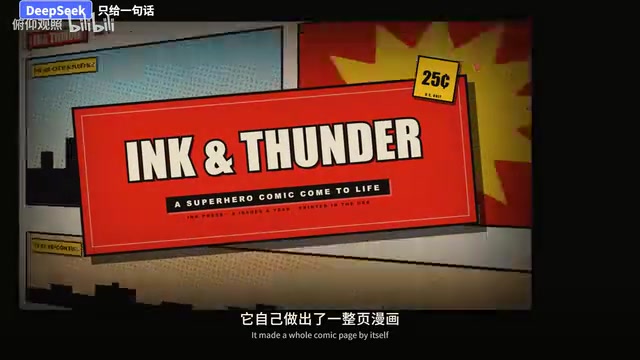
In terms of cost, this short segment plus the earlier tests cost only one yuan in total. The trade-off is speed: that segment took 20 minutes. For creators who are budget-sensitive and don't have extreme time requirements, this is an acceptable trade-off.
Opus 5.5 here refers to a frontier model in Anthropic's Claude series, which performs outstandingly on code generation and visual creative tasks; DeepSeek is a large model series from China's DeepSeek company, known for its reasoning capabilities and price advantage. Both can directly output runnable front-end code (usually HTML/CSS/JavaScript or Canvas/WebGL animations) based on natural language prompts. The more specific the prompt — camera movement, rhythm, color scheme, composition — the more stable the generated result. This is also why the same set of prompts can be reused across models: the style description itself carries most of the creative intent, and model differences mainly show up in depth of understanding and generation speed.
How to Use It and One Easy Pitfall
The usage logic is simple: after downloading the folder, have DeepSeek's Harness read the entire folder directly. Each style corresponds to one prompt; Opus 5.5 can use it, and DeepSeek can too — no need to distinguish models. Creators just need to clearly explain what they want to express — how the camera moves, how several styles blend — and the model can generate accordingly.

The creator specifically warns about a pitfall they encountered: remember to specify in the prompt whether background music and sound effects are needed. The first time they generated, they forgot to mention it, and the resulting video had no sound. This detail seems minor but directly affects the usability of the final video.
Harness here refers to the runtime framework or agent environment built around a large model, capable of reading local folders, parsing the prompt files within, and calling the model to generate code according to instructions. Compared to copying prompts one by one into a chat box, having Harness read the entire folder directly offers the benefit of batch retrieval, combination, and invocation of styles — suitable for creative workflows that require repeated experimentation. Before use, confirm that the tool has local file read permissions, and keep folder hierarchy and file naming as clear as possible, otherwise the model may not find the corresponding style.
The Attitude Behind the Open Source Release
This resource is completely free — no need to buy courses, send private messages, or follow any sales links. The creator emphasizes twice, at the beginning and end: do not repackage this content into courses or paid skills for sale, and please keep it free when sharing with others.
Judging by the volume, organizing 341 styles is no small amount of work; the creator claims this may be the largest scale on the internet. For creators interested in code animation, this prompt library can serve as a low-cost material foundation to get started.
One-line Summary
A Bilibili creator open-sourced 341 code animation prompts; DeepSeek tested to approach Opus 5.5 results.
Paragraph Summary
A Bilibili creator has released all 341 code animation style prompts they curated completely free and open source, divided into 10 major categories by art style and use case, including self-developed samples, camera movement and editing approaches, cartoon, Chinese-style, color scheme and font sets, MG Styles, Code Video, and art styles corresponding to 98 Best Picture Oscar winners. All styles are packaged into a local webpage that opens offline with a double-click, supporting category filtering, intuitive search, one-click copy of Chinese and English prompts, and checkbox export of a selection list. The creator ran a controlled test with the same prompts and found DeepSeek's output almost identical to Opus 5.5; even a one-sentence prompt produced a fairly complete comic newspaper animation, at about one yuan per segment and about 20 minutes of runtime. When using it, specify whether background music and sound effects are needed; the author explicitly prohibits repackaging the resource into paid courses for sale.
Related articles

Gemini 4 Carbon Tops Global Rankings as AI Productivity and Open-Source Ecosystems Surge
Google DeepMind's Gemini 4 Carbon tops global benchmarks, built for complex agents and system security. ByteDance launches Doubao Work integrated with Feishu, Anthropic's AI autonomously breaches 5 system-level attack chains, and ModelBest and Fudan open-source on-device multimodal and image generation models.

Overseas Creator Breaks Down N8n AI Agent Business Playbook: From Tooling to Monetization
An overseas creator breaks down the N8n AI agent business playbook: comparing Zapier, Make, and N8n, detailing four monetizable automation categories—lead capture, WhatsApp follow-up, booking, and content pipelines—plus agency pricing and a sales playbook.

Empacer: The Voice-First AI Assistant for Small Business Owners That Topped Product Hunt
Empacer is a voice-first AI assistant for small business owners: three-question setup, voice requests turned into customer replies, social posts, and invoices—all owner-approved. It won #1 Product of the Day on Product Hunt with 231 upvotes and 47 comments.