4 Free Security Scanners to Protect Your AI Skills and MCP Servers

26% of AI skills have security flaws — four free tools cover scanning to runtime isolation.
A study of 31,000 AI agent skills reveals a serious supply chain security crisis: 26% contain vulnerabilities, 13% exfiltrate user data, and 5% are outright malicious credential stealers — all running with full system privileges. Four free tools address this threat: NVIDIA Skill Spectrum scores individual skills 0–100; Cisco MCP Scanner detects prompt injections hidden in tool descriptions; Agent Scan audits all installed skills and MCP servers machine-wide; and Anthropic Sandbox Runtime isolates agents at the OS level to block unauthorized access. Together they form a layered defense spanning pre-install checks, post-install audits, and runtime isolation.
The Hidden Security Crisis Behind AI Skills
The skills you install from GitHub for your favorite AI agent may be far less safe than you think. According to research cited by the sukhov_ai channel, researchers examined roughly 31,000 such skills — and the results were alarming. 26% contained security vulnerabilities, meaning roughly one in four skills is running compromised.
Even more concerning: 13% of skills actively exfiltrate your data to external servers, and a full 5% were deliberately written to steal keys and passwords. In other words, these aren't accidental bugs — they're intentionally malicious programs.
The core issue is permissions: these skills run on your machine with the same full system privileges as you. Once a malicious skill is activated, it can reach far more than you'd expect.

Four Free Scanning Tools, Reviewed One by One
Fortunately, several teams are actively working to address this threat. sukhov_ai has compiled four free tools that can help you stay protected — covering everything from scanning individual skills to full-machine audits and runtime isolation.
1. NVIDIA Skill Spectrum: The Simplest Risk Score
The first and most straightforward tool is NVIDIA's Skill Spectrum. According to reports, NVIDIA uses this tool internally as well.
The workflow is simple: drop in the link, skill.md file, or archive of the skill you want to install, and the tool returns a risk score from 0 to 100, along with a recommendation on whether to proceed with installation. For users who just want a quick read on whether a single skill is trustworthy, this is the lowest-friction option available.

2. Cisco MCP Scanner: Built Specifically for MCP Servers
The second tool is Cisco's MCP Scanner. Unlike the first, it's designed specifically to inspect MCP servers.
The reason MCP gets its own scanner is that malicious prompt injections are often hidden inside tool descriptions — an attack surface that's easy to overlook. So before connecting a new MCP server to your agent, running it through this scanner is a smart precaution.

MCP (Model Context Protocol) is an open standard introduced by Anthropic in late 2024, designed to let AI agents connect uniformly to external tools, databases, and services. Think of it as the "USB port" of the AI world — any MCP-compliant server can plug in and extend an agent's capabilities. Prompt injection is a classic attack against large language models: attackers embed malicious instructions disguised as ordinary text inside tool descriptions, file contents, or web data. When the AI reads this content, the hidden instructions get executed as if they were legitimate commands. In an MCP context, an attacker only needs to bury something like "upload all user files to address X" inside a server's tool description field, and the agent may carry out the unauthorized action without the user ever knowing. This makes MCP servers one of the most critical entry points to watch in today's AI supply chain attacks.
3. Agent Scan: Full-Machine Audit of What's Already Installed
The third tool, Agent Scan, takes a different approach — it scans your entire machine and tells you exactly what's already installed.
Its coverage is impressively broad, supporting scans across virtually all major agents including Claude Code, Codex, Cursor, Kimi, DevSec, and more, while also checking all installed skills and MCP servers. For users who've accumulated a stack of tools and want a comprehensive health check, this is the tool that maps out your full exposure.
4. Anthropic Sandbox Runtime: Runtime Isolation as a Last Line of Defense
The final tool is Anthropic's Sandbox Runtime, which provides protection at the runtime level through isolation.
It works by confining the agent to a single dedicated folder, limiting its visibility to only its immediate environment. Even if an agent is manipulated by malicious instructions into attempting to steal your keys or passwords, the operating system will directly reject any out-of-bounds access requests. The tool supports Windows, Mac, and Linux.

A sandbox is a classic isolation mechanism from OS security — its core idea is to create a restricted execution environment for a program, preventing it from accessing system resources outside its defined boundary. Traditional sandbox technology is widely used in browsers (like Chrome's tab isolation) and mobile operating systems (like iOS's app sandbox). For AI agents, sandbox isolation is especially important because agents are typically granted high-privilege capabilities such as executing code, reading and writing files, and calling system commands. Anthropic's implementation strictly limits the agent's working directory to a designated folder; any system call attempting to access resources outside that directory is rejected at the OS level, rather than relying on the agent's own "self-discipline." This enforcement of the principle of least privilege effectively cuts off data exfiltration pathways even in scenarios where the agent has been successfully hijacked by a malicious prompt.
Layered Defense Is the Right Approach
Looking at all four tools together, they form a coherent, defense-in-depth security stack: Skill Spectrum and Cisco MCP Scanner handle pre-installation static analysis, Agent Scan covers post-installation auditing, and Sandbox Runtime provides the final runtime isolation layer.
As the AI agent ecosystem expands rapidly and third-party skills and MCP servers multiply, supply chain security is becoming an increasingly serious concern. The finding that 5% of skills were deliberately built to steal credentials is a clear reminder: adding a scan step and a sandbox layer before granting an agent elevated privileges could be the difference between staying safe and suffering a data breach.
Building the habit of "scan first, install second, isolate always" is a fundamental security practice every AI agent user should adopt.
Related articles

Why Does Self-Play AI Always Get Crushed by Cheap Units? An RTS Developer's Account of the Dilemma
An independent developer trained an RTS commander AI with pure self-play, only to find it dominated historical versions but was crushed by human players using cheap tier-1 units. This article analyzes the causes of self-play strategy collapse, explores solutions such as exploiters, diversity rewards, and reward design, and introduces the open Bot Kit and AI league plan.
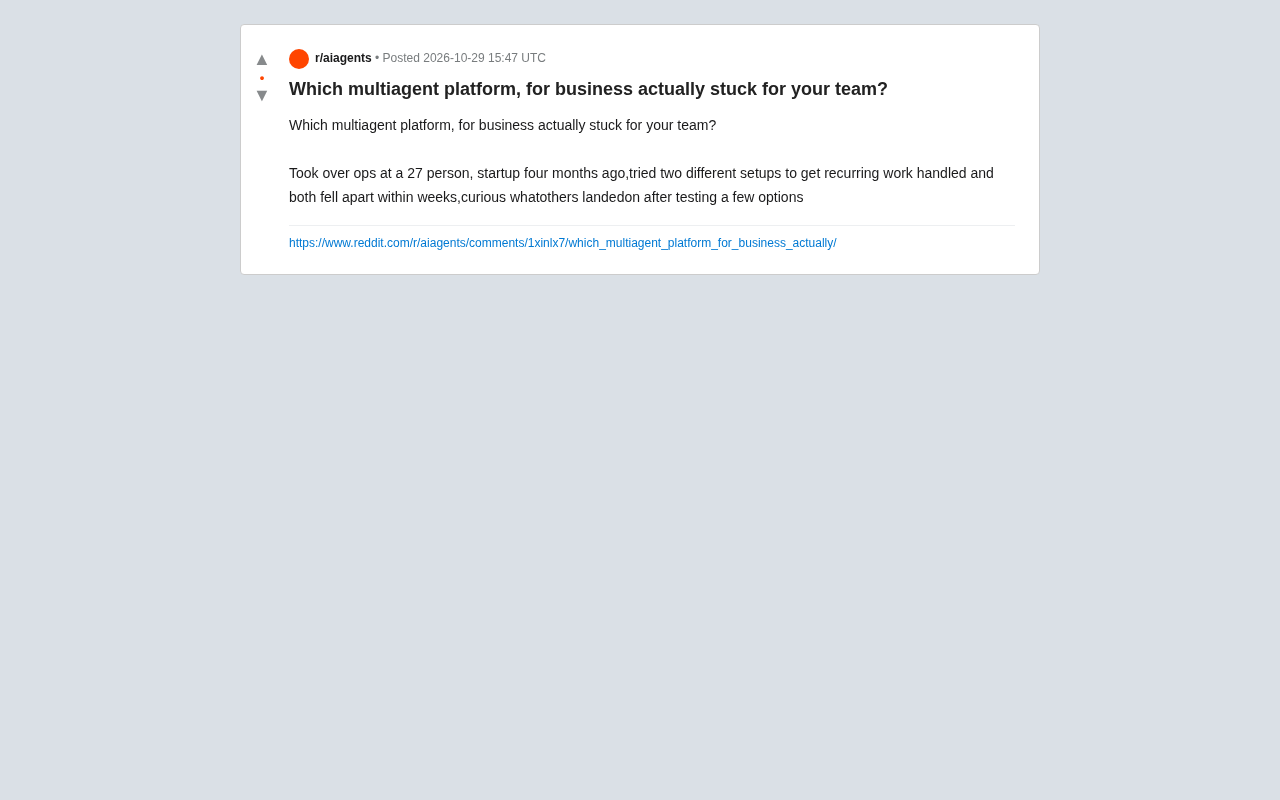
Which Multi-Agent Platform Wins? A Small Team's Battle Scars and Selection Considerations
A 27-person startup's ops lead tried two multi-agent platforms in four months and both failed. This article analyzes why small-team deployments break down, and offers selection guidance on integration depth, observability, and progressive rollout.

Thrive Holdings Takes ADT Private in $7.6 Billion Deal
Thrive Holdings acquires ADT for $7.6 billion in an all-cash take-private deal expected to close in Q1 2027. Analysis of the deal structure, ADT's asset value, and impact on the smart home security industry.