A Beginner's Guide to LLM Fine-Tuning: From Principles to Industry Implementation

From costs and scenarios to open-source cases, a systematic breakdown of the technical boundaries and decision logic of LLM fine-tuning.
Based on Bilibili creator Muyan's three-hour course, this article distills the core logic of LLM fine-tuning. It first categorizes general LLMs by capability into language, vision, and multimodal types, and by scale into general, industry, and vertical-domain layers, pointing out that fine-tuning is the key path from general to industry and vertical applications. It then explains two major reasons general models fail in specialized scenarios: training data lacks domain knowledge, leading to irrelevant answers, and sensitive healthcare/finance data cannot be exported. Cost comparisons show that pre-training T5 with tens of billions of parameters can cost up to ten million dollars per run, while fine-tuning achieves domain adaptation at minimal cost. The article also summarizes six scenarios suited for fine-tuning and validates feasibility with three open-source projects: Bencao, LawGPT, and FinGPT, concluding with three judgment dimensions: domain knowledge gaps, data sensitivity, and long-term inference costs.
LLM fine-tuning is currently one of the most cost-effective parts of AI engineering deployment. In a three-hour course, Bilibili creator Muyan starts from the layered structure of general-purpose large models and breaks it down all the way to open-source fine-tuning cases in three industries: healthcare, law, and finance. This article distills the core logic to help you build a systematic understanding of the technical boundaries of fine-tuning.
The Three Layers of General LLMs and Where Fine-Tuning Fits
Muyan first categorizes general large models by capability dimension into three types: language models (such as GPT and T5, responsible for Q&A and translation), vision models (recognizing behaviors and scenes in images), and multimodal models (handling images, language, and audio simultaneously). By purpose and scale, they can also be divided into general large models, industry large models, and vertical-domain large models.
The three form a progressive relationship. A general large model is like a college student with broad general knowledge; an industry large model is like a graduate student who has chosen a direction in finance or law; a vertical-domain large model is like a PhD student focused on highly specific scenarios such as stock analysis or referral-based user acquisition. Fine-tuning is precisely the key means of moving from "college student" to "graduate student" and even "PhD student."
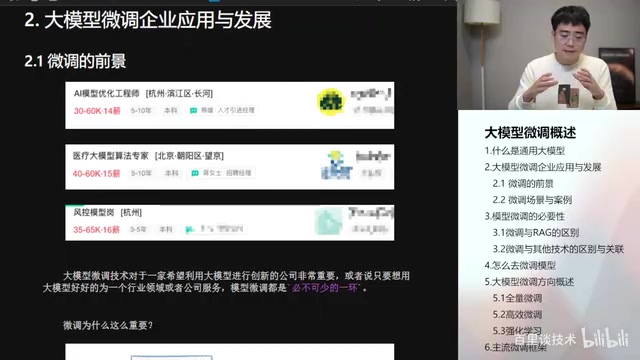
Muyan checked recruitment apps and found that salaries for model optimization roles are relatively high even within the development field, and the reason companies are willing to pay top dollar is straightforward: general large models cannot provide sufficient value in specialized domains, and only models adapted to a domain can deliver real monetization capability.
Why General LLMs Fail in Specialized Scenarios
An employee asks a large model, "What is our company's employee handbook?" The model cannot answer — it doesn't know which company you belong to, nor has it studied your internal policies. This is not because the model isn't large enough, but because the training data simply doesn't contain this content.
The healthcare scenario illustrates the problem even more clearly. A patient asks, "Can ibuprofen be taken together with cold medicine?" A general large model has not learned medical domain knowledge and cannot give a reliable answer. Only when the model has studied professional data can it answer details such as precautions and whether to take before or after meals. The value of fine-tuning lies in bridging this gap between general capability and industry needs.

Beyond knowledge gaps, data security is another hard constraint. Data in industries such as healthcare and finance is highly sensitive private information, and enterprises cannot hand it over to third parties for retraining — the risk of leakage is unacceptable. Fine-tuning allows enterprises to adapt models on their own data, circumventing this obstacle.
Knowledge cutoff and hallucination are two key background concepts for understanding this issue. A large model's parameters固化 (bake in) the knowledge covered by its training data, and once training is complete, the knowledge is no longer updated — this is called "knowledge cutoff." When users ask about internal corporate policies or the latest medical guidelines, the model either admits it doesn't know or generates plausible-sounding but incorrect answers based on language pattern probabilities — the latter is "hallucination." Hallucinations are especially dangerous in specialized scenarios because the model's output tone is often as confident as a correct answer, making it hard for non-expert users to distinguish. Fine-tuning, by injecting domain data, on one hand expands the model's domain knowledge boundary, and on the other hand calibrates its output distribution using domain corpora, reducing the model's tendency to "fabricate" on professional questions. This is also one of the reasons industry models are irreplaceable in scenarios with high compliance requirements.
The Cost Equation: Why Not Everyone Can Afford Pre-Training
Some may ask: since domain expertise is needed, why not pre-train an industry model from scratch? The answer lies in the cost structure.
Pre-training requires data collection, storage, cleaning, and governance; a professional team for long-term maintenance; GPU/CPU compute; and electricity costs from long training runs. Muyan cites a set of comparative figures: Google's T5 model with 11 billion parameters costs about $1.3 million per single run, and with peripheral tuning and training, a single run could reach around $10 million — equivalent to the annual revenue of many small companies. Even switching to the smaller BERT (110 million parameters), a single fine-tuning or training run costs between $2,500 and $50,000; at the 1.5 billion parameter scale, running costs fall in the $80,000 to $1.6 million range.
In contrast, fine-tuning is about "spending little to achieve much." For the same goal, fine-tuning can produce business-relevant results at a minimal resource cost. Another hidden cost is inference: when using a general large model to handle industry questions, one often needs to stack a large number of prompts to guide the output, and prompts translate into token billing — with many calls, long-term overhead is also considerable. A fine-tuned model can complete tasks with very few prompts, yielding more accurate results, faster responses, and lower per-call costs.
The relationship between parameter scale and compute cost deserves separate mention. The training compute of Transformer-type models is roughly proportional to the number of parameters and training tokens, and Scaling Law further indicates that model capability improves as a power law with parameter count, data volume, and compute — meaning that to achieve a step-change in capability, investment often needs to grow exponentially or even by orders of magnitude. T5's 11 billion parameters already count as a "small-to-medium" pre-trained model; training a GPT-3-level model with hundreds of billions of parameters can cost millions to tens of millions of dollars. In contrast, parameter-efficient fine-tuning methods such as LoRA train only a small number of newly added low-rank matrices, often reducing trainable parameters to less than 1% of the original model, dramatically compressing memory usage and training time, so that domain adaptation can be completed on a single card or a small number of GPUs — this is precisely the technical foundation that makes fine-tuning economically viable.
Six Typical Scenarios Suited for Fine-Tuning
Muyan outlines several signals for judging whether fine-tuning is needed:
- Specific task requirements: domains such as healthcare, finance, and law that require professional Q&A.
- Text sentiment analysis: identifying whether user reviews are satisfied, dissatisfied, or neutral, and feeding this back to companies to drive product iteration.
- Small data volume: a new product has only tens of thousands of records, far below the training scale of general large models, but enough to complete a targeted fine-tuning.
- Language style and personalization: a sales bot targeting the Guangdong region interacts in dialect, which general models struggle to understand; after fine-tuning, the experience improves significantly.
- Supervision of complex business rules: banking business rules are hard even for humans to learn; after the model learns the rules, it can help monitor risky operations such as account violations, abnormal large transactions, and logins from unusual locations.
- Balancing domain depth and generalization: for essay grading on an online education platform, after learning historical knowledge and grading mechanisms, the model can break down scores by knowledge point — awarding partial credit for getting the year right, more for getting the key figure right, rather than all-or-nothing.

What these scenarios share is that general large models lack the corresponding domain data, while the business has clear requirements for accuracy and compliance.
Open-Source Fine-Tuning Cases in Three Industries
The most reference-worthy part of the course is three already open-sourced industry fine-tuning projects, which prove that fine-tuning is not just theory.
Traditional Chinese Medicine: Bencao. Fine-tuned by Harbin Institute of Technology, using Llama 7B, Chinese Llama Alpaca, and ChatGLM6B as base models, all using public data, trained for 10 epochs on an A100G taking 2 hours, with 4.6K GitHub stars. TCM theory has complex rules, and this model validates fine-tuning's ability to handle complex professional knowledge.
Legal domain: LawGPT. Also based on a 7B model and public datasets, with concrete implementation in legal scenarios, and 5.8K GitHub stars.
Finance domain: FinGPT. The most popular, reaching 14K stars and still being updated in the past two months. It comes in two versions: one based on Xunfei Xinghuo (XRJRM6B) plus LoRA fine-tuning, and another based on Llama 7B plus LoRA, both using public data.

Muyan particularly notes that the best-performing fine-tuned models are usually commercial products that are not open-sourced; the fact that open-source industry models can accumulate thousands to tens of thousands of stars itself indicates that the direction has matured and has the potential for commercial-grade deployment.
LoRA (Low-Rank Adaptation) is the core technique adopted by all three cases. The approach freezes all parameters of the original model, inserts two small matrices A and B as bypasses alongside the Transformer's attention layers, expresses the weight update as a low-rank decomposition ΔW = BA, and trains only these two small matrices. Since the rank r typically ranges from 8 to 64, the number of trainable parameters drops by two to three orders of magnitude compared with full-parameter fine-tuning, and memory requirements plummet accordingly, so even ordinary consumer-grade GPUs can run fine-tuning of 7B models. At inference time, BA can be merged back into the original weights without adding extra latency. Another advantage of LoRA is pluggability: the same base model can be mounted with LoRA weights from different domains and switched as needed, which is particularly practical for enterprises that need to serve multiple industries simultaneously.
The Boundaries of Fine-Tuning and How to Choose
Fine-tuning is not a panacea. Its core positioning is: transforming a general large model into a specialized model, bridging the gap between general capability and industry expectations, and bringing model output closer to human expectations.
To judge whether to fine-tune, you can start from three dimensions: whether the domain knowledge is missing from general models, whether the data is sensitive and cannot be exported, and whether long-term inference costs are spiraling out of control due to prompt inflation. If any one of the three holds, fine-tuning is usually a more pragmatic choice than pre-training or pure prompt engineering.
For developers who want to get hands-on, LoRA (Low-Rank Adaptation) mentioned in the course is the common technique running through all three cases — it makes fine-tuning feasible under limited compute. The subsequent hands-on coding section is worth studying alongside the open-source repositories of Bencao, LawGPT, and FinGPT.
Related articles

9 AI Subscription Plans Compared: The Real Cost Per 100M Tokens Revealed
Bilibili creator tests 9 AI subscription plans from Volcano, Alibaba, Tencent, Baidu, Zhipu, Xiaomi, MiniMax and more, converting them all to real cost per 100M tokens, breaking down fixed-quota vs. three-tier coefficient billing and how caching, time-of-day discounts, and window limits affect actual quota.

Vibe Coding for Beginners: Expressing Intent Instead of Handwriting Code
What is Vibe Coding? A 137-episode Bilibili course defines it: the core is expressing intent, not writing code. This article analyzes Vibe Coding's productivity logic, target audience, and entry expectations to help beginners decide if it's worth learning.

LangChain Beginner's Guide: An Agent Development Roadmap from LangGraph to Deep Agents
Clarify the encapsulation relationship among LangChain, LangGraph, and Deep Agents, and master the learning path and selection logic for agent development frameworks—suitable for beginners in large model development.