A Brutal Week in Cybersecurity: AI Uncovers PHP Vulnerability, Node.js and LiteLLM Also Hit

AI automatically uncovered a high-severity PHP vulnerability, with Node.js and LiteLLM also in urgent straits—the remediation window is being compressed.
This week the security field saw dense disclosure of three high-severity vulnerabilities: a PHP vulnerability automatically discovered by AI, a Node.js runtime defect, and a security issue in the AI tool LiteLLM. The three span different technology stacks yet have equally broad impact. The article notes that AI's involvement in vulnerability discovery greatly improves discovery efficiency, but it also gives attackers equal acceleration, significantly compressing the remediation window after disclosure. As the infrastructure of the modern web backend, Node.js runtime-level defects have an extremely broad impact; LiteLLM exposes the common weakness of weak supply-chain review at the AI application layer. The author recommends that security teams inventory dependencies, establish an independent review process for AI toolchains, and subscribe to vulnerability disclosure channels, replacing passive patching with a routine response cadence.
When AI starts automatically hunting for vulnerabilities, the security team's nightmare is only just beginning. This week, a string of high-severity vulnerabilities came to light—from PHP to Node.js to the popular AI tool LiteLLM—leaving security teams with barely a moment to breathe.
One Wave After Another: Three High-Severity Vulnerabilities Erupt at Once
According to RSS sources, the cybersecurity field saw a dense round of vulnerability disclosures this week. Most notable was a high-severity PHP vulnerability discovered automatically by AI, marking a new phase in which vulnerability discovery is becoming automated and intelligent. At the same time, the widely used JavaScript runtime Node.js also revealed security flaws, and the AI development tool LiteLLM was not spared either. The three vulnerabilities touch different technology stacks yet have equally broad impact, putting developers and operations teams that rely on these components to a severe test.
AI Vulnerability Discovery: The Double-Edged Sword Behind Greater Efficiency
The most noteworthy focus of this incident is the role of AI in discovering the PHP vulnerability. Traditionally, vulnerability discovery relies on manual audits and fuzzing by security researchers—time-consuming and dependent on expert experience. AI's involvement greatly speeds up discovery, but it also means attackers can use similar techniques to accelerate exploitation. For the open-source community, faster vulnerability discovery is a good thing, but the remediation window after disclosure is also being compressed. Security teams need to reassess: when the speed of vulnerability discovery exceeds the speed of remediation, how do you build a more agile response mechanism?
What Is Fuzzing
Fuzzing is an automated software testing technique whose core idea is to feed large amounts of random or semi-random data into a program and observe whether it crashes, behaves abnormally, or handles input improperly, thereby uncovering potential vulnerabilities. Traditional fuzzing tools (such as AFL and libFuzzer) rely on coverage feedback to guide input mutation and can automatically explore code paths to some extent, but they still require humans to write test harnesses, set seed corpora, and triage results. AI's involvement mainly operates at two levels: first, using large language models to understand code semantics and directly locate suspicious dangerous function calls or data flows; second, using machine learning models to generate more targeted inputs and increase the probability of triggering deep-seated defects. Compared with purely manual auditing, this approach greatly lowers the marginal cost of the "discovery" step and significantly raises the frequency of vulnerability disclosures.
Node.js and LiteLLM: The Dual Risk to Infrastructure and AI Tools
The reason the Node.js vulnerability strikes a nerve is that it is practically the infrastructure of the modern web backend, with a huge number of production environments depending on its stable operation. Any runtime-level defect can affect thousands upon thousands of services. And LiteLLM, as a popular AI tool library, its security issues reveal a new risk at the AI application layer—developers tend to focus on model capabilities while neglecting security audits of underlying components. Together, these two vulnerabilities trace a complete attack surface from infrastructure to the application layer.
Why Runtime Vulnerabilities Have Broader Impact
Node.js is a JavaScript runtime environment on which applications, third-party libraries, and frameworks are all built. A so-called "runtime-level defect" means the problem lies in the interpreter, event loop, built-in modules, or underlying dependencies (such as the V8 engine or HTTP parser), rather than in specific business code. The danger of such vulnerabilities is that they do not depend on a developer writing a wrong line of code; as long as a service runs on the affected runtime version, it can be triggered, so the scope of impact is often the entire technology stack. Remediation also often requires upgrading the runtime itself, involving compatibility verification and regression testing, with a longer cycle than changing business code. This is precisely why the Node.js vulnerability makes operations teams nervous.
LiteLLM's Role and Risk Characteristics
LiteLLM is a Python library/proxy service for uniformly calling multiple large-model APIs. Developers often use it to abstract away differences between vendor interfaces and centrally manage keys and call quotas. Its security risks are representative: on the one hand, as a proxy layer, it often holds API Keys for multiple models, so once compromised, what leaks is not just data but also call credentials that can be abused; on the other hand, such tools iterate quickly and receive relatively weak community review, and developers easily assume that "a new tool is a safe tool." The AI application stack's supply chain is therefore shorter and more concentrated than the traditional web stack, and the consequences of a single point of failure are more direct.
Three Practical Recommendations for Security Teams
Faced with high-frequency vulnerability disclosures, passive patching is no longer enough. Teams are advised to first inventory their dependencies and clarify which services are exposed to affected versions; second, establish a separate security review process for AI-related toolchains and not assume a tool is safe just because it is "new"; finally, pay attention to subscription mechanisms for vulnerability disclosure channels to shorten the time lag from "learning of a vulnerability" to "assessing impact." This week's chaos may be only the beginning—establishing a routine vulnerability response cadence matters more than chasing every news item.
Software Bill of Materials (SBOM) and Vulnerability Subscription Mechanisms
The engineering approach to inventorying dependencies is to generate and maintain a Software Bill of Materials (SBOM)—a structured list recording all software components, versions, and dependency relationships, commonly in formats such as SPDX and CycloneDX. With an SBOM, when a new vulnerability is disclosed you can quickly compare against affected versions instead of manually digging through configuration files. For vulnerability subscriptions, in addition to following vendor security advisories, you can also connect to data sources such as CVE/NVD, GitHub Security Advisory, and OSV, and use automated tools to match advisories against your own SBOM and raise alerts. Together, these two mechanisms can compress the time from "learning of a vulnerability" to "assessing impact" from days to hours.
One-line Summary
AI automatically uncovered a high-severity PHP vulnerability, with Node.js and LiteLLM also in urgent straits at the same time—the remediation window is being compressed.
Paragraph Summary
This week the security field saw dense disclosure of three high-severity vulnerabilities: a PHP vulnerability automatically discovered by AI, a Node.js runtime defect, and a security issue in the AI tool LiteLLM. The three span different technology stacks yet have equally broad impact. The article notes that AI's involvement in vulnerability discovery greatly improves discovery efficiency, but it also gives attackers equal acceleration, significantly compressing the remediation window after disclosure. As the infrastructure of the modern web backend, Node.js runtime-level defects have an extremely broad impact; LiteLLM exposes the common weakness of weak supply-chain review at the AI application layer. The author recommends that security teams inventory dependencies, establish an independent review process for AI toolchains, and subscribe to vulnerability disclosure channels, replacing passive patching with a routine response cadence.
Related articles

Why Does Self-Play AI Always Get Crushed by Cheap Units? An RTS Developer's Account of the Dilemma
An independent developer trained an RTS commander AI with pure self-play, only to find it dominated historical versions but was crushed by human players using cheap tier-1 units. This article analyzes the causes of self-play strategy collapse, explores solutions such as exploiters, diversity rewards, and reward design, and introduces the open Bot Kit and AI league plan.
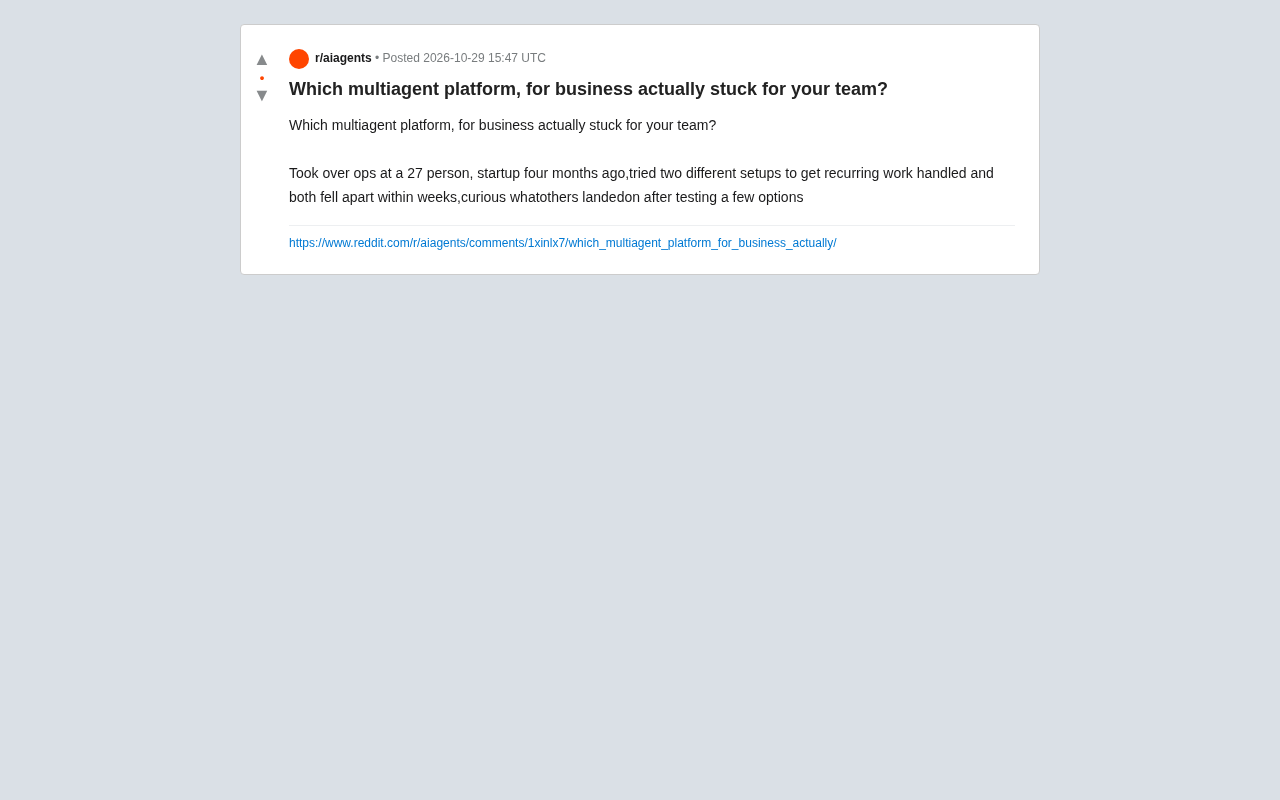
Which Multi-Agent Platform Wins? A Small Team's Battle Scars and Selection Considerations
A 27-person startup's ops lead tried two multi-agent platforms in four months and both failed. This article analyzes why small-team deployments break down, and offers selection guidance on integration depth, observability, and progressive rollout.

Thrive Holdings Takes ADT Private in $7.6 Billion Deal
Thrive Holdings acquires ADT for $7.6 billion in an all-cash take-private deal expected to close in Q1 2027. Analysis of the deal structure, ADT's asset value, and impact on the smart home security industry.