A Deep Dive into Multi-Agent Systems: Technical Progress from the OpenAI Team

OpenAI researchers go deep on multi-agent systems with Dwarkesh Patel, signaling it as a rising AI research frontier.
An OpenAI researcher held an in-depth conversation with tech podcast host Dwarkesh Patel on multi-agent systems, publicly crediting six team members for their contributions. Multi-agent systems, which coordinate multiple AI agents to tackle complex tasks, are seen as superior to single LLMs for task decomposition, parallel processing, and error correction. The high-profile public discussion reflects both the rising importance of this research direction and the increasingly collaborative nature of frontier AI research. Specific technical details await the full episode release.
Multi-Agent Collaboration Emerges as a New Focus in AI Research
A tweet from an OpenAI researcher signals that technical discussions around multi-agent systems are becoming an increasingly important topic in the AI field. The researcher held an in-depth conversation about multi-agent systems with well-known tech podcast host Dwarkesh Patel (@dwarkesh_sp), and publicly thanked several colleagues at OpenAI who contributed to the related research.
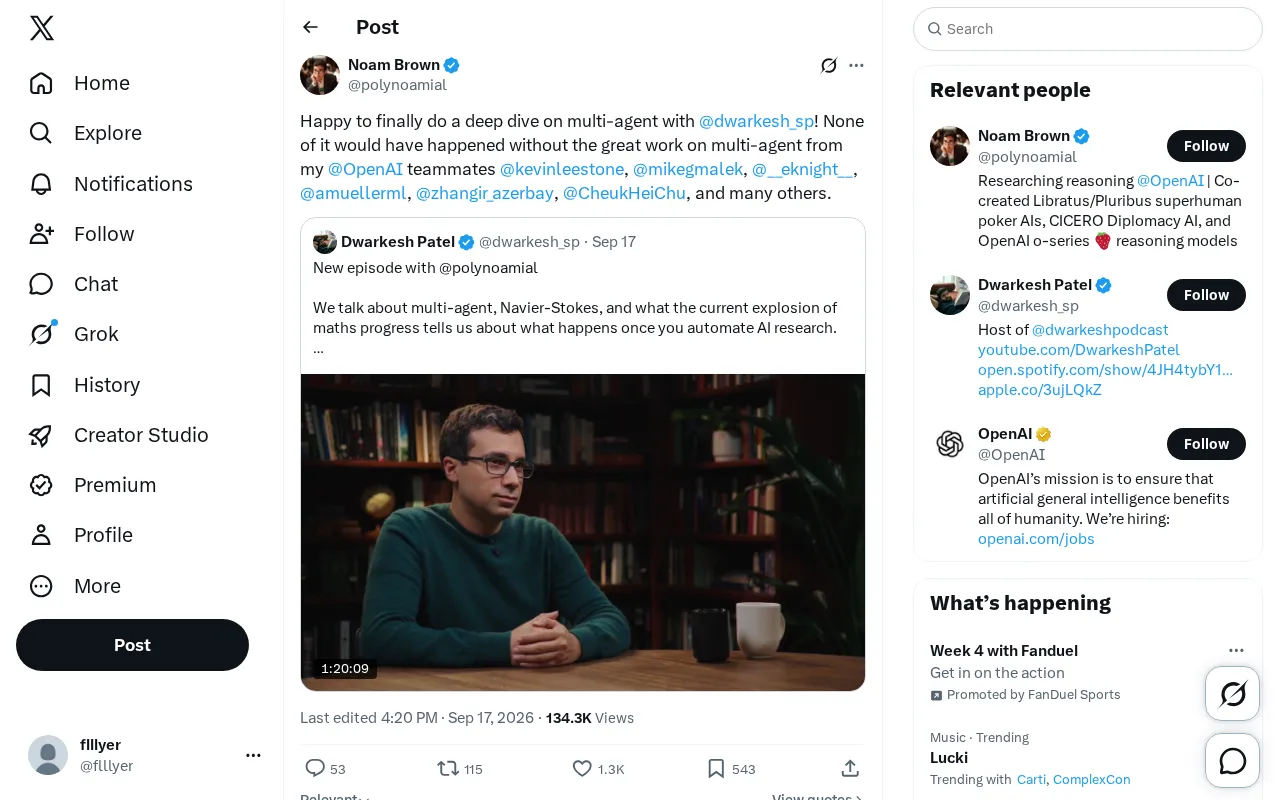
Based on publicly available information, this conversation served as a systematic review of research progress in the multi-agent space. The tweet specifically emphasized that these advances were the result of team collaboration — acknowledging contributions from multiple OpenAI team members including @kevinleestone, @mikegmalek, @eknight, @amuellerml, @zhangir_azerbay, and @CheukHeiChu.
Why Multi-Agent Systems Deserve Attention
Multi-agent systems refer to architectures where multiple AI models or agents work together in a coordinated, division-of-labor fashion to accomplish complex tasks that a single model would struggle to handle. Compared to a single large language model, multi-agent architectures are generally considered to have greater potential in scenarios involving task decomposition, parallel processing, role specialization, and complex reasoning.
Industry interest in this direction has been steadily rising, with many frontier labs exploring how to enable multiple agents to communicate, coordinate, and self-correct more effectively. The fact that OpenAI researchers chose to share their findings in depth on a high-visibility podcast platform reflects the growing weight this research direction carries in the field.
The core orchestration approaches for multi-agent systems typically fall into two categories: the "Pipeline" model, where agents pass tasks along in a fixed sequence, and the "Debate/Critique" model, where multiple agents independently answer the same question and then review each other's outputs to reduce the hallucination risk of any single model. Additionally, "Tool-use Agents" can call external tools such as code execution, search, and database queries, pushing beyond the limitations of pure language models. Popular open-source frameworks like AutoGen, LangGraph, and CrewAI are already widely used in the community to build such systems — but maintaining context consistency across agents and controlling cascading errors remain engineering challenges that have yet to be fully solved.
The Research Ecosystem Behind Team Collaboration
One notable aspect of the tweet is the collective acknowledgment of multiple team members, which highlights the reality that cutting-edge AI research is increasingly dependent on teamwork. Multi-agent systems, as a form of systems engineering, inherently involve multiple workstreams — model training, system orchestration, evaluation and testing — making it difficult for any single researcher to complete alone.
This practice of public attribution and acknowledgment also reflects the AI research community's emphasis on a collaborative culture. For practitioners tracking AI developments, signals like these often reveal a lab's research priorities more clearly than any specific technical detail.
Information Limitations and What to Watch For
It's worth noting that the only publicly available source at this time is a teaser-style tweet, which does not disclose specific technical details, research data, or methodology from the conversation. The architecture design, performance benchmarks, and practical application scenarios of multi-agent systems will require the full conversation to be released before further analysis is possible.
For readers who want to go deeper on this topic, following the complete podcast episode is recommended to get first-hand access to the technical discussion. As research into multi-agent systems continues to advance, this field is poised to deliver meaningful breakthroughs in areas such as complex task automation and AI collaboration systems.
Related articles

Anthropic IPO Explained: Fuel for the AI Boom or the Spark for a Bubble?
Anthropic files for an IPO under ticker ANT. Breaking down the prospectus: 80% of revenue from usage-based pricing, $72B of an $80.7B net loss being non-cash charges, 900% net revenue retention, and how past IPOs like SpaceX performed on day one and over three years — answering the AI bubble question.

Will AI Kill the Research Paper? Mathematicians Offer a New Answer
Mathematicians on the Lex Fridman podcast discuss whether AI will kill research papers—from journal review pressure to Lean formal verification, GitHub open source fatigue to Mathlib's crowdsourcing model, exploring the evolution of academic contributions and the future of mathematical knowledge verification.

Enterprise LLM Development: From RAG to Multi-Agent in Practice
A course breakdown of enterprise LLM application development: from prompt engineering and RAG to multi-agent engineering practice and FDE project delivery, helping developers understand why Agent technology is a key focus for enterprise deployment and learn systematically to avoid detours.