A New Way to Use Replit: Generate a Product Roadmap with Budget and Customer Feedback in One Go

Replit proposes combining budget and customer feedback in one AI workspace to generate a product roadmap via consecutive prompts.
Replit's official social channels propose a new use case: place budget data and customer feedback in the same workspace, first have AI organize the numbers and needs, then issue an additional instruction to output a release plan and product roadmap. The article notes that the truly time-consuming part of product planning is organizing, not analysis; this two-step interaction is more controllable than a single long prompt, and intermediate results can be human-reviewed. The use case extends Replit's positioning from "help you write code" to "help you decide what code to write," best suited to small teams and independent developers without dedicated product operations. Enterprises need to assess data compliance risks, and the AI's priority ranking can only serve as a starting point—business judgment still requires human sign-off. In practice, structure your inputs, specify the output format, and stay skeptical of AI conclusions.
From Two Spreadsheets to One Roadmap: Replit Takes Aim at the Product Manager's "Last Mile"
"You have a budget, and you have customer feedback, but you still don't know what to ship." This is a typical scenario Replit raised on social media. Its proposed solution is straightforward: drop both the budget data and customer feedback into Replit, let the AI organize the numbers and surface the needs, then add one more instruction—"use these numbers and feedback to plan the release."
This use case sounds simple, yet it points to a step that most AI coding tools overlook: the decision-making stage before code generation.
Why Product Planning Always Gets Stuck
Budgets and feedback usually live in two separate places. The budget sits in financial spreadsheets; the feedback lives in support tickets, surveys, or community chat logs. The product manager's job is to align these two kinds of information: which needs have the loudest demand, which can realistically be delivered within budget, and which can only go on the "someday" list.
What makes this process time-consuming isn't the analysis itself—it's the organizing. Replit's approach hands the organizing and analysis to AI, leaving humans to make judgments and trade-offs. According to Replit's official description, users can organize budget figures and explore customer needs within the same workspace, then issue an additional instruction for the AI to output a release plan and product roadmap.
Product Roadmap is a core deliverable in product management. It lists features, improvements, or projects planned for delivery along a timeline, typically annotated with priority, owner, and approximate time windows. The purpose of a roadmap isn't precise scheduling—it's aligning the team and stakeholders on a shared understanding of "what to do next and why." Traditionally, roadmap inputs include user research, competitive analysis, sales feedback, and engineering capacity assessments, and product managers must make trade-offs among these conflicting signals. AI's role is mainly information aggregation and preliminary ranking, but the strategic trade-offs behind a roadmap (such as balancing short-term revenue against long-term experience) still depend on human judgment—which is why the article emphasizes that "an AI-generated roadmap can only serve as a starting point for discussion."
Replit's Positioning Is Extending Toward "Decision Support"
Replit has long been seen as an AI coding environment in the browser, focused on a fast path from idea to launch. This officially promoted use case pushes its capability boundary one step upstream: it's not just "help you write code," but "help you decide what code to write."
One Workspace, Two Types of Input, One Continuous Instruction
Based on the official description, this workflow has two key design choices. The first is co-locating the inputs—budget and feedback are placed in the same context so that the AI can perform cross-analysis. The second is follow-up interaction: the user first has the AI organize the numbers and needs, then issues the planning instruction, splitting a one-shot question into two steps.
This two-step approach is more controllable than a single long prompt. The output of the first step can be reviewed by a human, and any deviations can be corrected before the roadmap is built on a pile of bad data.
Context Window refers to the total input a large language model can process simultaneously in a single conversation, including text provided by the user, file contents, and prior conversation history. The article's claim that "budget and feedback must be in the same context for the AI to perform cross-analysis" depends on this mechanism: only when both types of material are simultaneously within the model's visible range can the model connect them. Context windows have a capacity limit; anything beyond it gets truncated or must be processed in segments. In practice, therefore, breaking the budget into line items and grouping feedback by theme not only improves readability but also ensures key information enters the context first, reducing omissions caused by overly long content.
Multi-step Prompting is a prompting strategy that breaks a complex task into several consecutive interactions, as opposed to a "single long prompt." A single long prompt requires the model to complete organizing, analysis, and planning in one output; any error in any step contaminates the final result and is hard to trace. The two-step approach instead has the model produce intermediate results first (such as organized budget line items and a needs list), which a human reviews and confirms before issuing the next instruction. The cost of this approach is more interaction rounds; the benefit is greater verifiability and controllability, making it especially suitable for planning tasks with messy data sources and high error costs.
Who This Use Case Suits—and Who It Doesn't
For small teams and independent developers, the value of this workflow is most obvious. They often lack dedicated product operations staff, and their budgets and feedback are scattered everywhere; using AI to align them once can save considerable time.
For enterprises with high data sensitivity, however, putting budget and customer feedback into a third-party AI environment requires additional assessment of compliance risks. In addition, an AI-generated roadmap can only serve as a starting point for discussion—the business judgment behind prioritization still needs a human to make the call.
A Few Practical Tips for Implementation
If you plan to try it, a few things are worth noting: make your input data as structured as possible—for example, break the budget into line items and group feedback by theme, and the quality of the AI's analysis will improve noticeably. Follow-up instructions should be specific, with an explicit output format, such as "list the roadmap by quarter and mark budget consumption." And stay skeptical of the AI's priority ranking—treat it as a second opinion, not a conclusion.
Data Compliance refers to the laws and internal policies an organization must follow when collecting, storing, and processing data, commonly based on regulations such as the Personal Information Protection Law, GDPR, and industry-specific requirements. Entering budget data and customer feedback into a third-party AI service involves two risk points: first, customer feedback may contain identifiable personal information, and cross-border or cross-organizational transfers require a legal basis; second, budgets are commercially sensitive information, and some enterprises require such data never to leave a controlled environment. Before adopting such tools, therefore, organizations typically need to confirm the provider's data retention policy, whether data is used for model training, and whether it meets the regulatory requirements of their industry—and where necessary, desensitize and aggregate the input data first.
Conclusion
What Replit is promoting here isn't a new feature but a way of working: put budget and feedback into the same AI workspace and use consecutive instructions to produce a release plan. Its significance lies in reminding developers that AI coding tools can extend beyond coding—figure out what to build first, then start writing.
(This article is based on content posted on Replit's official social channels; this use case has not yet been independently evaluated by third parties for cross-verification.)
Related articles

Why Does Self-Play AI Always Get Crushed by Cheap Units? An RTS Developer's Account of the Dilemma
An independent developer trained an RTS commander AI with pure self-play, only to find it dominated historical versions but was crushed by human players using cheap tier-1 units. This article analyzes the causes of self-play strategy collapse, explores solutions such as exploiters, diversity rewards, and reward design, and introduces the open Bot Kit and AI league plan.
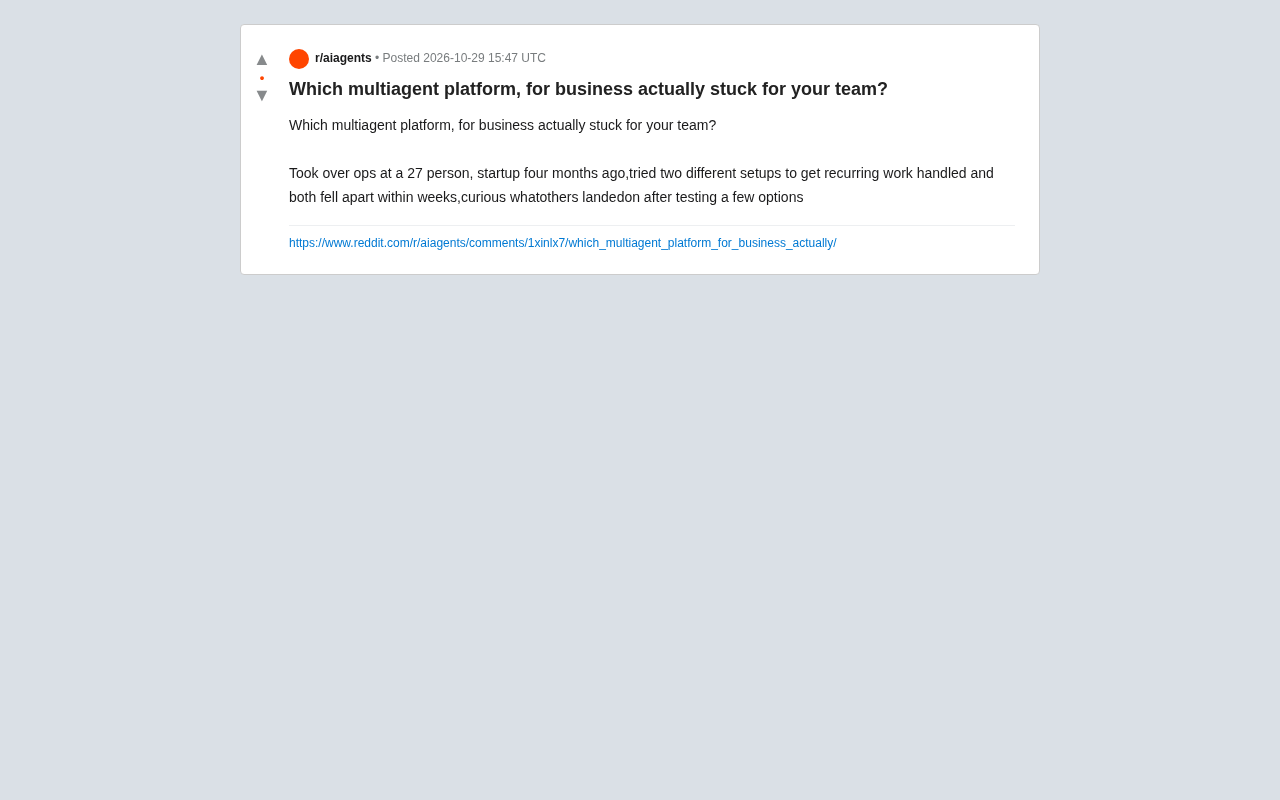
Which Multi-Agent Platform Wins? A Small Team's Battle Scars and Selection Considerations
A 27-person startup's ops lead tried two multi-agent platforms in four months and both failed. This article analyzes why small-team deployments break down, and offers selection guidance on integration depth, observability, and progressive rollout.

Thrive Holdings Takes ADT Private in $7.6 Billion Deal
Thrive Holdings acquires ADT for $7.6 billion in an all-cash take-private deal expected to close in Q1 2027. Analysis of the deal structure, ADT's asset value, and impact on the smart home security industry.