Agentic Loop: The Mechanism That Lets AI Write Code and Fix Bugs Autonomously

Agentic Loop lets AI agents execute in a closed loop, read errors, and self-correct—humans step back to rule-setting and review.
The article introduces the Agentic Loop concept from YouTube channel ViCode, framing it as the core mechanism in AI coding's evolution from one-shot code generation to autonomous execution and correction. It transfers the execute—read output—detect errors—fix—re-execute feedback loop from developer to AI agent. Implementation requires a real execution environment and follows three steps: clear system prompt rules, unit tests before code delivery, and immediate adoption.
AI coding tools are evolving from "generate a snippet of code once" to "run it yourself, watch it yourself, fix it yourself." The YouTube channel ViCode introduced a concept in a short video—the Agentic Loop—framing it as a key mechanism for boosting developer productivity. Although brief, the content touches on the most fundamental paradigm shift in today's AI coding tools.
What Exactly Is the Agentic Loop
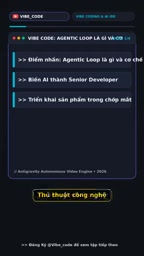
ViCode's core argument in the video is: stop working in the fragmented way of "have AI write a snippet, copy-paste it, and paste the error back when it fails." The essence of the Agentic Loop is to give the AI tool closed-loop permission—execute code, read terminal output, detect errors, automatically fix them, then execute again, looping until it passes.
The difference from traditional conversational programming lies in "ownership of the feedback loop." Previously, the feedback loop was in human hands: the human runs the code, the human reads the errors, the human pastes the errors back into the chat. The Agentic Loop hands this loop over to the AI agent itself, and the human steps back into the role of rule-setter and result reviewer.
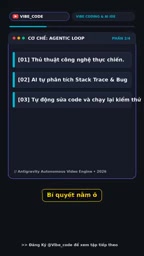
From an engineering perspective, the prerequisite for this mechanism to work is that the AI can access a real execution environment—terminal, file system, test runner. If you only show the model code text, it cannot know whether what it wrote will actually run; only by letting it see execution results does self-correction become possible.
Feedback Loop is a foundational concept in cybernetics, referring to a system feeding its output back as input to adjust subsequent behavior, thereby continuously approaching a target state. In software engineering, compiler errors, test failures, and runtime exceptions are all typical feedback signals. In traditional development, most of this loop is manually connected by humans; the key to the Agentic Loop is using automation to string together the "run—observe—modify" chain, allowing the agent program to iterate repeatedly without human intervention. Understanding this helps distinguish "AI-assisted programming" from "AI agent programming": in the former, humans still bear the main feedback responsibility within the loop; in the latter, humans only set goals and acceptance criteria outside the loop.
Three Steps to Implementation: From Rules to Verification
ViCode's practical path has only three steps, but each points to an easily overlooked key point.
Step 1: Write Clear Rules in the System Prompt
The video emphasizes "thiết lập quy tắc rõ ràng"—establishing clear rules—in the system prompt (written as System.prom in the original). The significance of this step is often underestimated. The Agentic Loop gives AI the authority to execute and modify autonomously; if the rules are vague, it may loop repeatedly in the wrong direction, wasting tokens and time. The rules should cover at least: which directories it is allowed to operate in, what types of errors should cause it to stop and ask a human, and where the boundaries for code modification lie.
System Prompt is a category of instructions in conversational AI that takes priority over user input, used to set the model's role, behavioral boundaries, and output specifications. Unlike ordinary prompts, the system prompt is typically injected at the start of a session and remains in effect throughout the interaction, making it suitable for carrying global constraints such as "which directories may be accessed," "which errors must trigger a stop and a question," and "which files must not be modified." In the Agentic Loop scenario, the system prompt is effectively the developer's "operating manual" for the AI agent, and its clarity directly determines the controllability of the agent's autonomous loop. If the tool supports it, finer-grained permissions can also be managed via sandboxes or configuration files rather than relying entirely on natural language descriptions.
Step 2: Require the AI to Write Unit Tests Before Delivering Code
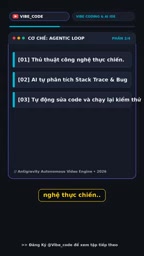
The original phrasing is "luôn yêu cầu AI viết kèm Unitec trước khi bạn giao code"—always require the AI to write unit tests (original "Unitec" is a phonetic abbreviation for Unit Test) before handing you the code. This is the source of acceptance criteria for the entire loop. Without tests, the AI's "self-repair" has no clear termination condition—it can only judge by feel that "it looks right"; with tests, the loop has an executable pass/fail signal, and the agent knows when to stop.
This also explains why the Agentic Loop naturally fits test-driven development: tests are objective standards written before implementation, and the AI continuously approaches this standard within the loop.
Unit Test is an automated test written for the smallest testable unit in code (usually a function or method), using assertions to check whether input and expected output match to determine whether that unit works correctly. Its key value lies in transforming the vague judgment of "is the code correct" into a machine-executable pass/fail signal—precisely the basis on which the Agentic Loop can terminate itself. Test-driven development (TDD) further requires writing tests before implementation, making tests a precise expression of requirements. When an AI agent uses test passage as its termination condition within the loop, the quality of test coverage is equivalent to the strictness of the acceptance criteria: insufficiently covered tests will let the agent prematurely "declare success," leaving hidden risks.
Step 3: Apply Immediately
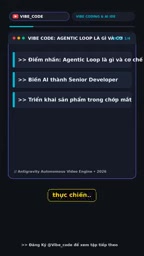
The third step is a call to action—"áp dụng ngay hôm nay," get started today. ViCode packages it as the slogan "become a leading programmer in the AI era." Setting aside the marketing tone, the substantive meaning of this step is: the Agentic Loop is not a future concept—existing AI coding tools already have the capability to configure this loop; the only difference is whether developers actively set it up.
What This Mechanism Changes and What It Leaves Behind
What changes is the granularity and rhythm of work. Developers no longer review AI output snippet by snippet; instead, they define tasks, set rules, and check final results and test coverage. The round-trip time previously spent on "copying errors, describing problems, waiting for rewrites" is compressed into automatic loops inside the agent.
What remains is review responsibility. The Agentic Loop can automatically fix problems with clear signals—syntax errors, type mismatches, test failures—but it cannot judge whether the requirements themselves are correctly understood or whether architectural choices are reasonable. The looser the rules, the more room the AI has for autonomous looping, and the greater the cost of going off track. Therefore, the boundary settings in the system prompt and the coverage quality of unit tests effectively determine whether this mechanism is a productivity tool or a source of rework.
ViCode's content is extremely short and does not elaborate on specific tool configurations or loop termination strategies—it is a directional hint rather than a complete tutorial. But the three steps it identifies—clear rules, tests first, closed-loop execution—constitute the minimum viable framework for the Agentic Loop, and for developers already using AI coding tools with terminal execution capabilities, it is a starting point that can be implemented directly.
One-line Summary
Agentic Loop lets AI agents execute in a closed loop, read errors, and self-correct, while humans step back to rule-setting and result review.
Paragraph Summary
The article introduces the Agentic Loop concept proposed by the YouTube channel ViCode, viewing it as the core mechanism in the evolution of AI coding tools from "generate a snippet of code once" to "autonomous execution and correction." The essence of the Agentic Loop is transferring ownership of the "execute code—read terminal output—detect errors—automatically fix—execute again" feedback loop from the developer to the AI agent, with humans stepping back into the role of rule-setter and result reviewer. The mechanism's prerequisite is that the AI can access a real execution environment, such as a terminal, file system, and test runner. The implementation path has three steps: set clear rules in the system prompt, require the AI to write unit tests before delivering code, and get started immediately. The article also notes that while this mechanism can automatically handle problems with clear signals, requirement understanding and architectural judgment still require human responsibility.
Related articles

DeepSeek Open-Sources DeepInfer: What Is an Inference Framework Actually For?
DeepSeek open-sources its inference framework DeepInfer under Apache 2.0, supporting DeepSeek V4.1 Flash offline inference. This article explains its request scheduling, FlashMLA/DeepGEMM compute optimization, DSPark speculative verification acceleration, and what it means for developers and ordinary users.

Open-Source AI Learning Agent: A Full Workflow Experience from Topology Graphs to Exam Generation
Explore an open-source AI learning agent: built on DeepSeek API, it constructs knowledge systems via topology graphs, with automatic document generation, notes, super documents, and exams. Learn about its Agent workflow and design highlights.

DeepSeek Whale Girl Open-Source MV Meme: AI Industry Coded Slang About Pivoting to Closed Source
Bilibili's DeepSeek Whale Girl rap MV uses fictional memes to tease the AI open-source vs. closed-source debate, with lyrics full of industry slang. This article explains the meme culture, the Whale Girl symbol, and the open/closed tension.