Agentic Paper Bomb: Using Multi-Agent Systems to Automatically Generate Enterprise Compliance Documents

A developer has five AI agents play executive roles to autonomously generate enterprise compliance and security documents, raising questions about information overload and reliability.
The article introduces the "Agentic Paper Bomb" experiment by a Reddit developer: five AI agents each play executive roles, autonomously discussing and producing process documents in areas like enterprise compliance, security, and DevOps. The experiment is based on GCP, uses Firestore to store chat records, and has agents poll once per hour—though polling frequency and storage can be flexibly adjusted. The author borrows the term "paper bomb" to refer both to the phenomenon of automatically generating large numbers of documents and to the implicit concern of information overload. The core fun of the experiment lies in role definition, which directly affects output quality and interaction style. The article notes that the experiment has a low technical barrier, but role design, collaboration mechanisms, output review, and avoiding hallucinations are the real challenges worth exploring.
What Is Agentic Paper Bomb?
Recently, a developer on Reddit shared an interesting experiment: having five AI agents each play executive roles, autonomously discuss and produce processes and documents in areas like enterprise compliance, security, DevOps, IT/HR, and onboarding. The author jokingly calls this approach a "paper bomb"—back in the early days when FOIA (Freedom of Information Act) requests were automated, people used this term to describe the scene of massive numbers of documents being automatically generated and flooding institutions. Now, the same logic has been transplanted into the agent world.
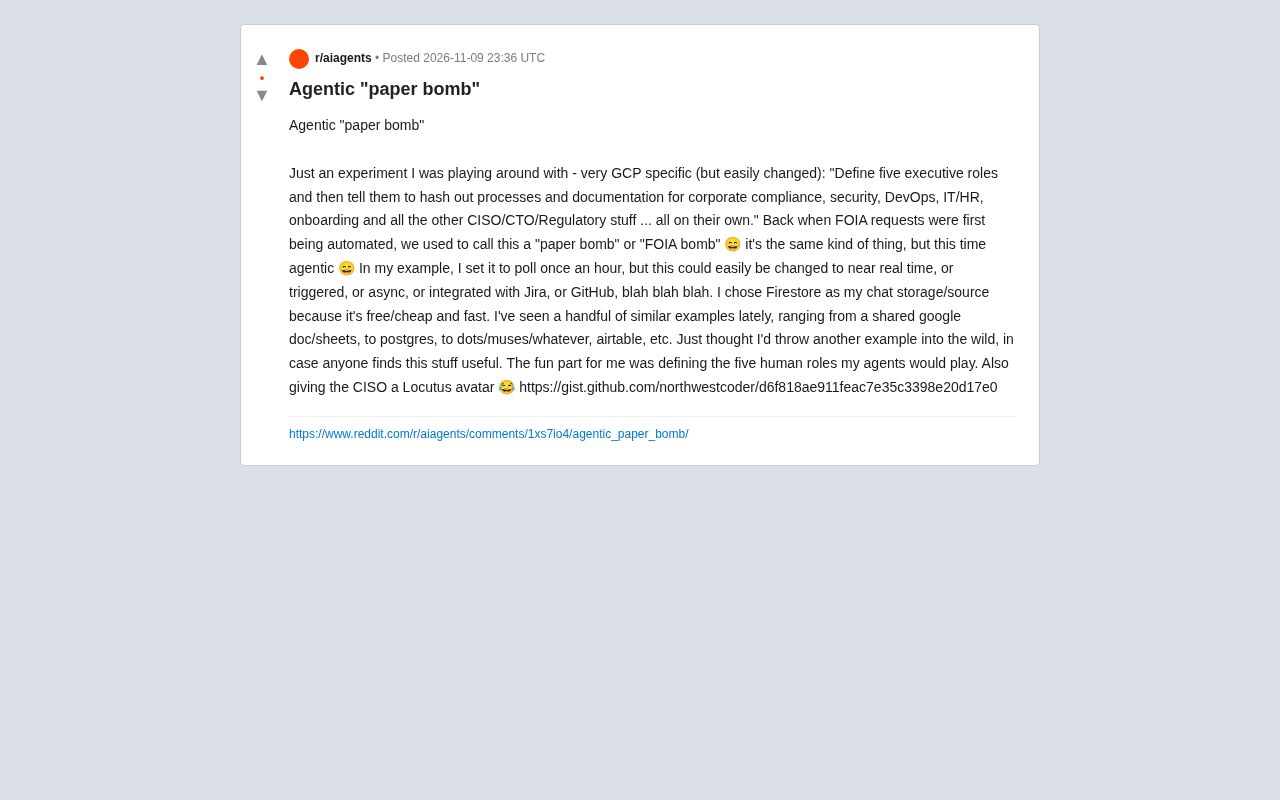
The author wrote in the post: "Define five executive roles, then let them hash out processes and documents themselves... all done by themselves." This experiment relies heavily on GCP, but the author also notes that other tech stacks can be easily swapped in. The core idea isn't complicated: assign roles to agents and let them collaborate around enterprise governance topics.
FOIA (Freedom of Information Act) is a U.S. federal law that took effect in 1967, granting the public the right to request government records from federal agencies. With the development of automation tools, the "FOIA bomb" phenomenon emerged: individuals or organizations use software to generate requests in bulk, leaving agencies overwhelmed by paperwork. The author borrows this historical context to compare agents automatically generating enterprise documents to a "paper bomb," which vividly illustrates the scale of the document flood while also hinting at the potential management challenges involved.
The Experiment's Technical Architecture
Role Definition Is Where the Fun Is
The author mentions that the most interesting part is defining five "human roles" for the agents to play. He even gave the CISO a Locutus avatar (Captain Picard assimilated by the Borg in Star Trek). This suggests that role setting affects not only the content the agents output but also their interaction style and decision-making tendencies.
Polling and Storage Choices
In the example, agents are set to poll once per hour, but the author emphasizes this can easily be changed to near-real-time, event-triggered, asynchronous, or integrated with tools like Jira and GitHub. Firestore was chosen for chat storage, justified by being free/cheap and fast. The author also observes that there have been many similar cases recently, with storage solutions ranging from shared Google Docs/Sheets to Postgres, Airtable, and more.
The Potential and Concerns of Multi-Agent Collaborative Document Generation
The value of this experiment lies in demonstrating a possibility: a large amount of repetitive, framework-oriented document work in enterprises might be handed to a group of agents with well-defined roles to draft and iterate. Five executive roles each handling their own domain—covering compliance, security, DevOps, IT/HR, onboarding, and other functions—could theoretically produce first drafts quickly.
But the "paper bomb" metaphor itself carries self-deprecation. Automatically generating large numbers of documents is like automatically submitting large numbers of FOIA requests—it can cause information overload. Whether the compliance documents produced by agents are reliable, whether human review is needed, and whether the "discussions" between roles might fall into loops or produce hallucinations are all questions that need answering. The author doesn't delve into these, but the openness of the experiment lies precisely here—it throws out a provocation for the community to think about the boundaries.
Takeaways for Developers
From an engineering perspective, this experiment has a low barrier to entry: define role prompts, pick a storage solution, add a polling loop. The real difficulty lies in role design and collaboration mechanisms. How the five executive roles divide work, how they "hold meetings," and how they reach consensus determine output quality. The author places the fun in role definition, showing that this is both a technical and a creative endeavor.
If you want to try it too, you can start with a small scenario—for example, having two agents play product manager and engineer respectively, writing requirements documents and technical proposals around a feature. Lightweight storage like Firestore is enough to get started, and you can later consider integrating into existing workflows. As the author says, he's just throwing another example out into the wild to see if anyone finds it useful.
Summary
Agentic Paper Bomb is a lightweight but thought-provoking experiment. It pushes multi-agent collaboration from "completing tasks" toward "generating organizational processes," touching on the sensitive territory of enterprise document automation. The technical implementation isn't complex, but role design, output review, and avoiding information overload are the directions truly worth exploring.
Related articles

Building a Sound Source Localization System with Claude Code to Find a Mysterious Beeping Sound
Simon Willison built Beep Locator with Claude Code: multiple devices as microphones, trilateration pinpointed a mysterious beep to ~40cm, showing how to give coding agents hearing.

Rob Roy Classic Dialogue Analysis: The Price of Leadership and the Choice to Survive
An analysis of the classic confrontation dialogue between Rob Roy and Sibbald in *Rob Roy*, exploring the price of leadership, the balance between survival and dignity, and the human insight behind power games.

Jensen Huang Reportedly Hires PR Firm Known for Handling Scandals
Wired reports Jensen Huang hired a PR firm with a history of handling high-profile sex scandals after The New York Times reported on his wife's business dealings. This article analyzes the crisis management signals behind the move and its impact on Nvidia's reputation.