AI Agent Approval Workflows: Why Human Confirmations Always Get Mindlessly Clicked
The root cause of approval popup failure is rules and keys resting with the agent; externalize them and trigger infrequently.
Starting from a Reddit discussion, the article explains the common dilemma of adding approval popups to AI agents: taken seriously on day one, useless within a week. The author argues the issue is where rules are stored—when the agent holds both keys and rules, approval is an "honor system." Solutions include separating rules from keys, upfront OPA policy checks, or MCP gateways managing keys. Effective approvals require low frequency and showing actual impact; otherwise they devolve into mindless clicking.
The Approval Popup Dilemma: Fresh on Day One, Useless Within a Week
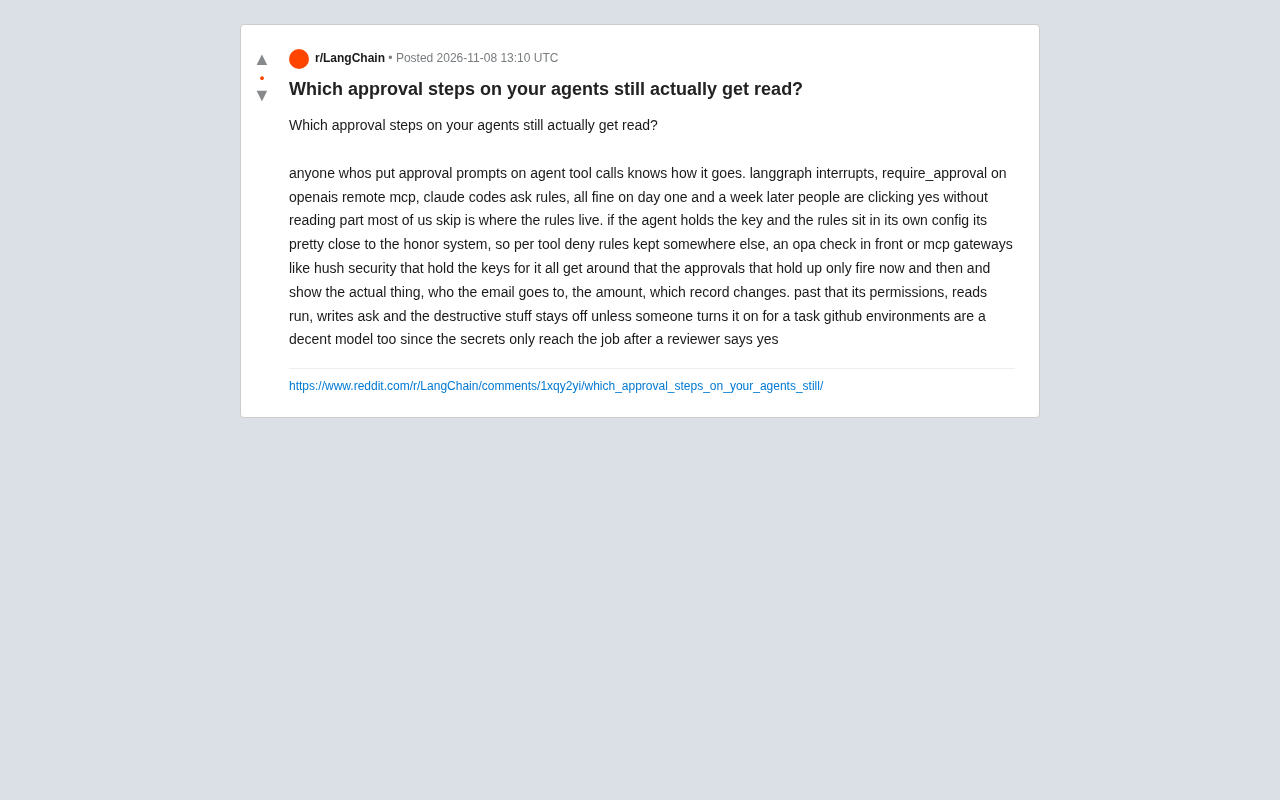
When it comes to adding approval prompts to AI agent tool calls, almost every developer has been through the same arc: LangGraph interrupts, OpenAI remote MCP's require_approval, Claude Code's ask rules—on day one everyone reads them carefully, but a week later, most people click "yes" without even looking at the content. This is the core question raised in a recent Reddit discussion thread: which approval steps still actually get read?
The post points out that the problem isn't the approval mechanism itself, but where the rules are stored. If the agent holds the keys itself and the rules are written in its own config, then this approval setup is essentially a "honor system"—the agent is fully capable of bypassing or ignoring the rules.
Separating Rules from Keys: Making Approval No Longer "Self-Supervision"
The post author argues that to break this "honor system," the key is to strip the rules and keys out of the agent's configuration. He mentions several viable approaches:
- Setting deny rules per tool, but placing them somewhere the agent cannot modify;
- Adding an OPA (Open Policy Agent) check in front of the agent;
- Using an MCP gateway (such as solutions like Hush Security) to centrally hold the keys.
What these approaches have in common: the agent no longer simultaneously possesses both "the keys" and "the rules." It must go through an external system to perform sensitive operations, and that external system can independently enforce policy, unaffected by the agent's own configuration.
OPA (Open Policy Agent) is an open-source general-purpose policy engine, incubated and now graduated by the CNCF. It uses the declarative Rego language to write policies and exposes a decision interface through an independent service (or library): the caller sends the request context (who, wants to do what, on which resource) to OPA, and OPA returns allow or deny. Its key value lies in separating policy from enforcement—policies are centrally stored, independently version-controlled, and the applications being governed cannot tamper with them. Applied to the AI agent scenario, the agent must consult OPA before every sensitive tool call, while the policy files are maintained by operations or security teams—the agent can neither see nor modify them, thereby turning "self-supervision" into "external arbitration."
An MCP gateway is a middleware layer built for the Model Context Protocol. MCP is an open protocol that lets AI agents connect to external tools and data sources, but if the agent directly holds the downstream credentials for each tool, then once it falls victim to prompt injection or its configuration is altered, the credentials will leak. An MCP gateway centrally manages the credentials; the agent only communicates with the gateway, which authenticates to upstream services on its behalf and can enforce policy validation, auditing, and rate limiting when forwarding. This way, sensitive credentials never enter the agent's runtime environment, and even if the agent is compromised, it cannot directly call downstream systems.
What Kind of Approval Actually Works?
The post further points out that approvals that truly remain effective have two characteristics: low trigger frequency and showing actual content.
"Showing actual content" means the approval UI must clearly tell the approver: who this email is being sent to, what the amount is, which record will be modified. If the approval only shows "allow this tool call?", it will quickly degenerate into a mindlessly clicked button.
This view has gained considerable agreement in the community. High-frequency approvals almost inevitably lead to "approval fatigue," while approvals lacking context leave people unable to judge risk. Combined, approval becomes a mere formality.
Permission Tiers: Open Reads, Ask for Writes, Destructive Operations Off by Default
Beyond approval design, the post also proposes a more fundamental permission model: read operations pass through directly, write operations require asking, destructive operations are off by default, unless someone manually enables them for a specific task.
The logic of this model: approvals should be used where human judgment is genuinely needed, not applied uniformly to all operations. Read operations are low-risk and don't need interruption; write operations may produce side effects and need confirmation; destructive operations (such as deletion, overwriting) should be prohibited by default and require explicit authorization.
GitHub Environments: An Approval Model Worth Borrowing
The post finally mentions the design of GitHub Environments: secrets only reach the job after a reviewer approves.
The merit of this model is that approval isn't a "confirmation popup" but a gate—without approval, the secrets simply won't appear in the execution environment. The approver is responsible for the outcome, not for a button. Compared to a simple popup confirmation, this mechanism is closer to genuine security control.
GitHub Environments is an abstraction of deployment targets in GitHub Actions, allowing you to configure protection rules separately for different environments (such as staging, production). The most relevant mechanism is required reviewers: the workflow pauses before entering the environment and waits for designated reviewers to approve; before approval, environment-specific secrets will not be injected into the job. The essential difference from an ordinary "confirmation popup" is that approval blocks at the credential issuance step, not after the action executes—without approval, you simply cannot obtain the keys needed for execution. It also supports rules like wait timers and restricting deployable branches, which corroborate the "low-frequency, high-impact, outcome-responsible" approval principles advocated in this article.
Summary
Approval workflows can't be designed by just "adding a confirmation box." When both the rules and the keys are in the agent's hands, approval is just for show; when approval frequency is too high and information is insufficient, approval degenerates into mindless clicking. The truly effective approach is: separate rules from keys, trigger approvals only on low-frequency, high-risk operations, show the specific impact in the approval, and use permission tiers to reduce unnecessary approval needs at the source.
One-line Summary
The root cause of approval popups failing is that rules and keys sit in the same agent's hands; they must be externalized and triggered infrequently.
Paragraph Summary
Starting from a Reddit discussion, the article points out the common dilemma of adding approval popups to AI agents: taken seriously on day one, useless within a week. The author argues the problem isn't the approval mechanism itself but where the rules are stored—when the agent holds both the keys and the rules, approval is merely an "honor system." The solution is to separate rules from keys, for example by placing per-tool deny rules somewhere the agent cannot modify, adding an upfront OPA policy check, or using an MCP gateway to centrally manage keys. Effective approvals must also meet two characteristics: low trigger frequency and showing actual content (recipients, amounts, modified records), otherwise they degenerate into mindless clicking due to approval fatigue and lack of context. The article further proposes a permission tier model: open reads, ask for writes, destructive operations off by default; and uses GitHub Environments as an example to show that "gate-style" approval—where secrets only reach the job after approval—is superior to popup confirmation.
Related articles
 Tech Frontiers
Pushing the Limits of Extreme Sudoku on a 16GB GPU: Insights from Depth and Flow Matching
A researcher trained a 16.54M-parameter model on a 16GB GPU to solve extreme Sudoku, finding effective depth breaks the 60% plateau and flow matching with improved sampling pushes accuracy past 99% with ~50× lower layer-evaluation budget.
 Tech Frontiers
MuJoCo: An Analysis of DeepMind's Open-Source General-Purpose Physics Simulator
An in-depth analysis of Google DeepMind's open-source physics simulator MuJoCo: high-performance C++ kernel, MJCF modeling format, contact solving principles, MJX GPU acceleration, and robot reinforcement learning use cases.
 Tech Frontiers
Claude API Quick Start: The Official Quickstarts Project Collection
Anthropic's official claude-quickstarts project collection helps developers quickly build deployable apps with the Claude API. Nearly 20k stars, Python-based, great for beginners and prototyping.