AI Agent Authentication: The Missing Piece of the Security Architecture Puzzle
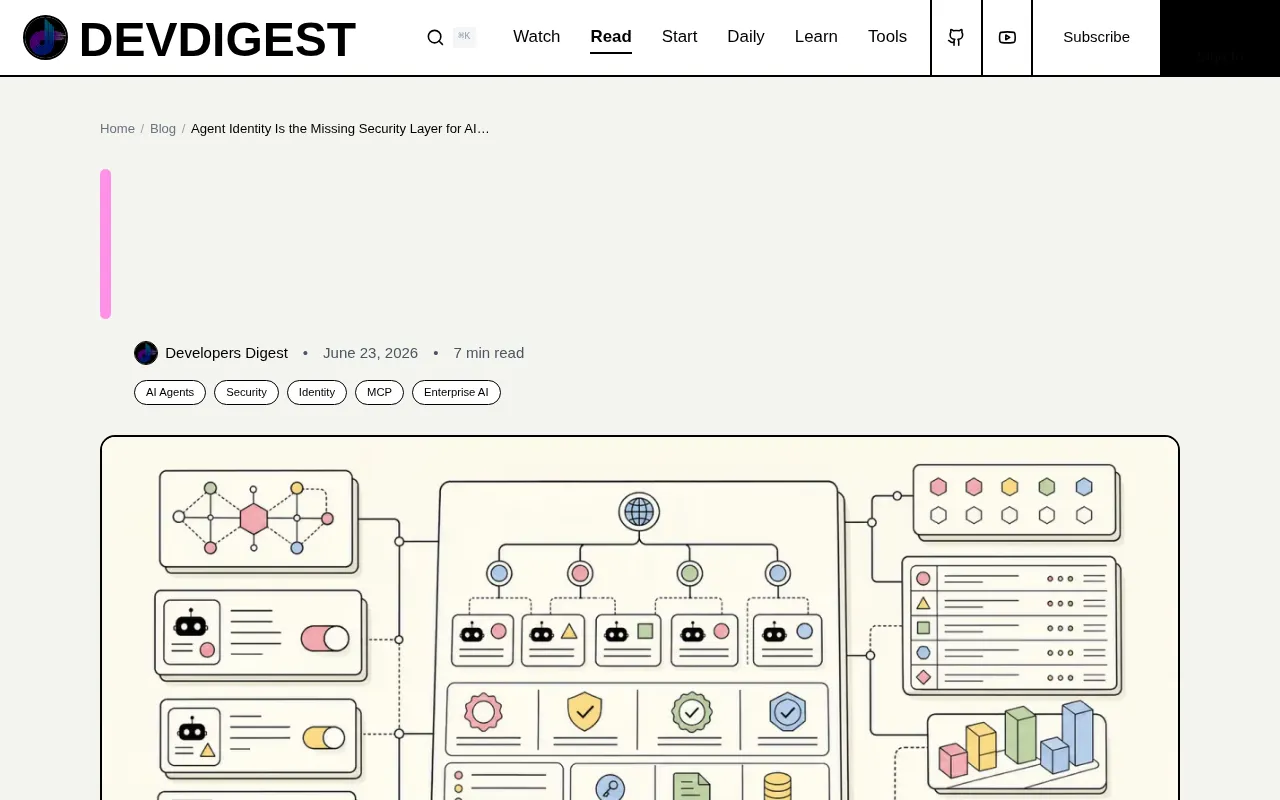
Why identity verification is the critical missing layer for secure AI Agent infrastructure.
As AI Agents move into production, the lack of identity verification creates serious security risks. The Linux Foundation's Agent Name Service proposal addresses four core needs: verifiable identity, scoped capabilities, revocation mechanisms, and audit trails. This article explores why Agent identity is becoming the next critical infrastructure layer alongside model capabilities and tool-calling protocols.
When AI Agents Start Collaborating Across Systems
As AI Agents move from the lab into production environments, a long-overlooked security issue is surfacing — how exactly do these autonomous AI agents prove "who they are"?
The Linux Foundation's recently proposed Agent Name Service directly addresses a critical gap in AI Agent infrastructure: before Agents can securely execute tasks across tools and systems, they need a comprehensive identity verification mechanism. This isn't just a technical detail — it's the core security layer that determines whether AI workflows can scale in enterprise scenarios.
An Agent Without Identity Is a Dangerous Agent
From Human Identity Management to Agent Identity Management
In traditional software systems, we've built mature Identity and Access Management (IAM) frameworks. Every user has a unique identifier, clearly defined permissions, login logs available for auditing, and accounts that can be immediately revoked if compromised. This system has been running for decades and forms the bedrock of enterprise security.
The evolution of IAM spans several decades, progressing from early LDAP directory services to modern federated identity protocols like SAML, OAuth 2.0, and OpenID Connect, continuously adapting to increasingly complex IT environments. A complete IAM system typically includes four core functions: Authentication (confirming who you are), Authorization (confirming what you can do), Account Management (managing the identity lifecycle), and Auditing (recording all operations). In the cloud-native era, IAM further evolved concepts like Service Accounts and Workload Identity to manage the identities of non-human entities. However, these mechanisms fundamentally still assume that the managed entities behave deterministically and predictably — an assumption that the autonomous decision-making nature of AI Agents completely shatters.
Yet when AI Agents enter this ecosystem, things get complicated. A single Agent may need to simultaneously access databases, call APIs, manipulate file systems, and communicate with other Agents. It's not a human user — it can't log in with a traditional username and password. It's also not a simple API call, because it has autonomous decision-making capabilities and its behavior paths can't be fully predicted.
The current reality is: most AI Agents moving between systems either share developer credentials, use hardcoded API keys, or have no identity verification mechanism at all. This is like letting someone without an ID card freely move between banks, hospitals, and government agencies, signing documents on your behalf — the risk is obvious.
Four Security Requirements — None Can Be Omitted
The Linux Foundation's Agent Name Service proposal clearly identifies four core capabilities required for AI Agents to operate securely:
-
Verifiable Identity: Every Agent must possess a unique identity that can be verified by third parties, ensuring that interacting parties can confirm "you really are the Agent you claim to be."
-
Scoped Capabilities: An Agent's permissions must be precisely defined. A data analysis Agent shouldn't have the authority to delete a database, just as an intern shouldn't have the CEO's signing authority. The concept of "scoping" here reflects the most fundamental Principle of Least Privilege in information security, first systematically proposed by Jerome Saltzer in 1975. In the AI Agent context, the principle of least privilege faces new challenges: an Agent's task boundaries are often dynamic and context-dependent. For example, a data analysis Agent may need to read a financial database when processing financial reports, but needs access to the CRM system when performing market analysis. This requires the permission system to support fine-grained, task-context-based dynamic authorization rather than static role assignments.
-
Revocation: When an Agent is compromised, behaves abnormally, or is no longer needed, it must be possible to immediately revoke its identity and all associated permissions, and this revocation must take effect instantly across the entire ecosystem.
-
Audit Trails: Every operation performed by an Agent should leave a tamper-proof record for post-hoc investigation, compliance review, and security analysis.
Why Now Is the Critical Moment
The Agent Ecosystem Is Exploding
From OpenAI's GPT Actions to Anthropic's MCP protocol, from LangChain to AutoGen, AI Agent frameworks are maturing rapidly. Enterprises are deploying multi-Agent systems to handle complex workflows like customer service, code review, and data pipelines. Gartner predicts that by 2028, more than 15% of daily work decisions will be made autonomously by Agents.
The current AI Agent ecosystem is flourishing with diversity. OpenAI's GPT Actions allow ChatGPT to call external services via APIs, essentially combining the reasoning capabilities of large language models with external tool execution. Anthropic's Model Context Protocol (MCP) attempts to establish an open standard that lets AI models connect to various data sources and tools in a unified way — similar to a USB-C port for the AI world. LangChain, one of the most popular Agent development frameworks, provides modular components for chain-of-thought calls, memory management, and tool integration. Microsoft's AutoGen focuses on multi-Agent collaboration scenarios, allowing multiple Agents with different roles to jointly complete complex tasks through conversational protocols. Each of these frameworks defines its own way for Agents to interact with the outside world, but at the identity verification layer, almost all of them are blank — each framework uses a different authentication mechanism (or none at all). This is precisely the fragmentation problem that Agent Name Service aims to solve.
In this context, the absence of an identity security layer is no longer a "future problem" — it's a present-day vulnerability. Imagine this scenario: a malicious Agent impersonates an enterprise's internal data analysis Agent and gains access to sensitive customer data. Without an identity verification mechanism, the system simply cannot distinguish the real from the fake.
The Challenge of Integrating with Existing Security Systems
Agent identity management can't be built from scratch — it needs to seamlessly integrate with existing security systems like PKI (Public Key Infrastructure), OAuth, and Zero Trust Architecture.
Public Key Infrastructure (PKI) is the cornerstone of secure internet communication, using digital certificates and public-private key pairs to achieve identity verification and data encryption. When you visit an HTTPS website, your browser uses the PKI system to verify the site's true identity. Core PKI components include Certificate Authorities (CA), Registration Authorities (RA), Certificate Revocation Lists (CRL), and the Online Certificate Status Protocol (OCSP). Zero Trust Architecture is a security paradigm that has gained prominence in recent years, with its core principle being "never trust, always verify" — regardless of whether a request comes from inside or outside the network, every access must undergo strict identity verification and authorization. Google's BeyondCorp project was an early practitioner of Zero Trust Architecture. In the Agent context, the Zero Trust principle is especially important: an Agent should not be automatically trusted simply because it runs on the corporate intranet — every cross-system call should independently verify its identity and permissions. OAuth 2.0 provides a standardized way for delegated authorization, allowing users to authorize third-party applications to access their resources without sharing passwords — a mechanism that can be extended for Agent permission delegation scenarios.
The design philosophy of Agent Name Service is similar to the internet's DNS system — providing Agents with a globally queryable naming and identity resolution service, but with added dimensions of permission scoping and lifecycle management. DNS resolves human-readable domain names into machine-readable IP addresses and is a hierarchical, distributed naming system composed of root name servers, top-level domain servers, and authoritative name servers. DNS succeeded because it solved a fundamental problem in the early internet: how to uniquely identify and locate a computer on a global scale. Agent Name Service aims to solve a similar problem for AI Agents — in an ecosystem that could contain millions of Agents, how to uniquely identify each Agent, query its capability scope, and verify the authenticity of its identity. But Agent Name Service is more complex than DNS because it needs to integrate not just name resolution, but also capability declarations (what this Agent can do), trust chain verification (who vouches for this Agent's identity), and dynamic lifecycle management (creation, updates, suspension, and destruction of Agents). This is akin to merging DNS, PKI, and RBAC (Role-Based Access Control) into a unified infrastructure layer.
This means the technical community needs to address several key questions:
- Standardization: How can Agents built with different frameworks use a unified identity protocol?
- Performance: Identity verification cannot become a bottleneck for real-time Agent interactions.
- Balancing Decentralization and Centralization: Who serves as the "authority" for Agent identity?
Industry Impact and Outlook
Implications for Developers
If you're building AI Agent applications, you should be reserving a place for the identity layer in your architecture design right now. Even though Agent Name Service hasn't yet become a formal standard, the following practices are worth adopting immediately:
- Assign a unique identifier to each Agent and avoid sharing credentials
- Implement the principle of least privilege, allocating capabilities at task-level granularity
- Log complete operation records for every Agent
- Design "emergency stop" and credential revocation workflows for Agents
Impact on the Industry Landscape
The Linux Foundation's involvement in defining Agent identity standards sends an important signal: the security infrastructure for AI Agents is moving from "every man for himself" to "industry-wide collaboration." This mirrors the path the Linux Foundation took when driving container standards (OCI) and Kubernetes governance.
This history is worth revisiting in depth. In 2013, Docker burst onto the scene and container technology rapidly gained adoption, but with it came the risk of fragmentation in container formats and runtimes. In 2015, the Linux Foundation joined forces with Docker, CoreOS, Google, Microsoft, and other major vendors to establish the Open Container Initiative (OCI), defining open standards for container image formats and runtimes. This move prevented the container ecosystem from fracturing and laid the groundwork for Kubernetes' subsequent rise. Similarly, Kubernetes itself was donated by Google to the Cloud Native Computing Foundation (CNCF) under the Linux Foundation in 2015, earning industry-wide trust and adoption through a neutral governance structure. The Agent Name Service will likely follow a similar path: first, the Linux Foundation establishes a neutral governance framework, attracts major AI vendors to participate in standard-setting, and then drives industry adoption through open-source implementations. This "standards first, implementation second" approach has been repeatedly proven to be the most effective model for industry collaboration at the infrastructure level.
It's foreseeable that Agent identity will become the third critical infrastructure layer in the AI Agent ecosystem, following model capabilities and tool-calling protocols. Organizations that establish standards in this space first will hold a strategic advantage in the future AI Agent economy.
Conclusion
Identity verification may seem like a "boring" infrastructure topic, but it's precisely the critical threshold that separates AI Agents as toys from AI Agents as productivity tools. Without a reliable identity layer, trust between Agents cannot be established, cross-organization Agent collaboration cannot be realized, and enterprise-grade security compliance is nothing but a castle in the air.
The Linux Foundation's Agent Name Service proposal may be just a starting point, but it points in the right direction: before granting AI Agents more capabilities, first ensure we can control and track how those capabilities are used. This is one of the most pragmatic and urgent topics in AI security today.
Related articles
Codex Security: A Configuration Guide to Automatically Blocking Vulnerabilities at the PR Stage
OpenAI engineers demonstrate Codex Security PR Reviews: automatically scan for vulnerabilities at the GitHub PR stage, have AI generate fix commits and re-verify, with repository-level automatic review and alert threshold configuration.

Daybreak Blue Application and Enablement: Complete Process Guide
Based on the official demo video, this guide details the Daybreak Blue application and enablement process, covering enterprise verification, intended use statements, role permission configuration, user access verification, and API key creation to help cybersecurity teams quickly onboard frontier AI models.

United Airlines Bans AI Agents from Booking Flights, Escalating the Battle Between Airlines and Intelligent Agents
United Airlines bans AI agents from booking flights for travelers, sparking Hacker News debate. This analysis examines channel control, risk logic, the trust gap in the agent economy, and practical impacts on travel AI developers.