AI Agent in Action: Building a Smart Office Assistant with WorkBuddy

AI Agents add "action" and "loop-closing" beyond chat LLMs; WorkBuddy shows this leap with low-barrier office automation.
Starting from chat LLMs' inability to directly operate local files, the article highlights AI Agents' core value: executing tasks and delivering results after authorization. Using Tencent WorkBuddy, it demonstrates batch DOCX-to-PDF conversion and automatic archiving via natural language—no coding, ~3 minutes, 1.55 credits. It compares chat LLMs and Agents on tool use, file operations, and self-adjustment, maps general-purpose vs programming-specific Agents, and notes WorkBuddy fits lightweight office tasks; its free credits suit budget-sensitive users, though complex-task performance may lag—choose by scenario fit.
From "Thinking" to "Doing": Why Do We Need AI Agents?
When we use chat LLMs like Doubao or DeepSeek in our daily work, we often run into an awkward situation: it can understand your needs and even provide detailed solutions, but ultimately you still have to do the execution yourself. For example, if you want to batch-convert all DOCX files in a folder to PDF and archive them, Doubao will tell you to "install dependencies first, then run a Python script"—but for non-programmers, that code itself is a barrier. More importantly, it cannot directly read your local files, call software, or execute commands—it is only an "intelligent advisor," not an "intelligent assistant."
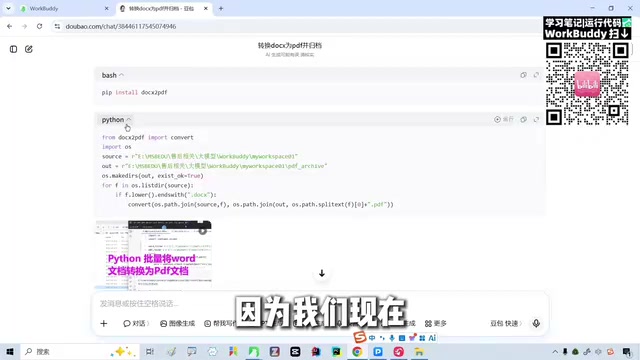
This is exactly the problem that AI Agents are meant to solve. Take Tencent's WorkBuddyAd as an example—it is positioned as an AI Agent tool for office scenarios. It can not only understand natural language instructions but also, after receiving authorization, directly operate local files, execute system commands, and deliver results to you. From "answering questions" to "executing tasks," from "giving suggestions" to "delivering results"—this is a key leap in the form of AI tools.
AI Agent refers to an artificial intelligence system that can perceive its environment, make autonomous decisions, and take actions to achieve specific goals. Unlike traditional chat LLMs that can only generate text, Agents have "tool use" capabilities—influencing the real world by calling external APIs, executing code, or operating software. Their core architecture typically includes four modules: planning, memory, tool invocation, and reflection, enabling them to break down complex tasks into sub-steps and execute them step by step. This concept emerged after 2023 with the improvement of LLM capabilities and is regarded as a key form of LLMs moving from "content generation" to "task execution."
WorkBuddy in Action: Batch File Conversion in Three Minutes
Scenario Setup and Operation Steps
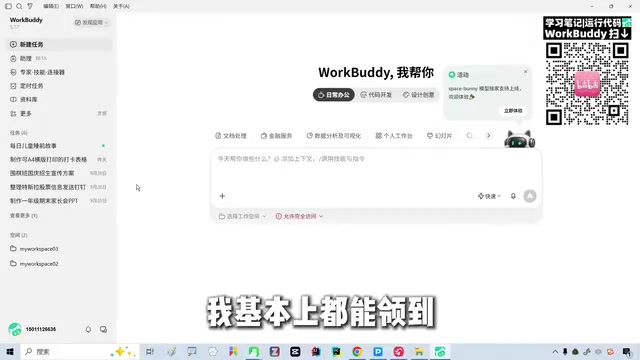
We simulate a real need: convert all DOCX files in a directory on the computer to PDF and automatically archive them into a new folder. After entering this natural language instruction in WorkBuddy's chat interface, it starts working. The interface displays elapsed time and credits consumed in real time—this small task took about 3 minutes and consumed 1.55 credits. After completion, you can preview the conversion results and close the preview once confirmed. The entire process requires no coding and no manual dependency installation.
Authorization Mechanism and Execution Loop
WorkBuddy can operate local files because the user grants "full access" permission. After authorization, it can view specified folders, batch-process documents, execute conversion commands, and archive results to the target location. This "execution loop" is the core feature of Agent tools: if a step in the middle fails, it can try alternative approaches on its own, or adjust through multi-turn dialogue with the user, rather than requiring a human to pass results at every step like a chat LLM.
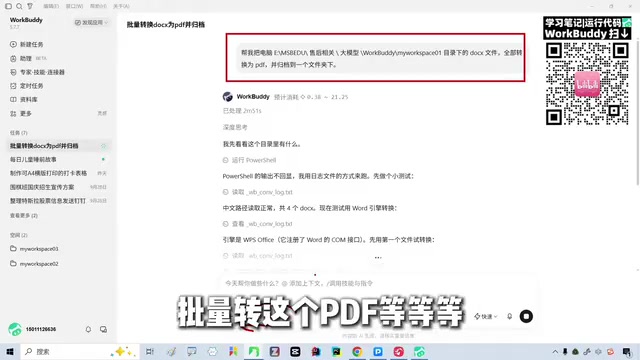
Execution Loop is the core mechanism that distinguishes an Agent from a chatbot. It refers to the cycle of "perception-decision-execution-feedback" that an Agent forms while completing a task: it calls tools to perform operations, observes the execution results (success, failure, or partial completion), and then adjusts the next action based on the results until the goal is achieved or user intervention is needed. This loop enables the Agent to handle uncertainty and exceptions—for example, automatically trying other conversion methods when file formats are incompatible—without requiring step-by-step human guidance.
Credit System and Cost Considerations
WorkBuddy uses a credit system: 2,000 credits are given upon registration, and 100 credits can be actively claimed each day. For daily office tasks, 100 credits are enough to cover most lightweight needs. Compared with tools like Codex that require a paid membership (about 200 RMB per month) and require circumventing internet restrictions, WorkBuddy's free quota is friendlier to budget-sensitive users. Of course, free also means there may be performance gaps—for example, on complex tasks, its processing speed and result quality may not match paid tools, but through repeated dialogue adjustments, it can still achieve usable results.
Credit system is a common usage-based billing model for AI services, where users consume credits in exchange for computing resources such as model inference and tool invocation. Compared with fixed monthly subscriptions, the credit system allows light users to pay based on actual usage, making costs more controllable; however, heavy usage may result in total spending exceeding a subscription. WorkBuddy's credit consumption is related to task complexity and the number of execution steps, and users can estimate consumption based on dialogue turns and task scale.
WorkBuddy vs Chat LLMs: Capability Boundary Comparison
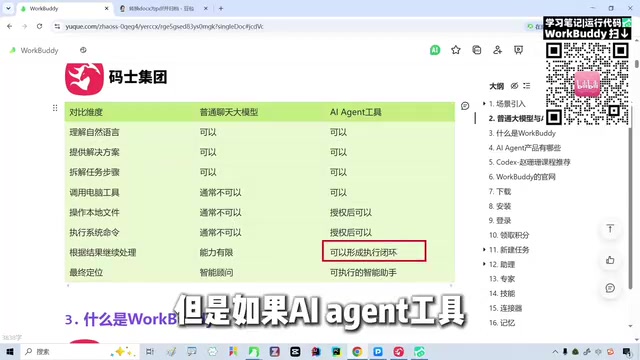
| Capability Dimension | Chat LLM (e.g., Doubao) | AI Agent (e.g., WorkBuddy) |
|---|---|---|
| Understand natural language | ✅ | ✅ |
| Break down tasks and provide solutions | ✅ | ✅ |
| Call local tools / execute commands | ❌ | ✅ (after authorization) |
| Read and operate local files | ❌ | ✅ |
| Self-adjust based on execution results | ❌ (requires human to pass results) | ✅ (forms an execution loop) |
| Positioning | Intelligent advisor | Intelligent assistant |
As the table shows, chat LLMs and Agent tools overlap at the "understanding" level, but Agents add two key capabilities: "taking action" and "closing the loop." This means an Agent can independently complete the entire process from requirement to delivery, while a chat LLM can only stay at the suggestion stage.
AI Agent Product Landscape: WorkBuddy's Positioning
Current AI Agents on the market roughly fall into two categories: general-purpose and programming-specific. General-purpose ones include WorkBuddy, OpenClawAd, etc., targeting broad scenarios such as office work and daily tasks; programming-specific ones include Codex, Claude Code, etc., focusing on code generation and software engineering. Although WorkBuddy can also write code (there is a "code development" option in the interface), its product focus is office automation, and code is just one of its uses. For non-programmers who want to use AI to improve office efficiency, WorkBuddy has a lower barrier to entry and is more friendly.
One detail: the capabilities of these products are converging. Whether domestic or foreign tools, the basic understanding, reasoning, and action capabilities will eventually level out, with differences increasingly reflected in product focus, ecosystem integration, and pricing strategy. When choosing, users should not overthink "who is stronger" but should focus on "who is more suitable for my scenario."
General-purpose Agents and programming-specific Agents differ mainly in product focus and target users. General-purpose Agents target a wide range of office and daily tasks, emphasizing low barriers to entry and natural language interaction, suitable for non-technical users; programming-specific Agents deeply integrate with development environments, optimizing code generation, debugging, and software engineering workflows, targeting developers. The two may overlap in underlying capabilities (general-purpose ones can also write code), but product design, ecosystem integration, and pricing strategy differ significantly.
Usage Recommendations and Limitations
WorkBuddy is suitable for lightweight office automation tasks such as file format conversion, batch renaming, and simple data processing. For complex tasks, it may take a long time (a case shows that processing an Excel design task took 23 minutes, while Codex took only 2-3 minutes), and the results may not be right the first time. Users are advised to be patient and make gradual corrections through multi-turn dialogue. In addition, credit consumption is related to task complexity; although the free quota is sufficient, heavy usage still requires planning.
Overall, WorkBuddy lowers the barrier to using AI Agents, allowing non-technical users to experience the smooth feeling of "AI doing work for me." If you are looking for an office assistant that requires no deployment and no circumventing internet restrictions, it is worth a try.
One-line Summary
AI Agents add "taking action" and "closing the loop" capabilities beyond chat LLMs, and WorkBuddy demonstrates this leap with low-barrier office automation.
Paragraph Summary
Starting from the limitation that chat LLMs can only provide solutions and cannot directly operate local files, the article introduces the core value of AI Agents: directly executing tasks and delivering results after authorization. Using Tencent WorkBuddy as an example, it demonstrates the entire process of batch-converting DOCX to PDF and automatically archiving them via natural language instructions, with no coding required, taking about 3 minutes and consuming 1.55 credits. The article compares the capability differences between chat LLMs and Agents in tool invocation, file operations, and self-adjustment, and outlines the product landscape of general-purpose and programming-specific Agents. Finally, it points out that WorkBuddy is suitable for lightweight office tasks, and its free credit system is friendly to budget-sensitive users, but performance on complex tasks may be insufficient; selection should focus on scenario fit.
Related articles

Hermes Agent Beginner's Guide: Hands-On with a Self-Evolving AI Agent
A beginner's guide to Hermes Agent, the open-source self-evolving AI agent that gained 41.7K GitHub stars in two months—covering Harness Engineering, the learning loop, three-layer memory, WSL installation, and hands-on configuration.

From Single-GPU Bottlenecks to Hundreds of Billions of Parameters: 6 Key Questions in Large Model Distributed Parallelism
Based on a Bilibili tutorial, this article organizes core knowledge of large model distributed parallelism: starting from decoder-only architecture's token-by-token generation and the essence of X times W computation, it analyzes six key questions including data parallelism, tensor parallelism, and pipeline parallelism under single-GPU bottlenecks. Suitable for learners in private deployment and model training scenarios to build systematic understanding.

FDE in Action: Three Core Responsibilities and Career Guide for AI's New Species
Based on a Bilibili live demo, this article analyzes the three core responsibilities, team role division, and career learning path of FDE (Forward Deployed Engineer), helping developers understand this new role between algorithms and business.