AI Agent Testing in Practice: From Writing Scripts to Commanding Intelligent Agents

AI Agents give testers brain plus limbs — shifting the role from script-writer to agent commander.
Based on a hands-on training bootcamp for testing professionals, this article breaks down the core difference between LLMs and AI Agents: LLMs can only think and respond, while agents add task planning, persistent memory, and tool-calling to actually get things done. Against this backdrop, the testing profession is being restructured — AI Testing is emerging as a new career direction built around directing agents to handle testing work. The course categorizes agent products into project-level (e.g., Claude Code) and system-level (e.g., Dify), and outlines a three-day progressive learning path from environment setup to fully automated, visualized test case generation.
AI Agents are transforming the way software testing professionals work. Where testers once wrote scripts line by line to execute test cases, they can now direct intelligent agents to automatically generate and run testing tasks. This article is based on a hands-on training course designed for testing practitioners, covering the core concepts of AI Agent testing, the fundamental differences between large language models and agents, and the capability shift currently reshaping the testing profession.
LLMs vs. Agents: The Brain vs. the Limbs
Many people conflate large language models with agents, but their roles are fundamentally different. The LLMs we use every day — DeepSeekAd, Qwen, and others — are essentially question-and-answer interfaces: you open a chat window, ask something, and get a response. Their capability boundaries are clear: they can reason and provide answers, but they can't actually complete a task on your behalf.
The course offered a fitting analogy: think of a large language model as the human brain. It can reason that one plus one equals two, and it can help you draft the content of a test case. But if you ask it to export those test cases directly into an Excel file or generate a Word document, it simply can't do it. The brain thinks — it doesn't act.
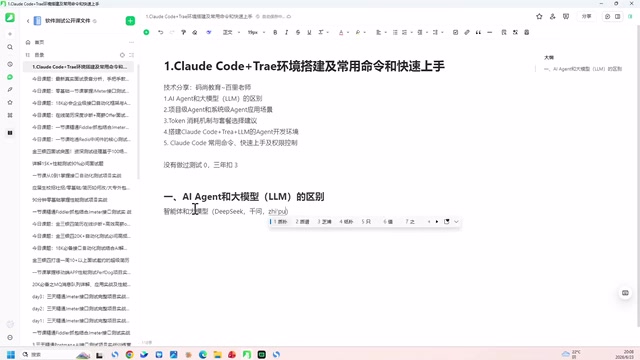
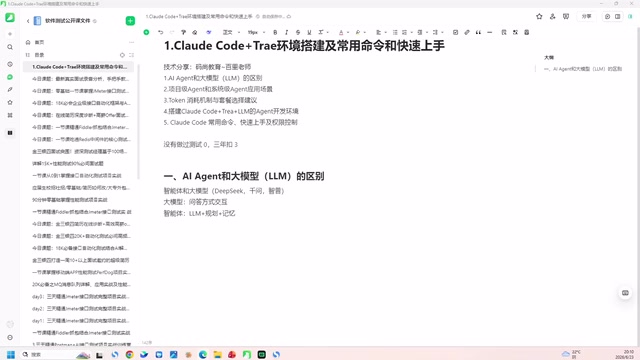
An Agent, by contrast, is brain plus limbs. It contains the LLM at its core, but also adds several key capabilities that allow it to actually carry tasks through to completion.
The Three Core Capabilities of an Agent
Compared to a standalone LLM, an agent gains three additional layers of capability — and these are precisely what enable it to handle complex testing tasks.
Task Planning
When you hand an agent a goal, it can autonomously break that goal down into steps and plan how to execute them. This is something a plain LLM cannot do — an LLM only responds to a single prompt at a time. An agent, on the other hand, decomposes a large task into a series of executable sub-steps and works through them in sequence.
Memory
Agents retain a record of what has been done before, using that history to inform subsequent actions. This addresses a common problem in LLM conversations — the loss of context. Key information mentioned earlier won't be forgotten later in the interaction. Persistent memory keeps the agent consistent across long, multi-step workflows.
Automatic Tool Use
Agents can automatically invoke a range of tools to accomplish their goals — generating files, running scripts, controlling a browser, and more. This is the "limbs" in action: rather than offering textual suggestions, the agent actually gets things done. The course also mentioned the concept of "skills" as a way to further extend an agent's capabilities.
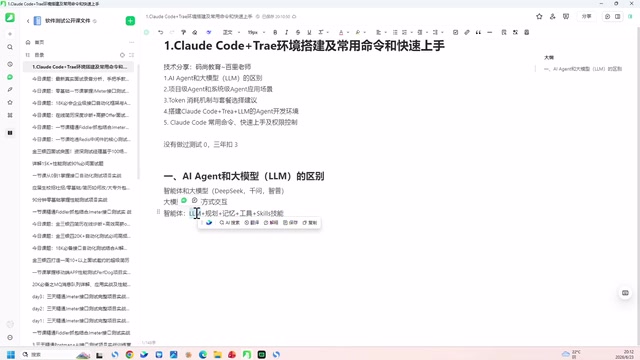
From a technical architecture perspective, agents typically operate on a framework like ReAct (Reasoning + Acting): the agent reasons about the task, selects an appropriate action, observes the result, and then enters the next reasoning cycle. This "think → act → observe" loop is the most fundamental architectural difference between an agent and a standard LLM. Because of it, an agent can continuously advance a multi-step task without human intervention until the goal is achieved or an unhandled exception is encountered.
Tool use (also known as Function Calling) is the technical foundation that enables agents to execute tasks in the real world. LLM providers such as Anthropic and OpenAI expose standardized function-calling interfaces at the model level, allowing developers to predefine a set of available tools (e.g., reading/writing files, running terminal commands, calling HTTP endpoints). During inference, the model decides whether a tool call is needed and returns structured call parameters. Claude Code is built on exactly this mechanism — it can directly manipulate the local file system, run test scripts, and read back execution results, enabling an end-to-end automated testing workflow.
A New Direction for Testers: AI Testing as a Career Path
When only LLMs existed, their contribution to testing work was quite limited — useful for drafting content, but not capable of integrating into real testing workflows. The rise of agents has fundamentally changed this dynamic.
The traditional testing capability model covers functional testing, API testing, automated testing, and performance testing. That model is now being restructured: functional testing is increasingly automated, and a critical new direction has emerged — AI Testing. At its core, AI Testing means using AI Agents to carry out testing work.
For testing professionals, this represents a role shift: from someone who writes scripts by hand to someone who directs agents to do the work. The course claimed efficiency gains of ten times or more — exact numbers will vary by context, but the directional shift is clear.
Types of Agents: Project-Level vs. System-Level
The agent product landscape is growing rapidly. The course broadly divides them into two categories: project-level agents and system-level agents. This distinction helps clarify the right tool for the right job — project-level agents focus on specific development or testing projects, while system-level agents cover broader workflows. The hands-on portion of the course centers primarily on Claude Code paired with related tooling.
Typical project-level agents include Claude Code, Cursor, and GitHub Copilot Workspace. These tools are deeply embedded in code or testing project workflows, handling tasks like code generation, test case writing, and script debugging. System-level agents are closer to "AI workflow orchestration" platforms — examples include Dify, Coze, and AutoGen — capable of chaining multiple tools and sub-agents into cross-system automated pipelines. They're well suited for end-to-end scenarios spanning requirement analysis through test report generation. The boundary between these two categories is blurring, but understanding their respective strengths still matters when choosing the right tool.
A Three-Day Hands-On Learning Path
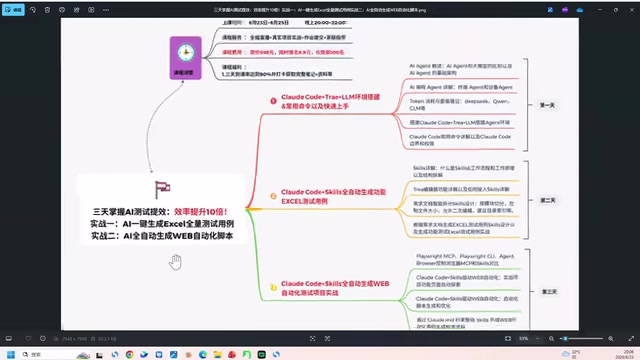
The bootcamp is structured as a progressive, depth-first journey:
- Day 1: Environment setup, common commands, quick-start essentials — building a solid foundation.
- Day 2: Using Claude Code with related tools to fully automate the generation of functional test cases in Excel format.
- Day 3: Fully automated generation of visualized test case projects — two complete end-to-end projects delivered.
Worth noting is the wide range of participant backgrounds the course caters to, from complete beginners to professionals with nearly a decade of testing experience. This reflects a broader reality: in the age of AI Agents, testers at every experience level need to relearn how to collaborate with intelligent agents.
Closing Thoughts
AI Agents are redefining what testing work looks like. Understanding the fundamental distinction between an LLM (the brain) and an agent (brain plus limbs) is the first step into this new domain. For testing professionals, the ability to direct agents to generate test cases, write scripts, and cover scenarios may well become a core competitive advantage. The real value isn't about replacing human effort — it's about handing repetitive labor off to agents, freeing testers to focus on higher-level strategy and judgment.
Related articles

DeepSeek Open-Sources DeepInfer: What Is an Inference Framework Actually For?
DeepSeek open-sources its inference framework DeepInfer under Apache 2.0, supporting DeepSeek V4.1 Flash offline inference. This article explains its request scheduling, FlashMLA/DeepGEMM compute optimization, DSPark speculative verification acceleration, and what it means for developers and ordinary users.

Open-Source AI Learning Agent: A Full Workflow Experience from Topology Graphs to Exam Generation
Explore an open-source AI learning agent: built on DeepSeek API, it constructs knowledge systems via topology graphs, with automatic document generation, notes, super documents, and exams. Learn about its Agent workflow and design highlights.

DeepSeek Whale Girl Open-Source MV Meme: AI Industry Coded Slang About Pivoting to Closed Source
Bilibili's DeepSeek Whale Girl rap MV uses fictional memes to tease the AI open-source vs. closed-source debate, with lyrics full of industry slang. This article explains the meme culture, the Whale Girl symbol, and the open/closed tension.