AI Bubble to Peak in 2028? Semiconductor Selloff and Credit Market Alarms

Semiconductor crash and OpenAI's valuation cut signal a repricing of AI assets spreading from stocks to credit markets.
The article opens with the Nasdaq's 5.52% single-day plunge and the Philadelphia Semiconductor Index's 12.25% drop, arguing this is not an ordinary correction but a repricing of AI assets. Triggers include a senator's call to halt US data center construction and OpenAI cutting its funding target from $30B to $20B and its valuation from $1.4T to $1.25T. The real cracks are in credit markets: CDS for Broadcom, AMD, and Nvidia surged 258%, 177%, and 172% respectively, with Barclays saying chipmakers are being repriced as concentrated lenders; CoreWeave's implied default probability exceeds 60%, and the Big Five's free cash flow flipped from positive $143.5B to negative $14B. Using PS Lombard's scenario, the article maps a 2028 path where capex is cut 45%, AI stocks fall 40%, and $20T evaporates, while noting memory prices have risen sevenfold but the turning point is already on the capacity tables.
A Repricing Behind the Crash
The Nasdaq plunged 5.52% in a single day, the Philadelphia Semiconductor Index tumbled 12.25%, and the combined market value of tech stocks evaporated $2.5 trillion overnight — the worst day since April 2025. Nvidia fell 9.26%, wiping out $446.6 billion in market value; AMD dropped 17.3%, SanDisk fell 22%, and Micron slid 12%. Semiconductors bore the brunt of the selling.
The trigger wasn't earnings. After the midterm elections, a senator publicly called for an immediate nationwide moratorium on data center construction.

On the same day, the not-yet-public OpenAI quietly changed its price tag: its funding target was cut from $30 billion to $20 billion, and its valuation was revised down from $1.4 trillion to $1.25 trillion. Within two days, the two AI giants shed over 4 trillion RMB combined. This is not an ordinary correction — it's a repricing.
The Cracks Are in the Credit Market, Not the Stock Price
In its latest report, Barclays used a striking phrase: 2008 was a repricing. Over the past six months, Broadcom's credit default swaps surged 258%, AMD's rose 177%, and Nvidia's climbed 172%. Barclays' assessment is that chipmakers are being repriced as concentrated lenders.
The weakest link is already flashing red. Neocloud provider CoreWeave's unsecured bond yield has broken through 15%, its 5-year CDS exceeds 1,000 basis points, and its implied default probability tops 60%.
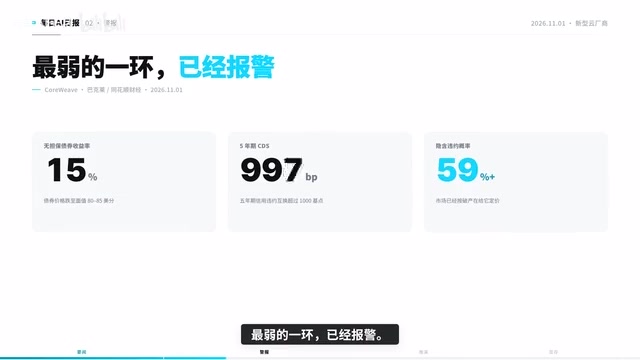
Blackstone also told Anthropic's investors: this $2 trillion unicorn may only get a 2B rating — that is, junk — after going public. Debt is accelerating — AI-related bond issuance reached $655 billion in 2026, compared with just $394 billion for all of 2025, and will approach $1 trillion in 2027.
Credit default swaps (CDS) are financial derivative contracts in which the buyer pays the seller a periodic fee in exchange for the right to compensation if a specific bond or loan defaults. The CDS spread (the annualized rate the buyer pays) is therefore seen as the market's real-time pricing of the issuer's default risk: the wider the spread, the higher the implied default probability. The article's Broadcom CDS surge of 258% and CoreWeave's 5-year CDS breaking 1,000 basis points mean the credit market is flashing warnings about these companies' ability to service debt that go well beyond what their stock prices reflect. CDS market participants are mostly professional institutions such as banks and hedge funds, and their pricing often captures signs of balance-sheet deterioration earlier than the stock market — which is why Barclays uses CDS rather than stock prices to argue for "repricing."
Unsecured bond yield refers to the return investors demand when the issuer provides no specific asset as collateral. The higher the yield, the less confident the market is about getting the principal back. CoreWeave's unsecured bond yield breaking 15% is far above the normal level for investment-grade corporate bonds and is approaching distressed-debt territory — a yield above 10% is typically considered highly stressed.
The Cash Flow Turning Point for the Big Five
In the first three quarters, the Big Five — Microsoft, Google, Amazon, Meta, and Oracle — generated $542.9 billion in operating cash flow against $556.9 billion in capital expenditure, turning free cash flow from positive $143.5 billion to negative $14 billion. The IMF has warned that an AI-related correction is already a major threat to global financial stability.
If 2008 was subprime, then 2028 could be AI subprime.
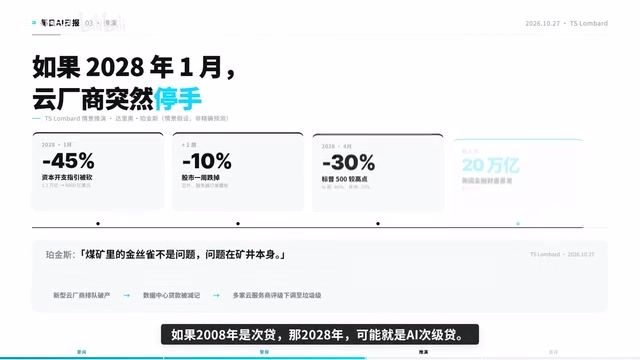
PS Lombard ran a scenario: in January 2028, hyperscalers stop ramping capital expenditure, cutting it 45% from $1.1 trillion to just $600 billion; within a week stocks fall 10%, and by April the S&P 500 is down 30% from its peak, AI-related stocks are down 40%, and $20 trillion in wealth has evaporated.
Compare with history: in the 2000 dot-com bubble, the S&P fell 49% and took 7 years and 2 months to recover; in the 2008 financial crisis, the S&P fell 57% and took five and a half years. As the saying goes, the canary in the coal mine isn't the problem — the problem is the mine itself.
Free cash flow is operating cash flow minus capital expenditure — the cash a company can truly deploy freely after maintaining and expanding its assets. The Big Five's free cash flow turning from positive $143.5 billion to negative $14 billion essentially means capital expenditure ($556.9 billion) exceeded operating cash flow ($542.9 billion). For hyperscalers, this means AI infrastructure buildout has shifted from "funding with profits" to "funding with debt," echoing the widening of CDS in the credit market.
"AI subprime" is an analogy to the 2008 subprime crisis: back then the risk was lending to homebuyers who couldn't service their debt; now it's providing large-scale debt financing to AI infrastructure operators whose profit prospects are unproven (such as neocloud providers like CoreWeave), then packaging or tranching that debt and selling it to institutional investors. If downstream compute demand falls short of expectations, defaults will ripple along the debt chain into the credit market.
Memory and VRAM: The Most Direct Beneficiaries of the Bubble
The most direct beneficiaries of this bubble are memory and VRAM. Over the past year and a half, a 32GB DDR5 memory kit has risen from $59 to $429 — a sevenfold increase. HBM is even more extreme, with contract prices expected to rise another 120% in 2027. It consumes 22% of DRAM wafer capacity yet contributes only 9% of volume.
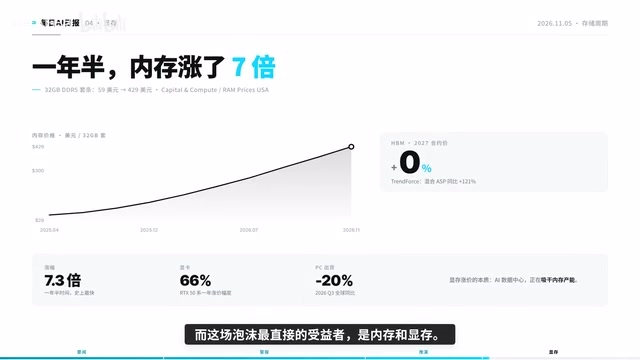
But the turning point is already written on the capacity tables. Counterpoint predicts DRAM and NAND prices will fall 20% to 30% by 2028. Analysts are even more direct: a peak between the second half of 2027 and the first half of 2028, with declines possibly reaching 50% to 70%. SK Hynix's CEO says 2027 will be the year of the worst shortage, while Samsung expects the supercycle to lose momentum in 2028.
So if you're planning to build a PC soon, don't rush to stock up on memory sticks. The bubble will burst, but compute isn't going away.
HBM (High Bandwidth Memory) is memory that vertically stacks multiple DRAM layers using through-silicon via (TSV) technology and packages them together with the GPU. Its bandwidth is far higher than traditional GDDR, making it a key component for training and inference of large models. Its manufacturing yields are low and it consumes a large share of wafer capacity — hence the article's point that it takes 22% of DRAM wafer capacity while contributing only 9% of volume. This is precisely the mechanism by which HBM price increases squeeze ordinary DDR5 supply and push up consumer memory prices.
The DRAM/NAND supercycle refers to a multi-year period of rising memory chip prices caused by supply-demand mismatch. The memory industry is strongly cyclical: price increases stimulate capacity expansion, expansion lags by two to three years and creates oversupply, and prices then collapse. Samsung's expectation that the supercycle loses momentum in 2028 and Counterpoint's forecast of a 20% to 30% price decline are based precisely on the capacity currently under construction being released in concentrated fashion in 2027–2028.
Related articles
 Tech Frontiers
MuJoCo: An Analysis of DeepMind's Open-Source General-Purpose Physics Simulator
An in-depth analysis of Google DeepMind's open-source physics simulator MuJoCo: high-performance C++ kernel, MJCF modeling format, contact solving principles, MJX GPU acceleration, and robot reinforcement learning use cases.
 Tech Frontiers
Claude API Quick Start: The Official Quickstarts Project Collection
Anthropic's official claude-quickstarts project collection helps developers quickly build deployable apps with the Claude API. Nearly 20k stars, Python-based, great for beginners and prototyping.
 Tech Frontiers
AI Agents Connecting Directly to APIs: Which Calls Can Be Safely Allowed?
AI agents can call any API, but the real challenge is deciding which calls can be safely allowed. This article analyzes allowance decisions from three dimensions—intent matching, least privilege, and controllable impact—and argues that the control layer should sit outside the agent, combined with audit traceability to build a trustworthy API call governance mechanism.