AI Chip Stocks Tumble and Gemini Omni 1.2 Flash: Daily Tech Briefing
AI chip stocks plunge in a single day as Google's video model and coding agent acquisitions advance together, with inference cost pressure emerging.
On November 5, U.S. AI chip stocks pulled back sharply, with Nvidia down 9.26%, AMD/Micron/Broadcom falling 9%-18%, and capital reducing compute chain exposure. AMD's earnings showed data center revenue up 97% year-over-year, with Instinct becoming the only second supply source of scale. Google released Gemini Omni 1.2 Flash with 3-15 second durations and local regeneration; OpenAI launched GPT-6 Cyber for cybersecurity. OpenAI acquired Pierre Computer and Meta acquired Conductor, shifting coding agent competition toward code hosting and multi-agent orchestration. Apple cut some engineering teams' daily AI quota from $300 to $200, highlighting inference cost pressure. Ollama, Playwright, and MCP Servers saw dense updates, and agent skill projects heated up on GitHub trends.
Market Turmoil: AI Chip Stocks See Sharp Single-Day Pullback
On November 5, the U.S. AI sector experienced a concentrated repricing. Nvidia closed at $181.60, down 9.26% for the day, making it the biggest drag on the S&P 500; AMD, Micron, and Broadcom fell between 9% and 18% on the same day, while QQQ dropped 6.5%. Chip stocks fell significantly more than the broader market, indicating that capital is reducing exposure to the compute chain.
The impact of this volatility doesn't stop at share prices. Short-term capital market fluctuations won't directly change local rendering and training budgets, but they will affect cloud GPU pricing and hardware procurement pace. For teams relying on cloud compute, cost expectations need to be recalibrated.
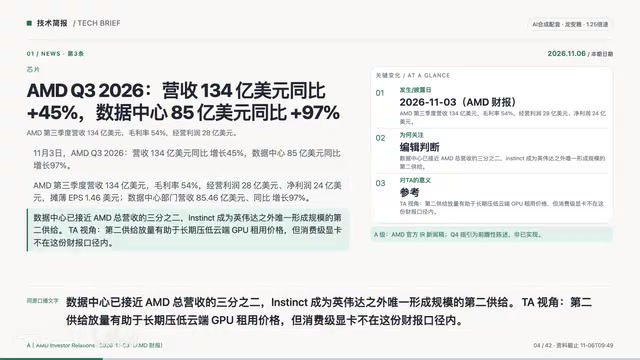
On the same day, AMD reported Q3 earnings: revenue of $13.4 billion, up 45% year-over-year; data center segment revenue of $8.546 billion, up 97% year-over-year, approaching two-thirds of total revenue. Instinct has become the only second supply source of scale besides Nvidia. Ramping up second supply helps lower cloud GPU rental prices over the long term, but consumer-grade GPUs fall outside this earnings report's scope.
Models and Products: Google Releases Gemini Omni 1.2 Flash
Google launched Gemini Omni 1.2 Flash, which supports generating video at specified durations of 3 to 15 seconds, allows modifications without regenerating the entire clip, and improves continuous camera movement and natural dialogue generation quality. Google says this version is faster and lower cost.
Controllable duration and local editing are key to bringing video generation into production workflows. By bringing these two capabilities down to the Flash tier, Omni further lowers the barrier to video generation tools. Local regeneration can reduce shot rework, but copyright of generated material and cross-shot consistency still require human oversight.
OpenAI, meanwhile, launched GPT-6 Cyber, a model dedicated to cybersecurity, with an internal risk rating of Critical, surpassing GPT-6 Astra on cybersecurity benchmarks. OpenAI says that while the new model enhances defensive capabilities, frontier models are beginning to be split into high-capability but constrained specialized versions by vertical scenario. This has no direct relation to content production, but it shows that vendors will use specialized models plus permission boundaries to control high-risk capabilities.
M&A and Agents: From Code Completion to Orchestration
OpenAI announced the acquisition of Pierre Computer Company, which builds Code Storage, a code repository for AI, some of whose tools had already been integrated into Codex. Competition in coding agents is shifting from code completion to code hosting, review, and decision records. If Codex gains repository and review context, batch changes to engine shader engineering will become more traceable in the future.
Meta acquired AI coding startup Conductor, which lets engineers deploy multiple coding agents in parallel on the same project, each advancing tasks separately. Competition among big tech is shifting from single completion models to multi-agent orchestration and review, with organizational workflows themselves becoming acquisition targets. When multiple agents modify the same asset library in parallel, version management and merge strategy matter more than model capability.
Perplexity launched TeamMates, positioned similarly to OpenAI Cloud Duet, where agents can stay online 24/7 executing tasks long-term rather than only answering single-turn questions. Always-on agents shift billing from per-call to per-seat or per-duration, and the product form is beginning to resemble a digital colleague. Such agents are suited for monitoring asset pipelines and batch processing tasks, but require audit logs and permission isolation.
Multi-Agent Orchestration refers to organizing multiple AI agents with independent goals into a collaborative workflow, where an upper-layer scheduler assigns tasks, coordinates dependencies, and aggregates results. Unlike traditional single-model completion, the orchestration layer focuses on task decomposition, concurrent execution, result merging, and conflict resolution. In coding scenarios, multiple agents can simultaneously modify different modules of the same repository, but this also introduces engineering issues such as version conflicts, merge strategies, and review attribution, so orchestration capability often determines actual output efficiency more than the capability ceiling of any single model.
Cost and Governance: Apple Cuts Internal AI Quotas
According to Bloomberg, Apple last month lowered the daily spending cap on AI tools for some engineering teams from $300 to $200, and is considering cutting it further to $100; Reuters reported the same figures. Even the cash-richest giants are setting hard caps on internal AI usage, indicating that inference costs still haven't fallen in step with capability improvements.
Independent evaluator METR released a risk assessment of Anthropic, saying its capability improvement rate on well-defined tasks is about twice as fast as during the period from March 2024 to October 2025. For the first time, a third-party assessment provides a capability growth rate rather than a single-point score, offering an external reference for frontier labs' pace commitments. Faster capability growth means toolchains and review processes must also shorten their update cycles.
Xiaomi released a video showing its full-size humanoid robot working continuously for 8 hours at the side-cover disassembly station of an automotive factory's center console, autonomously detecting and correcting anomalies and coordinating with the production line control system. However, Xiaomi did not disclose the success rate; without quantitative metrics, it remains only a vendor's self-report.

Inference Cost refers to the compute overhead consumed by a model on each generation or response. Unlike training cost, it grows linearly with usage and occurs continuously. Even as model capabilities improve, inference costs may not fall in step, because more complex reasoning chains, longer contexts, and always-on agents all drive up per-call overhead. Setting daily spending caps internally is essentially imposing a hard constraint between usage and cost, which also explains why even cash-rich giants need quota management for AI tool usage.
Open Source Updates: Local Models and Workflow Tool Updates
Ollama v0.4.15 adds Xiaomi MiMo V2.6 and the AutoTrust decision model family, supports KeyMeCode ClearMETR and migrates old KeyMeCli configurations, and auto-populates the Pi model list. The local 9B code model can generate scripts and tools in offline environments.
Playwright v1.65.0 test runner supports Bang, adds reports that include failures; in Ban mode there is no Watch UI mode and it won't rerun on file changes. Regression testing of external tools and internal panels can benefit directly.
Kunkou v0.26.8's Tui and Webshell share an execution loop and support concurrent workspace rollback; Tui's model rounds and tool batches now run shared Loop Mods, can submit prompts on their own in Headless runs, and support the PromptSubmit hook. Concurrent rollback reduces the problem of hard-to-recover assets after an agent makes a mistake.
OpenAI Python v3.47.0 adds a Model option to the Responses API, allowing the model to be specified within a single response request. Batch scripts can select models by task difficulty to control costs.
ZV v1.27.0's AI commit message generation now uses the repository's three most recent commits as style examples; the Agent panel loads tool-call diffs and Markdown on demand, reducing memory and CPU usage during always-on rendering. Commit style consistency helps with auditing asset repositories.
DeFi v1.19.0 implements layer-by-layer tracing of nested Workflows, with external tracing including the persisted execution steps inside called Workflows, attached under the corresponding ToSpan, preserving hierarchical LLM context for nested and repeated calls. Multi-part asset processing pipelines can be traced to specific steps and model calls.
N8N v2.47.2 fixes the issue where NPM-installed N8N failed on some platforms, and also releases 2.47.1 and 2.46.6 in the same batch. This tool is commonly used in automation pipelines.
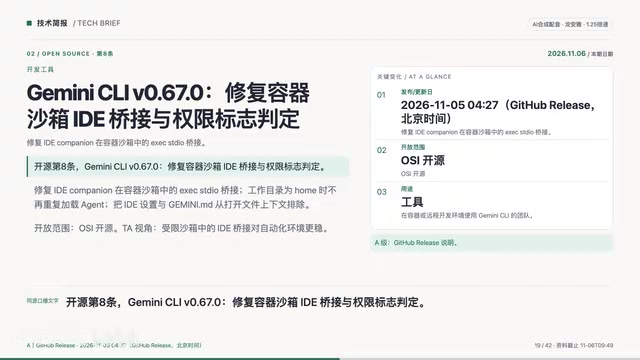
Gemini CLI v0.6.7.0 fixes the Exec STDIO bridge for IDE Companion in container sandboxes, no longer repeatedly loading the Agent when the working directory is Home, and excludes IDE settings and Gemini.md from the open-file context. IDE bridging in restricted sandboxes is more stable for automation environments.
MCP official Servers v2.3.0 updates the File System and Memory reference implementations, releasing Server Everything 2.2.1, Server File System 2.2.0, and Server Memory 2.1.0. These reference implementations can be used for local asset indexing services.
Babylon.js 9.34.0 changes WebGPU cached texture views to direct lookup instead of constructing Key strings; Inspector Lite adds a physics inspection panel. The physics debugging capability of Web3D preview tools is enhanced.
MCP (Model Context Protocol) is an open protocol that lets AI models access external tools and data sources in a standardized way; the official Servers repository provides reference implementations such as file system and memory. The significance of reference implementations like File System and Memory is that they provide reusable interface paradigms, so capabilities such as local asset indexing and context retrieval can be reused across models and tools. Developers can build local services on these reference implementations without having to adapt tool-calling formats separately for each model.
GitHub Trends: Agent Skills and Toolchains Heat Up
On the day's GitHub trending list, NVIDIA Auto-Analysis topped with 2,679 new stars, a Python framework that builds a semantic graph-structured reasoning layer on top of data, used for deterministic query generation, context retrieval, and explainable agent workflows.
Matt Pocock's Slash Skills added 2,071 stars, a collection of engineering skills accumulated in the author's Agents directory, aimed at real engineering tasks. Gary Tan's Slash GStack replicates his Cloud Code configuration, with 23 tools each playing CEO, designer, engineering manager, release manager, documentation engineer, and QA, adding 612 stars.
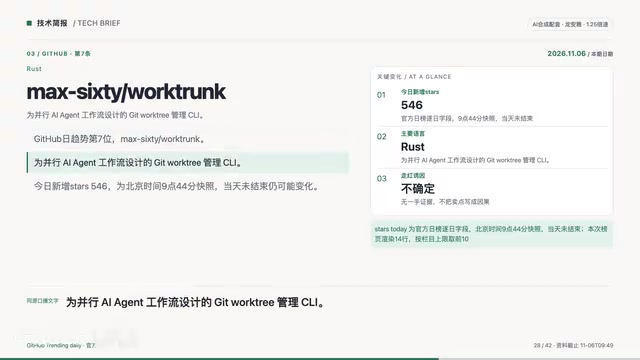
D4 Vinci's Scrapling added 1,655 stars, a web scraping framework from single requests to large-scale crawling, handling anti-scraping and page structure changes. VersioLabs' Agent Desktop added 2,173 stars, a Computer Use command-line tool for AI Agents. Max60's WorkTrunk added 546 stars, Git WorkTree management CI designed for parallel AI Agent workflows.
Scenario Lab Skills added 667 stars, letting any AI Agent produce video, audio, and 3D skills, first selecting a model and estimating cost before consuming, maintaining character and brand consistency through Scenario MCP, and providing the ability to drive Blender and Maya.
Paper Roundup: Video Understanding and Agent Training in Focus
Turnwise credit assignment addresses the problem in streaming video understanding where GRPO shares a single advantage value across the entire trajectory, proposing per-turn credit allocation to avoid repeated answers after early success and reluctance to ask follow-ups after early failure.
NeoVLA removes the fixed visual encoder, letting the model learn visual, language, and action policies directly from pixels, because manipulation tasks depend precisely on local geometry, boundaries, depth, and subtle state changes.
Frontier Physics, together with 42 physicists, built 56 tasks covering 9 directions of theoretical, computational, and experimental physics, checking both research quality and correctness. Gameverse provides 69,700 minute-level game videos with event-aligned annotations for controllable commonsense generation.
Multi-turn reinforcement learning research evaluates with Pass at KT across sampling breadth K and interaction depth T, finding that trajectory-level RL advantages depend on sufficient turn budgets, and gains decay markedly when budgets tighten; Agentic RL does not uniformly improve single-step decisions.
Hari's predictive control plane for optically interconnected AI data center networks points out that lasers within the same chassis share cooling and power and may fail correlatively, so availability is capped under a fixed spare ratio.
Pyroa Data Farm replaces teleoperation with LLM Agents, letting a coding Agent receive a data request and a calibration episode, re-publish in simulation and write an expert controller and success determination, producing transferable robot data at low cost.
ENOREVRDO addresses self-evolving reward calibration for emotional video generation, pointing out that emotional expression in video lacks a unique correct answer, fixed rewards struggle to capture emotional intent, and are prone to reward hacking.
StreamDuo pairs a trainable commentator with a frozen research agent for real-time commentary across games, finding that existing models can transfer pacing but not game world knowledge.
Same-policy distillation research finds that multi-teacher same-policy distillation approaches perfection in-distribution but masks incomplete integration of out-of-distribution capabilities; synthetic reasoning experiments show OPD does not fully transfer teachers' generalization ability.
GRPO (Group Relative Policy Optimization) is a reinforcement learning algorithm that estimates advantage values by comparing the relative merits of multiple sampled trajectories within a group, eliminating the need for an independent value network. In multi-turn interaction tasks such as long video understanding, GRPO typically shares a single advantage value across the entire trajectory, making it hard to distinguish which turn's decision actually contributed to the final result. Turnwise Credit Assignment addresses precisely this flaw by splitting the advantage value across each turn, so early success or failure isn't over-attributed to subsequent steps, thereby improving the stability of policy learning in multi-turn tasks.
One-line Summary
AI chip stocks plunge in a single day as Google's video model and coding agent acquisitions advance in tandem, with inference cost pressure emerging.
Paragraph Summary
On November 5, U.S. AI chip stocks pulled back sharply, with Nvidia down 9.26% and AMD, Micron, and Broadcom falling 9% to 18%, as capital reduced exposure to the compute chain. On the same day, AMD's earnings showed data center revenue up 97% year-over-year, with Instinct becoming the only second supply source of scale besides Nvidia. On the product side, Google released Gemini Omni 1.2 Flash, supporting specified durations of 3 to 15 seconds and local regeneration; OpenAI launched the cybersecurity-specific model GPT-6 Cyber. In M&A, OpenAI acquired Pierre Computer and Meta acquired Conductor, as coding agent competition shifted from code completion to code hosting and multi-agent orchestration. Apple lowered the daily AI quota for some engineering teams from $300 to $200, highlighting inference cost pressure. On the open source side, Ollama, Playwright, MCP Servers and others saw dense updates, and agent skills and toolchain projects heated up on the GitHub trending list.
Related articles
 Tech Frontiers
MuJoCo: An Analysis of DeepMind's Open-Source General-Purpose Physics Simulator
An in-depth analysis of Google DeepMind's open-source physics simulator MuJoCo: high-performance C++ kernel, MJCF modeling format, contact solving principles, MJX GPU acceleration, and robot reinforcement learning use cases.
 Tech Frontiers
Claude API Quick Start: The Official Quickstarts Project Collection
Anthropic's official claude-quickstarts project collection helps developers quickly build deployable apps with the Claude API. Nearly 20k stars, Python-based, great for beginners and prototyping.
 Tech Frontiers
AI Agents Connecting Directly to APIs: Which Calls Can Be Safely Allowed?
AI agents can call any API, but the real challenge is deciding which calls can be safely allowed. This article analyzes allowance decisions from three dimensions—intent matching, least privilege, and controllable impact—and argues that the control layer should sit outside the agent, combined with audit traceability to build a trustworthy API call governance mechanism.