AI Daily: GPT-6 Cyber Limited Release, Gemini Video Model 30% Price Cut, Baidu Open-Sources ERNIE 5.5

Six AI updates show model capabilities deepening and costs falling in parallel.
Around November 7, the AI field saw a dense wave of updates: OpenAI released the cybersecurity-focused GPT-6 Cyber with limited, vetted access; Google launched Gemini Omni 1.2 Flash with 15-second video, 30% cheaper 720p pricing, and SynthID watermarks; Baidu open-sourced the 280B sparse MoE ERNIE 5.5 Flash Base with revenue and regional license limits; Thinking Machines released the open-weight Inkling 2 Small; Moonshot AI launched Kimi Hosted Agents with financial templates; and Anthropic added a read-only Personal Finance beta to Claude. The overall trend: vertical capability deepening, falling costs, and stronger security constraints in parallel.
Today's AI Roundup: Six Developments Sketch New Industry Trends
On November 7, the AI world saw a dense wave of updates. From OpenAI's limited release of GPT-6 Cyber, a cybersecurity-focused model, to Google's 30% price cut on the Gemini Omni 1.2 Flash video generation model, to Baidu open-sourcing the 280B-parameter ERNIE 5.5 Flash Base, plus Thinking Machines, Moonshot AI, and Anthropic's explorations in agents and personal finance, these six developments point respectively to deeper model capabilities, falling costs, and expanding use cases. Here's a breakdown of each.
GPT-6 Cyber: A Cybersecurity-Focused Model, Limited Release
OpenAI released GPT-6 Cyber on November 5 (US time), positioned as a cybersecurity-focused model. According to official figures, the model discovered 81 previously unknown critical vulnerabilities in Firefox, and Mozilla has received the reports and issued fixes; in Linux kernel testing it reproduced 1,724 vulnerabilities and wrote working exploit code for 948 of them. These numbers all come from OpenAI itself, and The Decoder notes that no independent testing has yet verified them.
The model is not yet available to the public. The first batch is being provided via API and Codex only to vetted Daybreak Red customers, with gradual expansion to follow. OpenAI rates its cybersecurity capability as Critical, adds monitoring mechanisms to prevent abuse, and recommends running it in isolated environments under human supervision. In internal testing, without safety instructions the model held its guardrails 99.93% of the time, compared with 94.49% for the previous generation.
This release highlights the double-edged nature of AI in security offense and defense: vulnerability discovery and exploit-code generation have improved substantially, but the release strategy is extremely cautious, with vetting and isolation requirements now standard.
Gemini Omni 1.2 Flash: 30% Cheaper Video Generation, Up to 15 Seconds
Google Labs released the Gemini Omni 1.2 Flash video generation and editing model on July 5. A single clip can be up to 15 seconds, a 50% increase over Omni 1.1's 10 seconds, with durations selectable from 3 to 15 seconds in one-second increments. 720p video costs $0.07 per second, 30% less than Omni 1.1, making a 15-second 720p clip about $1.05. It supports multi-turn conversational editing of full 15-second segments.
Every video embeds an invisible SynthID watermark. The Gemini API and Enterprise editions are now generally available; generating 15-second clips in Google Waze incurs no extra charge; and the Gemini app is rolling out to Google AI Ultra subscribers. Whether it can be used directly in China is not stated on the official page.
Simultaneous improvements in duration and cost for video generation models mean the barrier to UGC video creation is further lowered, but the watermarking mechanism also reflects platforms' emphasis on content provenance.
SynthID is a digital watermarking technology developed by Google DeepMind that embeds an invisible identifying signal directly into the pixels or signal of AI-generated content (images, audio, text, video) rather than attaching it to file metadata, so it often remains detectable by specialized detectors after cropping, compression, or format conversion. For video generation, this means platforms can leave a traceable mark on content without harming visual quality, helping distinguish AI-generated from real footage. Note that a watermark is only a provenance tool; it does not prevent content from being re-edited or redistributed, and its effectiveness depends on the prevalence and consistency of detection tools.
Thinking Machines Releases Inkling 2 Small: A New Attempt at Open-Weight Models
Thinking Machines Lab released Inkling 2 Small on November 5, a mixture-of-experts model with 594B total parameters, activating only 17B per token. It scores 31 on the Artificial Analysis Intelligence Index, which the company says is far higher than previous models, and achieves the best performance among open-weight models on several financial benchmarks. The Decoder's headline calls it the "strongest Western open-weight model," but the official page does not describe it that way.
The model is currently a B-weight release and can only be used on Tinker. The company plans to release full weights under Apache 2.0 next week, contingent on completing external safety testing and red-teaming. The trade-off is higher token consumption: citing Artificial Analysis data, The Decoder reports that output tokens per task are about 4x the previous generation, at a cost of $1.18, nearly 6x the previous generation.
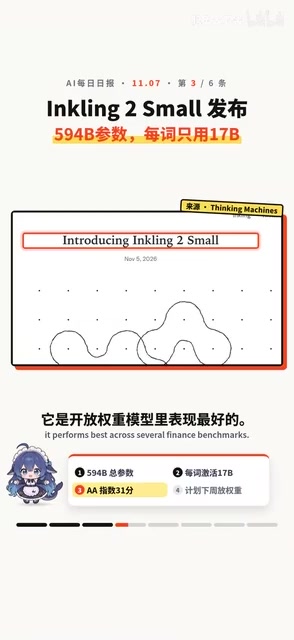
The trade-off between open weights and rising costs reflects how capability gains often come with increased inference overhead, requiring users to balance performance against budget.
Baidu Open-Sources ERNIE 5.5 Flash Base: 280B Sparse MoE, Free License for Commercial Use
Baidu open-sourced ERNIE 5.5 Flash Base on November 5, a 280B-parameter sparse mixture-of-experts model that activates 14B per token, pretrained on 33.5T tokens. The model is a base model, stopped at the end of pretraining without mid-training or post-training, with a 128K training context and support for up to 1,000 tokens in fine-tuning and inference.
In Baidu's published base-model evaluations, MMLU scores 93.3 versus 89.4 for DeepSeekAd V4 Flash; but on Chinese Simple QA, DeepSeek V4 Flash scores 75.3, higher than its 73.0. The license is Baidu's own agreement with conditions: commercial use is free of license fees for annual revenue under $50 million, but requires the label "Power Goodbye ERNIE" and a one-time notification to Baidu; the EU, UK, and South Korea are excluded regions. For the post-trained version, the company only says it will follow up, without a date.
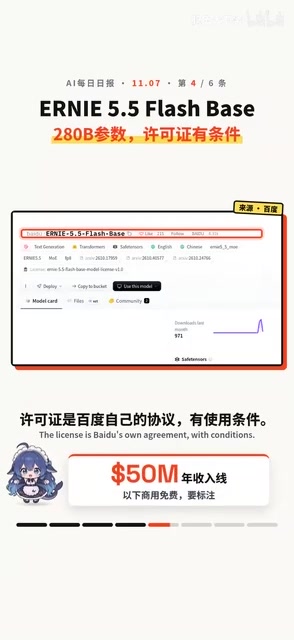
Open-source base models give developers a foundation for further training, but the license's regional restrictions and revenue threshold deserve companies' attention.
Sparse Mixture-of-Experts (MoE) is a model architecture consisting of multiple parallel "expert" subnetworks, where each input token is routed to only a few experts for computation while the rest do not participate. As a result, the model's total parameter count can be very large, but the number of parameters actually activated per inference is much smaller—ERNIE 5.5 Flash Base, with 280B total parameters activating only 14B per token, follows exactly this approach. Compared with dense models, sparse MoE can expand total capacity while controlling inference compute, at the cost of high memory usage (all experts must be loaded) and extra engineering complexity from routing and load balancing. This is why "total parameters" and "activated parameters" in the text are two metrics that must be viewed separately: the former concerns deployment resources, the latter concerns inference cost.
Moonshot AI's Kimi Hosted Agents: A Managed Agent Service
Moonshot AI released Kimi Hosted Agents on November 5, officially described as "Harness as a Service," placing the agent runtime framework in the cloud and providing an around-the-clock hosted environment. Compared with self-built solutions, the company says building a reliable runtime foundation in-house takes months. Each session runs in an isolated cloud sandbox, with session history, sandbox state, and output files all stored server-side.
There are three ways to use it: a command-line tool, an API, and a web console. Registering a Kimi Open Platform account is all that's needed. Pricing has three components: sandbox at 0.072 yuan per hour, plus model inference fees and plugin invocation fees. The first batch offers 8 financial agent templates, including investment research modeling, morning-brief generation, and portfolio monitoring, plus more than 140 skills and over 30 plugins. Kimi Inference Hook is currently available only to enterprise-verified users.
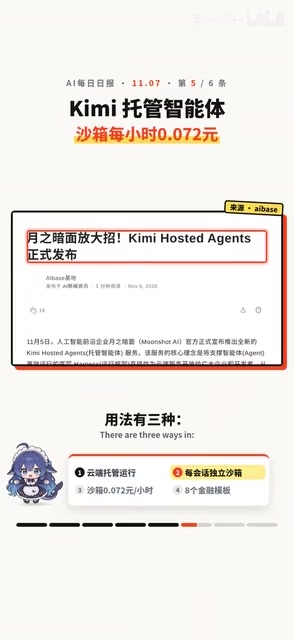
Managed agent services lower the deployment barrier for enterprises, and the targeted design of financial templates also shows an approach to landing in vertical scenarios.
In "Harness as a Service," harness refers to the agent's runtime framework (or scaffolding): it connects the large model's reasoning capability with tool calls, state management, multi-turn loops, error retries, sandbox execution, and other components—the infrastructure that turns an agent from something that "can talk" into something that "can get work done." Building such a framework in-house requires handling concurrency, isolation, observability, and many other engineering details, often taking months. Hosted services move this layer to the cloud, so developers only need to provide tasks and tool definitions to run, at the cost of runtime environment, billing, and data storage location all depending on the provider, requiring assessment of portability and compliance.
Anthropic Launches Personal Finance Feature for Claude
Anthropic launched a Personal Finance feature for Claude on November 5, in beta. Users can connect bank accounts and ask about balances, spending, and bills in everyday language. Starting this week it is rolling out to US Pro, Max, and Ultra subscribers, with bank accounts connected via Plaid.
Claude cannot see bank passwords and has read-only access, unable to transfer funds or invest. It can view account names, balances, and up to two years of transaction history, helping find duplicate charges and unexpected fees and estimate how much remains before payday. Conversations in the finance section are not used to train models, and users can unlink at any time. The company emphasizes that it does not provide investment advice, may make mistakes, and that important figures should be verified with the bank; it will later explore partnerships with licensed professionals and regulated institutions.
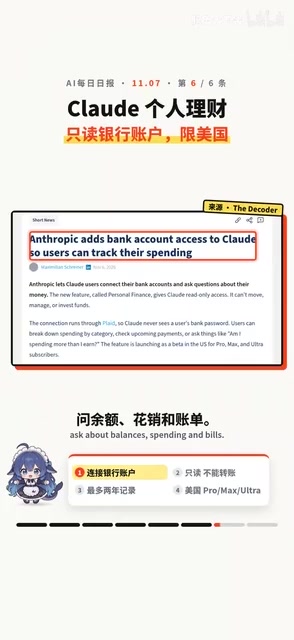
As AI assistants move into personal financial management, they take a conservative approach between convenience and security, with read-only access and privacy protection as core design principles.
Plaid is widely used account-connection infrastructure in fintech; third-party apps authorized through it can read transaction data without touching bank usernames and passwords. The flow is typically: the user logs into the bank and authorizes in the Plaid interface, Plaid returns an access token to the app, and the app uses the token to obtain account and transaction information. This model keeps credentials between Plaid and the bank, reducing the risk of the app storing passwords, and is the technical precondition for Claude to be able to "not see bank passwords." However, read-only access, token scope, and data retention policies still depend on the specific implementation, and users should still pay attention to authorization scope and revocation mechanisms.
Trend Watch: Capability Depth and Cost Optimization in Parallel
Today's six developments show two main threads: first, model capabilities deepening into vertical domains (cybersecurity, finance, video generation); second, costs and accessibility continuing to improve (cheaper video generation, open-source base models, on-demand pricing for hosted services). At the same time, constraint mechanisms such as security review, watermarking, and read-only access are being strengthened in tandem, indicating that leading vendors remain vigilant about abuse risk as they push capability boundaries. For developers, open weights and hosted services offer more choices, but license terms and long-term costs need careful evaluation.
One-line Summary
Six developments from OpenAI, Google, Baidu, Moonshot AI, and Anthropic show capability deepening and cost optimization in parallel.
Paragraph Summary
Around November 7, the AI field saw a dense wave of updates: OpenAI released the cybersecurity-focused GPT-6 Cyber, claiming discovery of 81 unknown Firefox vulnerabilities and reproduction of 1,724 Linux kernel vulnerabilities, but opening it only to vetted customers; Google launched Gemini Omni 1.2 Flash with up to 15-second video, 30% cheaper 720p pricing, and embedded SynthID watermarks; Baidu open-sourced the 280B sparse MoE base model ERNIE 5.5 Flash Base, free for commercial use but with revenue and regional restrictions; Thinking Machines released the open-weight model Inkling 2 Small; Moonshot AI launched the Kimi Hosted Agents managed agent service, focused on financial templates; and Anthropic rolled out a read-only Personal Finance beta for Claude. Overall, the trend shows vertical capability deepening, falling costs, and strengthened security constraints in parallel.
Related articles
 Tech Frontiers
MuJoCo: An Analysis of DeepMind's Open-Source General-Purpose Physics Simulator
An in-depth analysis of Google DeepMind's open-source physics simulator MuJoCo: high-performance C++ kernel, MJCF modeling format, contact solving principles, MJX GPU acceleration, and robot reinforcement learning use cases.
 Tech Frontiers
Claude API Quick Start: The Official Quickstarts Project Collection
Anthropic's official claude-quickstarts project collection helps developers quickly build deployable apps with the Claude API. Nearly 20k stars, Python-based, great for beginners and prototyping.
 Tech Frontiers
AI Agents Connecting Directly to APIs: Which Calls Can Be Safely Allowed?
AI agents can call any API, but the real challenge is deciding which calls can be safely allowed. This article analyzes allowance decisions from three dimensions—intent matching, least privilege, and controllable impact—and argues that the control layer should sit outside the agent, combined with audit traceability to build a trustworthy API call governance mechanism.