AI Daily: Manus Game Generation, Claude Duet Proactive Agent, and Seedance 2.5
Manus game generation, Claude Duet proactive agent, and ByteDance/Kling video models advance as AI embeds into workflows.
Today's three AI developments all point to a shift from single calls to embedded workflows. Manus launched Game Dev, automatically handling 3D scenes, rigging, and animation to generate browser-playable games with conversational edits, positioned as a rapid prototyping tool. Anthropic released proactive agent Claude Duet, which continuously observes connected apps and proactively reminds users, with an independent VM for offline operation, shifting from people finding AI to AI finding people. In video generation, ByteDance supplies Seedance 2.5 4K enterprise trials to 20 studios for S-tier IP production, while Kling 4.0 opens API applications for developer toolchains.
A one-minute roundup of today's big AI news: from game creation automation to proactive agents, and the enterprise rollout of video generation models.
Today's AI world is buzzing with activity—there are workflow innovations for developers, a paradigm shift in agent form, and video generation models making inroads into professional production scenarios. Here are the noteworthy developments, organized into three areas.
Manus Launches Game Dev Feature: Automated Rigging and Animation
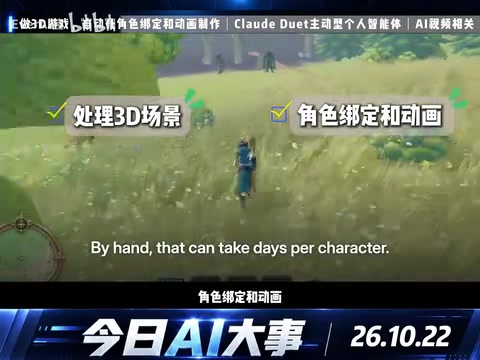
According to a daily news video by Bilibili creator "EverAI," Manus has introduced a game generation feature called Game Dev. Its core capability lies in automatically handling 3D scenes, character rigging, and animation construction, directly generating games that run in the browser.
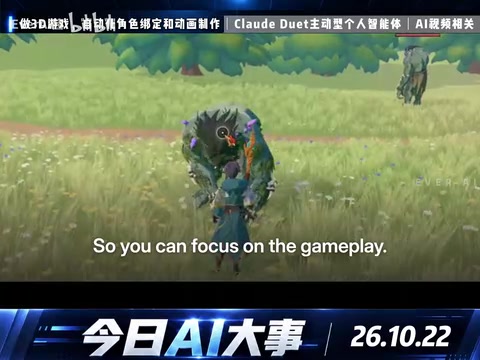
The practical value of this feature shows up on two levels. First is process compression: in traditional game prototyping, character rigging and animation debugging often consume a great deal of time, and Manus attempts to hand this work over to the model to complete automatically. Second is a change in iteration style—once the game is generated, it can be played immediately, and anything unsatisfactory can be adjusted through conversation, effectively embedding "conversational modification" into the game development loop.
In terms of product positioning, this is closer to a rapid prototyping tool than a full game engine. What it optimizes is the path from idea to playable demo, not a replacement for the production pipelines of Unity or Unreal. For indie developers and small teams, this "conversation-as-adjustment" interaction model may change working habits around early-stage creative validation.
Rigging is a key step in 3D animation production: building a "skeleton" system for a static model and binding mesh vertices to the bones so the model can be driven to perform actions. Rigging quality directly determines how natural the subsequent animation looks—deformation at joints, muscle compression and stretching, and reasonable weight distribution all require repeated manual debugging, and in traditional pipelines this often accounts for a large share of the character production cycle. Automated rigging usually relies on heuristic algorithms or learning-based methods to automatically infer bone positions and skinning weights, but still requires manual correction when facing complex topology, non-standard body types, or stylized characters. By handing this step to the model, Manus is essentially front-loading and compressing the most time-consuming technical labor, letting creators reach the "playable validation" stage sooner.
Anthropic Launches Claude Duet: From Passive Q&A to Proactive Observation
The proactive agent Claude Duet released by Anthropic (transliterated as "Cloud Dewey" in the video) represents an interaction logic entirely different from that of a chatbot.
A regular Claude requires the user to actively ask a question each time, whereas Duet, once authorized, continuously observes connected applications and proactively tells the user which matters are worth handling. According to the video description, it has its own independent virtual machine, so it can keep working even when the local computer is off, and it claims it can "let Opus 5.5 work for you 24 hours a day."
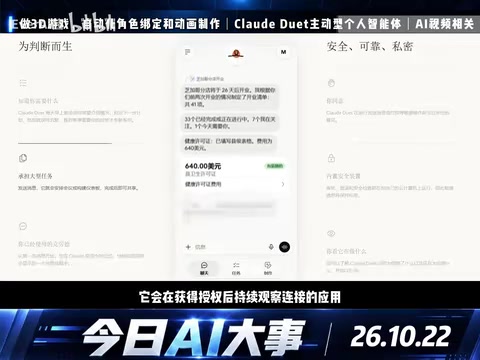
The key difference in this form lies in the trigger mechanism: it shifts from "people finding AI" to "AI finding people." The agent stays resident in the background, senses application states, and judges priorities, which offers direct imaginative potential for task management and information monitoring scenarios. But proactive agents also bring new questions—how to define the scope of observation, how to control the granularity of authorization, and how to avoid false alarms and interruptions. These engineering and product-level design decisions will determine whether it can truly integrate into everyday workflows.
Proactive agents differ from conventional conversational AI in one core respect: who holds the trigger. Traditional chatbots follow a "request-response" model, entirely initiated by the user; a proactive agent, after receiving continuous authorization, autonomously senses environmental states, judges the importance of events, and decides whether to intervene. This requires the system to have three capabilities: continuous state perception (reading the data streams of connected applications), priority judgment (distinguishing information worth interrupting the user for from noise), and controlled execution permissions (taking action within the authorized scope). The engineering difficulty lies not in the model capability itself but in authorization granularity design—which applications to observe, which fields to read, and under what conditions proactive push is allowed all require support from a fine-grained permission model; otherwise, proactive reminders can easily degrade into interruptions.
ByteDance Seedance 2.5 and Kling 4.0: Video Generation Moves Toward Professional Production
New developments in the video generation arena come from ByteDance and Kuaishou. ByteDance has launched an enterprise trial of Seedance 2.5 4K, currently tied to productions and supplied to 20 studios and directors worldwide for making S-tier IP films and TV series.
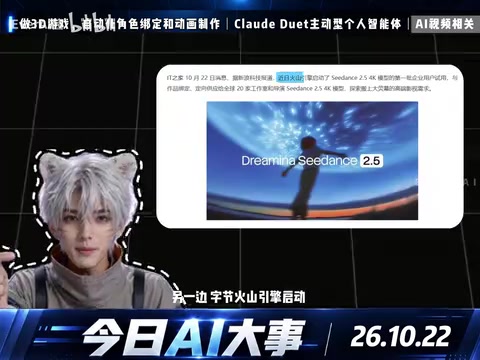
The limitation of being "tied to productions" is worth noting: it means the current stage is not open registration but project-based cooperation with professional production houses, with model output going directly into the film and television industry pipeline. The combination of 4K resolution and an S-tier IP positioning points to scenarios with higher demands on image quality and consistency, rather than short-form content creation for social media.
Meanwhile, Kling 4.0 has opened API applications. API-ification means capabilities extend from the product side to the developer side, allowing third parties to integrate video generation into their own toolchains. The two paths form a contrast: one moves toward deeply tied large-scale productions, the other toward a broadly covering developer ecosystem.
4K video generation faces technical thresholds in professional film and television scenarios that differ from those of consumer applications. Higher resolution is not just an increase in pixel count; it also means the model needs to maintain temporal consistency in a higher-dimensional latent space—the appearance, lighting, and materials of the same character must remain stable across different frames and shots, otherwise flaws will be magnified under cinema-grade projection conditions. In addition, the film and television industry pipeline has hard requirements for editability: generated results need to be able to plug into color grading, compositing, and editing pipelines, rather than being output only as finished clips. Seedance supplies studios on a project basis "tied to productions," which is to some extent also about honing these consistency metrics through real production feedback—complementing the path of an open API aimed at the developer ecosystem.
Today's Observation
Behind these three developments is a common trend: AI capabilities are shifting from "single calls" to "embedded in workflows." Manus is embedded in prototype iteration for game development, Claude Duet in continuous monitoring of daily tasks, and Seedance in the film and television production pipeline. Beyond competition on capability, how to design the rhythm of human-AI collaboration is becoming key to product differentiation.
The above content is compiled from the AI daily news video by Bilibili creator "EverAI." Some product names are recorded as transliterated in the video; refer to official releases for specifics.
One-line Summary
Manus game generation, the Claude Duet proactive agent, and video models from ByteDance and Kling advance on three fronts as AI shifts from single calls to embedded workflows.
Paragraph Summary
Today's three AI developments all point to a shift in AI capabilities from "single calls" to "embedded workflows." Manus launched Game Dev, which can automatically handle 3D scenes, character rigging, and animation, directly generating browser-playable games with conversational modification, positioned as a rapid prototyping tool rather than a full engine. Anthropic released the proactive agent Claude Duet, which, once authorized, continuously observes connected applications and proactively reminds users, with an independent virtual machine that can run offline, shifting the interaction logic from "people finding AI" to "AI finding people." In video generation, ByteDance is supplying an enterprise trial of Seedance 2.5 4K on a project basis to 20 studios and directors worldwide for S-tier IP film and television production; Kling 4.0 has opened API applications, extending into developer toolchains.
Related articles

The Truth Behind Titanic's Sinking: Key Decisions and Communication Failures in the National Geographic Documentary
National Geographic's The Unsinkable Ship uses survivor testimony to reconstruct Titanic's fatal decisions—from the missing MSG telegram prefix and the broken boiler-room-to-bridge link to how 'unsinkable' thinking delayed damage control and evacuation.

74M-Parameter Open-Source Model Partially Outperforms Jev AI in Testing
Fastino AI's Glider 2.5 models, with just 74M–300M parameters, reportedly outperform Jev AI in some guardrail benchmarks per YouTube testing, run on consumer hardware, and even play Doom. We analyze small models' competitiveness and deployment value on specific tasks.

Gemini 4 Argon Hands-On: Aggressive Pricing, 3D Capabilities Need Coaching
Gemini 4 Argon hands-on: limited-time $2/$10 pricing, million-token output, strong 3D and reverse-engineering work, but weak front-end aesthetics and zero-shot ability need coaching.