AI Giants' Valuation and Debt Concerns: OpenAI Funding Cut, Anthropic's Off-Balance-Sheet Liabilities Near $900 Billion

AI industry funding cools as off-balance-sheet debt, credit risk, and regulatory compliance form multiple hidden levers.
The article outlines the AI industry's risk structure along four lines: OpenAI cut its funding target from $30B to about $20B and its valuation expectation from $1.4T to $1.25T; Anthropic's off-balance-sheet long-term commitments for data centers, power, and GPUs approach $900B, and it may not obtain an investment-grade rating after IPO, relying on supplier credit guarantees; Intel's five-year CDS spread widened 17.5 bp in a day to a record 124.75 bp; Japan asks OpenAI and Anthropic to open frontier model security access under national cybersecurity measures. The author argues AI risk has expanded from valuation alone into a multidimensional structure of capex, off-balance-sheet debt, supplier credit, and regulatory compliance.
Funding Expectations Cool: OpenAI Valuation Shrinks to $1.25 Trillion
According to the Financial Times, amid recent volatility in secondary-market tech stocks and rising concerns over AI capital expenditures, OpenAI has lowered its latest funding round target from $30 billion to approximately $20 billion, with the expected post-money valuation also reduced from $1.4 trillion to $1.25 trillion. Sources say that because some institutions have cut their subscription allocations, the first tranche may close below $20 billion, and the company is accelerating final negotiations with investors.
This downward revision is not an isolated event. It reflects that capital markets' patience with massive AI infrastructure spending is being tested—when capital expenditures on compute procurement and data center construction are measured in hundreds of billions of dollars, investors are beginning to reassess the balance between short-term returns and long-term vision.
Anthropic's Hidden Leverage: $900 Billion in Off-Balance-Sheet Commitments
Compared with the valuation adjustment, another set of numbers is more alarming. According to the Financial Times and IPO filings, Anthropic's future off-balance-sheet long-term commitments for data centers, power, and GPU compute procurement approach $900 billion. Such commitments do not appear directly on the balance sheet, yet they constitute substantive long-term financial obligations.
The nature of off-balance-sheet liabilities is to "defer" risk. For a company that has not yet gone public, these commitments will become information that public-market investors must digest after listing. More critically, Blackstone has informed investors that Anthropic may struggle to obtain an investment-grade credit rating after going public, and is expected to fall more likely into the double-B category (i.e., the non-investment-grade/speculative-grade range). This will limit participation by some regulated institutional investors and make the company more reliant on credit guarantees from core suppliers such as Broadcom in subsequent debt financing.

Supplier credit guarantees becoming an implicit pillar of the financing structure means that AI companies' expansion pace is deeply tied to the credit conditions of upstream hardware vendors. This dependency is a safeguard when compute is scarce, but in a downturn it may amplify risk transmission.
Off-Balance-Sheet Liability refers to obligations that a company does not directly list on its balance sheet but that in practice constitute future cash outflows. Common forms include long-term purchase commitments, operating leases, guarantees, and joint venture arrangements. Unlike on-balance-sheet debt, the scale and maturity of off-balance-sheet liabilities often appear only in the notes to financial statements, making them easy for ordinary investors to overlook. For AI companies, multi-year take-or-pay contracts with data centers, power suppliers, and GPU vendors are typical off-balance-sheet commitments: companies must pay according to the contract regardless of whether they actually use the compute. Such obligations are an advantage for locking in resources during an industry upcycle, but in a downcycle they may become rigid burdens and affect credit rating agencies' judgment of leverage levels.
Intel CDS Spread Hits Record: Cash Flow Pressure on a Traditional Chip Giant
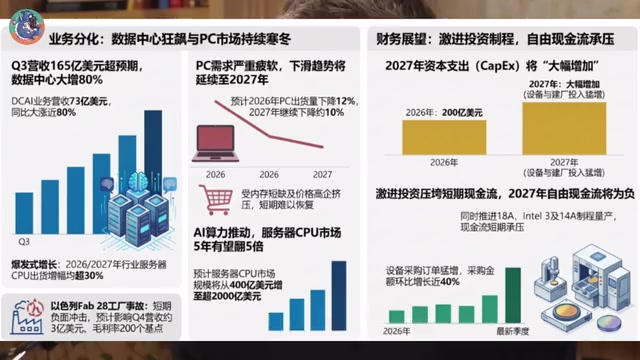
The other side of the AI boom is the predicament of those who have not fully benefited. After reporting weak results that sent its stock price plunging, Intel's credit default risk has risen significantly. Financial market data show that its five-year credit default swap (CDS) spread widened by 17.5 basis points in a single day to a record 124.75 basis points, the largest one-day increase in two years.
The company had previously warned that, hit by continued weakness in the PC market and rising costs of core components, its cash flow this year will face net outflow. The jump in the CDS spread is a direct signal of the market repricing default probability—when a chip giant that once dominated the PC era falls behind in the AI compute race, its credit profile may deteriorate faster than its business transformation.

Credit Default Swap (CDS) is a credit derivative: the buyer periodically pays a premium to the seller, and if the reference entity defaults or restructures, the seller compensates the buyer for losses. The CDS spread is the annualized premium paid by the buyer, usually measured in basis points; the wider the spread, the higher the market's pricing of the entity's default risk. Because CDS prices are formed through real-money transactions, they are often regarded as a more timely market signal than rating agencies. For example, 124.75 basis points means that providing default protection for $10 million in notional principal costs about $124,750 in annual premiums. A one-day spread widening of 17.5 basis points reflects a rapid reassessment of default probability and recovery rates, not a real deterioration in the company's fundamentals within a single day.
New Regulatory Trend: Japan Requires Opening Frontier Model Security Access
According to Nikkei, in response to recent frequent cyber data breaches, the Japanese government has asked Anthropic and OpenAI to open more cybersecurity access to frontier large models. Japan plans to incorporate this cooperation into an upcoming national cybersecurity package, with a focus on encouraging critical infrastructure operators to use advanced AI to identify system vulnerabilities and analyze attack methods.
This development reflects a deeper trend: governments are shifting from "regulating AI" to "using AI for defense." Requiring model vendors to open security access is essentially incorporating frontier models into national cybersecurity infrastructure. For AI companies, this is both a compliance obligation and an opportunity to build trust with governments, but it also creates tension between opening up model capabilities and protecting trade secrets.
Investment-grade and non-investment-grade (speculative-grade) ratings are credit rating agencies' classifications of an issuer's debt-servicing capacity. In the S&P and Moody's systems, for example, BBB-/Baa3 and above are investment grade, while below that is speculative grade (commonly called "junk"). Many regulated institutional investors—such as pension funds, insurers, and some mutual funds—are restricted by their charters or regulatory rules from holding speculative-grade bonds. Therefore, if a company receives only a speculative-grade rating after going public, its bond issuance costs will rise significantly and the range of debt investors it can reach will narrow, often requiring credit enhancement such as bank guarantees, supplier credit support, or asset collateral to complete large-scale financing.
The Trio of Capital, Debt, and Regulation
Looking at the four pieces of information together, the risk structure of the AI industry becomes increasingly clear. On the funding side, valuation expectations are being cut amid secondary-market volatility; on the financial side, off-balance-sheet commitments and credit rating constraints constitute hidden leverage; on the industry side, chipmakers that have failed to keep up in the compute race face credit deterioration; and on the regulatory side, government demand for AI security capabilities is becoming institutionalized.
This is not about talking down AI, but a reminder: when capital expenditures reach the hundreds-of-billions-of-dollars scale, financial discipline and risk transparency will become just as critical as model capability in determining whether a company can weather cycles. For investors, understanding off-balance-sheet commitments and CDS spreads may be more important than understanding leaderboard scores.
One-line Summary
AI industry funding cools as off-balance-sheet debt, credit risk, and regulatory compliance form multiple hidden levers.
Paragraph Summary
The article outlines the AI industry's risk structure along four lines: OpenAI, amid secondary-market volatility and capex concerns, has cut its funding target from $30 billion to about $20 billion, with valuation expectations falling from $1.4 trillion to $1.25 trillion; Anthropic's off-balance-sheet long-term commitments for data centers, power, and GPU procurement approach $900 billion, and it is expected to struggle to obtain an investment-grade rating after going public, requiring supplier credit guarantees; Intel, hit by weak results and a warning of net cash outflow, saw its five-year CDS spread widen by 17.5 basis points in a single day to a record 124.75 basis points; and the Japanese government has asked OpenAI and Anthropic to open security access to frontier models as part of national cybersecurity measures. The author argues that AI risk has expanded from a single valuation issue into a multidimensional structure of capital expenditure, off-balance-sheet debt, supplier credit, and regulatory compliance.
Related articles
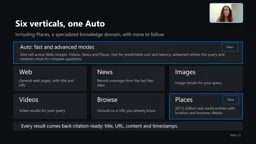
Microsoft WebIQ: Verifiable Real-Time Web Grounding for AI Agents
Microsoft WebIQ gives AI Agents real-time, citable web grounding across web, news, images, videos, and Places—164ms P95 latency, 50% fewer tokens, Scopes source control, and MCP integration.
Augmentable Gaussian Splatting: Building Photorealistic Simulation Environments for Robot Training
Team combines Gaussian Splatting with meshes to build photorealistic robot simulation environments, integrating MuJoCo Warp physics and Franka Panda for augmentable, relightable real-site simulation.

Gemini 4 Carbon Released: The Leap from Gemini 3 to Gemini 4 in Under a Year
Google releases Gemini 4 Carbon, less than a year after Gemini 3. In the official demo, Carbon reverse-engineered the Theme Park binary, added a new DeepMind-themed ride, and ported it to the web in one shot.