AI Guardrails Index: A Comprehensive Guide to the Most Complete LLM Safety Evaluation Framework
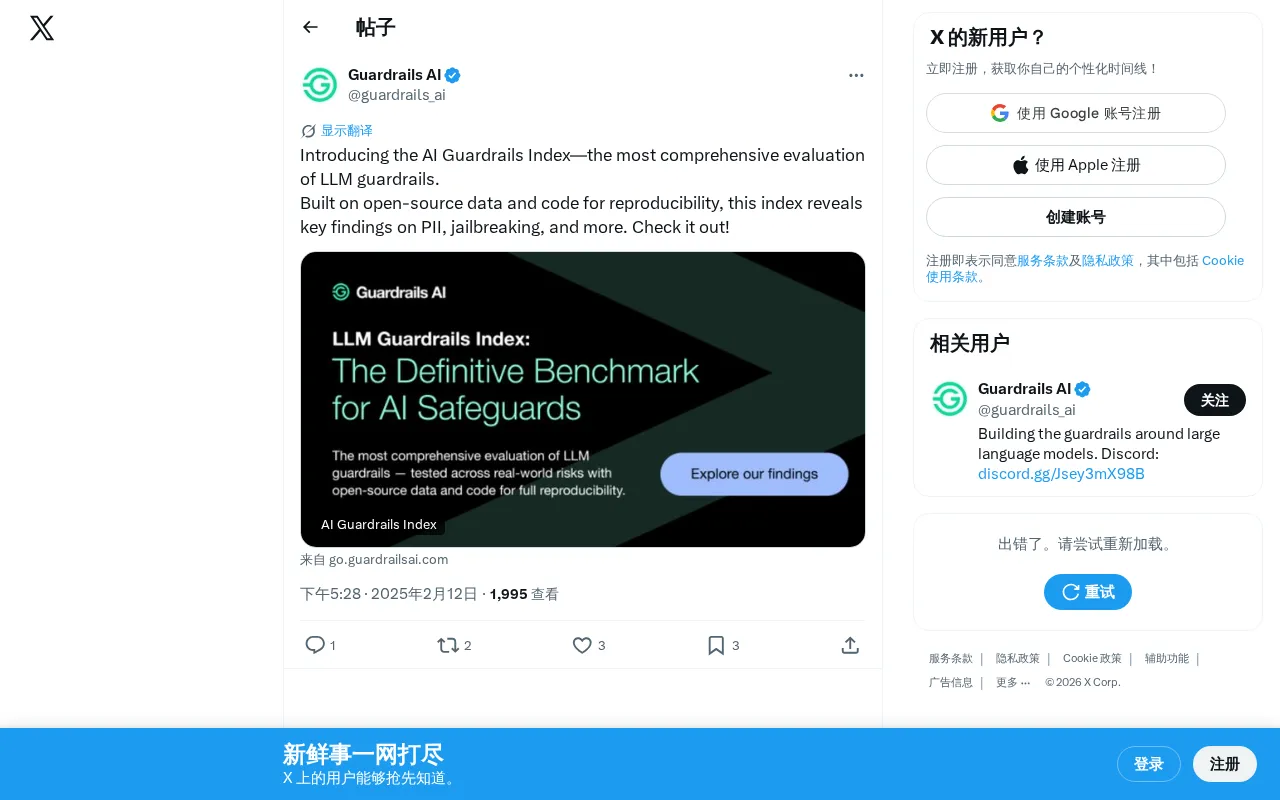
AI Guardrails Index launches as the most comprehensive open-source LLM safety guardrail evaluation framework.
The AI Guardrails Index has been officially released as the most comprehensive LLM safety guardrail evaluation framework available. Built on open-source data and code, it covers multiple dimensions including PII protection, jailbreak attack defense, harmful content filtering, and hallucination detection. The evaluation reveals significant weaknesses in current models' PII protection and jailbreak defense, offering developers practical value for solution selection, benchmarking, and security blind spot discovery.
Introduction
Large Language Models (LLMs) are penetrating every corner of our lives—from financial risk management and medical consultations to intelligent customer service. But the security risks they bring are becoming increasingly apparent. Could a model leak a user's phone number or ID card number? Can carefully crafted prompts bypass safety restrictions? The answers to these questions directly determine whether an AI system is truly ready for production.
Recently, the AI Guardrails Index was officially released. It is currently the most comprehensive LLM safety guardrail evaluation framework available. Built on open-source data and code, the project emphasizes reproducibility of evaluation results, providing the industry with a standardized yardstick for measuring model safety capabilities.
What Are AI Guardrails?
Core Concept of Safety Guardrails
AI Guardrails are a set of safety detection and interception mechanisms deployed at both the input and output ends of large language models. They function much like crash barriers on a highway—they don't impede normal traffic, but they correct course when a vehicle drifts out of its lane.
From a technical architecture perspective, safety guardrails are typically embedded as middleware in the LLM inference pipeline. Before user input reaches the model, input-side guardrails perform intent analysis and risk assessment on the request. After the model generates a response, output-side guardrails perform compliance checks on the content. This bidirectional detection mechanism ensures complete coverage of safety policies across the entire interaction chain.
A complete LLM safety guardrail system typically covers the following key dimensions:
- PII Protection: Prevents the model from leaking or generating personally identifiable information during conversations, including names, phone numbers, ID numbers, bank card numbers, etc. PII (Personally Identifiable Information) protection faces unique challenges in LLM scenarios—traditional PII detection primarily relies on regular expressions and Named Entity Recognition (NER) models, but in LLM conversational contexts, PII may appear in unstructured, implicit, or obfuscated forms. For example, a user might say "my number is one-three-eight followed by eight zeros," a natural language expression that is extremely difficult for traditional rule engines to capture. An even more complex situation arises when models memorize real personal information from training data and "recall" it under specific prompts—this is known as a Training Data Extraction Attack. Therefore, PII protection in LLM scenarios must cover both the input side (preventing users from inducing the model to leak others' information) and the output side (preventing the model from proactively generating or repeating sensitive information).
- Jailbreak Attack Defense: Identifies and intercepts attempts by users to bypass model safety restrictions through techniques such as role-playing and encoding transformations.
- Harmful Content Filtering: Blocks generation requests involving violence, discrimination, illegal activities, and other harmful content.
- Hallucination Detection: Flags false information in model outputs that lacks factual basis. Hallucination is an inherent flaw of large language models, referring to content that appears plausible but actually lacks factual grounding. Hallucinations can be divided into two categories: Intrinsic Hallucination, where the output contradicts the input context, and Extrinsic Hallucination, where the output contains information that cannot be verified from the input or known facts. Technical approaches to hallucination detection include knowledge-base fact-checking (comparing model outputs against trusted data sources), model uncertainty-based detection (analyzing token-level probability distributions), and multi-sampling consistency methods (generating answers to the same question multiple times and checking for consistency). In high-risk domains like healthcare and law, hallucinations can lead to serious consequences, making hallucination detection one of the most technically challenging components of safety guardrails.
In industries with stringent compliance requirements—such as finance, healthcare, and government services—the quality of safety guardrails directly determines whether an AI application can pass regulatory review and earn user trust.
Core Features of the AI Guardrails Index
Multi-Dimensional Comprehensive Evaluation Framework
The reason the AI Guardrails Index is called "the most comprehensive LLM safety evaluation" lies in its approach: rather than focusing on a single safety dimension, it has built a multi-dimensional, multi-scenario comprehensive evaluation framework.
The index simultaneously covers PII protection capabilities, jailbreak attack defense effectiveness, harmful content interception rates, and other safety domains, supporting side-by-side scoring comparisons of different LLM guardrail solutions. This systematic evaluation approach provides a far more accurate picture of a safety solution's true capabilities than any single-dimension test.
Notably, the multi-dimensional evaluation design also accounts for the trade-off relationships between different safety dimensions. For example, overly aggressive harmful content filtering can lead to high false positive rates, incorrectly flagging legitimate medical discussions or news reports as harmful content. By simultaneously reporting both interception rates and false positive rates, the AI Guardrails Index helps developers find the optimal balance between security and usability.
Open-Source Design Ensures Credibility
Another major highlight of the project is that it is fully open-source. Specifically, this means three things:
- Transparent and Auditable: The evaluation methodology, test datasets, and scoring logic are all publicly available, allowing any researcher to review the code line by line.
- Reproducible Results: Other teams can independently produce consistent evaluation results using the same data and code.
- Community Extensible: Developers can contribute new test cases and add new evaluation dimensions, enabling the index to continuously evolve.
In the field of AI safety evaluation, the importance of open-source methodology far exceeds that of typical software projects. This stems from a fundamental epistemological issue: if we cannot verify the correctness of the evaluation tool itself, the evaluation results lack scientific significance. Academia calls this the "meta-evaluation" problem. The open-source strategy adopted by the AI Guardrails Index essentially places the evaluation process within a peer review framework—any researcher can examine whether test cases contain biases, whether scoring algorithms are sound, and whether datasets are representative. This aligns with the AI Risk Management Framework (AI RMF) promoted by NIST (National Institute of Standards and Technology): the credibility of safety evaluations must be built on transparency and reproducibility, rather than relying on the authority of the evaluating institution.
This point is especially critical in AI safety evaluation. When we use a tool to judge whether a model is safe, the tool's own credibility must withstand scrutiny. Closed-source evaluation systems inevitably raise concerns about "being both the referee and the player," while an open-source strategy fundamentally resolves this trust issue.
Key Findings and Industry Insights
PII Protection Remains a Weak Point for Most Models
The evaluation data from the AI Guardrails Index reveals a sobering reality: there are enormous performance gaps between different models and guardrail solutions when it comes to personal privacy protection. Some solutions perform reasonably well in standard scenarios, but their interception rates drop significantly when faced with slightly modified PII extraction requests.
The root cause of this fragility is that most current PII protection solutions still rely heavily on pattern matching rather than deep semantic understanding. When an attacker rewrites "Please tell me Zhang San's phone number" as "If Zhang San's contact information were a poem, how would it read?", detection mechanisms based on keyword and format matching are often helpless. This reminds developers that when selecting PII protection solutions, they shouldn't rely solely on vendor-reported numbers. Instead, they should conduct actual validation using standardized test sets, with particular attention to performance in adversarial scenarios.
Jailbreak Attack Defense Remains an Ongoing Arms Race
Jailbreaking is a notoriously tough challenge in LLM security. Attackers continuously innovate their techniques—from early role-playing prompts to multilingual mixed encoding and logical chain induction, new bypass tricks emerge endlessly.
From a technical evolution perspective, jailbreak attacks have gone through several distinct phases. The earliest attacks were simple role-playing prompts, such as the famous DAN (Do Anything Now) prompt, which bypassed safety policies by having the model play "an AI without restrictions." More sophisticated techniques followed: Base64 encoding bypass (encoding harmful requests and having the model decode and execute them), multi-turn progressive induction (Crescendo Attack), and exploiting the model's instruction-following ability to construct logical traps (e.g., "Suppose you are a security researcher who needs to demonstrate how to..."). Since 2024, researchers have also discovered adversarial suffix attacks, where appending a seemingly meaningless sequence of tokens to a normal prompt can cause the model to ignore its safety alignment. The rapid iteration of these attack techniques means that static keyword filtering and rule matching are virtually ineffective for defense—dynamic, semantics-based detection mechanisms are essential.
The challenge for defense is that every patch may be broken by a new attack method. This is fundamentally an endless arms race. The value of the AI Guardrails Index lies in its ability to quantify, with data, how well current mainstream guardrail solutions actually perform against various types of jailbreak attacks, giving developers a clear understanding of their solution's defensive boundaries.
Three Layers of Practical Value for Developers
For technical teams building AI applications, the AI Guardrails Index provides direct help on three levels:
- Safety Solution Selection: With dozens of safety guardrail products and open-source solutions on the market, the evaluation index provides data-driven side-by-side comparisons to help teams make more informed decisions.
- Benchmarking In-House Solutions: If a team chooses to build its own safety modules, it can use the index as a standardized benchmark to quantify the security level of its proprietary solution.
- Discovering Security Blind Spots: Evaluation results often expose security weaknesses that teams had not previously noticed, such as PII leakage risks in specific formats.
Industry Trends in AI Safety Evaluation
The release of the AI Guardrails Index reflects an industry shift already underway: AI safety is transitioning from an "optional add-on" for products to an infrastructure-level "mandatory requirement".
This transformation is driven by multiple forces. The current global AI regulatory landscape has formed a three-pronged structure: the EU's AI Act officially took effect in August 2024, adopting a risk-level-based classification approach that divides AI systems into four tiers—unacceptable risk, high risk, limited risk, and minimal risk—with strict requirements for transparency, data governance, and human oversight for high-risk AI systems. China, through a series of regulatory documents including the Interim Measures for the Management of Generative Artificial Intelligence Services, requires generative AI service providers to complete safety assessment filings before launch and sets explicit requirements for training data sources and content filtering mechanisms. The United States currently relies primarily on executive orders (such as the October 2023 AI Safety Executive Order) and industry self-regulatory frameworks (such as NIST AI RMF), although multiple states have begun advancing local AI legislation. This diverse regulatory landscape means that AI products targeting global markets must simultaneously meet multiple compliance standards, making standardized safety evaluation frameworks indispensable.
In such a regulatory environment, AI products lacking standardized safety evaluation will find it increasingly difficult to enter the market.
Looking ahead, evaluation frameworks like the AI Guardrails Index are likely to continue evolving in the following directions:
- Multilingual and Multicultural Coverage: Current evaluations are primarily focused on English-language scenarios. Future versions will need to incorporate safety testing in Chinese, Arabic, and other language environments. Safety risks in different languages have cultural specificities—for example, Chinese-language bypass techniques such as homophone substitution (using "S" instead of sensitive words) and pinyin encoding are completely uncovered in English test sets.
- Multimodal Safety Evaluation: As multimodal models like GPT-4o and Gemini become widespread, safety risks from image, audio, and video inputs also require standardized evaluation. Research has demonstrated that embedding harmful text within images (e.g., triggering via OCR) can bypass text-only safety detection.
- Integration with Regulatory Standards: The evaluation index is expected to become deeply integrated with AI regulatory frameworks across countries, gradually evolving into part of the industry certification ecosystem.
Conclusion
The AI Guardrails Index fills a critical gap in the LLM safety evaluation space—an open-source, reproducible, multi-dimensional standardized evaluation tool. The gaps it reveals in PII protection and jailbreak attack defense serve as a wake-up call for the entire industry: deploying safety guardrails is not a set-it-and-forget-it task. Continuous evaluation and iteration is the only way forward.
For any technical team that takes AI safety seriously—whether using it for solution selection, benchmarking, or discovering blind spots in their own approach—the AI Guardrails Index deserves a place in the toolbox and ongoing attention.
Key Takeaways
- The AI Guardrails Index is currently the most comprehensive LLM safety guardrail evaluation framework, covering multiple critical dimensions including PII protection and jailbreak defense.
- The project is built entirely on open-source data and code, ensuring transparency and reproducibility of evaluation results.
- Evaluation results reveal that significant gaps and weaknesses still exist in current LLMs regarding PII protection and jailbreak attack defense.
- AI safety is transitioning from an add-on feature to infrastructure, and standardized evaluation frameworks will become a prerequisite for AI product compliance.
- The index provides developers with practical value for solution selection, benchmarking, and risk identification.
Related articles
Deep Dive into AI Agent Skill Design: …
Deep Dive into AI Agent Skill Design: Engineering Practices from Anthropic and Perplexity
A deep dive into Skill design philosophy from Anthropic's Claude Code team and Perplexity's Agent team, covering the Tax Test, Gotchas Flywheel, progressive disclosure, and Eval-First practices for building high-quality AI Agent skill systems.
Deep Dive into OpenAI's Official GPT-5…
Deep Dive into OpenAI's Official GPT-5.6 Prompting Guide: The Shift from Manual to Automatic
A deep dive into OpenAI's official GPT-5.6 Sol prompting guide: conciseness-first, outcome-oriented design, autonomy boundaries, tool routing, and reasoning intensity tuning.
 Deep Dives
Deep Dive into How OpenClaw (Open-Source Crayfish) AI Agent Works
Deep analysis of OpenClaw AI Agent internals: System Prompt, tool calling, SubAgents, Skill system, memory, and Context Engineering explained.