AI Has Made Resumes Ineffective? Referred Candidates Get 40% Interview Rate vs. 3% for Direct Applications

AI homogenizes job applications, making referrals and verifiable results the key screening factors.
The article explores the homogenization problem brought about by AI-generated job applications. When all cover letters become flawless, recruiters struggle to discern candidates' true abilities. Data from recruiting software company Ashby shows that between 2021 and 2024, referred candidates had an interview rate as high as 40%, while direct applicants had only 3%. Despite selection bias, the probability gap between channels is real. The article points out that verifiable work results (such as portfolios and project records) and personal endorsements (such as referrals) are differentiating signals that AI struggles to mass-produce. Therefore, job seekers should shift their energy from polishing application text to accumulating public work and real industry relationships, and recruiters need to rely more on verifiable signals for screening.
AI can help you write a perfect job application, but it's also helping everyone else write the same perfect application. When every cover letter is polished to a shine, can recruiters still tell who's actually qualified? Data from recruiting software company Ashby offers a telling answer: verifiable work results and people willing to vouch for you may carry more weight than a polished resume.
When Every Cover Letter Is Flawless
Imagine a recruiter opening hundreds of applications. Every letter is carefully crafted, every candidate expresses enthusiasm for the company. According to the video analysis, this kind of "perfection" is rapidly depreciating — AI has made it effortless to write a beautiful application, and recruiters are facing a flood of highly homogenized text.

The problem isn't whether AI writes well, but that when everyone can use AI to write equally well, the application itself no longer conveys a differentiating signal. It's hard for recruiters to judge from a fluent piece of self-promotion who actually has the skills the role requires.
Ashby Data: The Interview Rate Gap Between Referrals and Direct Applications
Recruiting software company Ashby analyzed millions of job applications from 2021 to 2024, and the results show a clear stratification: 40% of candidates who came through referrals got an interview, compared to just 3% of those who applied directly.
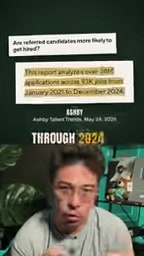
It's worth noting that this data doesn't directly prove that referrals "cause" higher interview rates. As the video points out, referred applicants may themselves be better fits for the role — they may understand the company better, have more relevant backgrounds, or have already been screened by someone on the inside.

But even with this selection bias, the data still reveals a fact: different application channels simply don't operate on the same order of magnitude when it comes to reaching an interview. When AI makes "saying you're a good fit" something anyone can do, the value of channels and endorsements is amplified.
The key mechanism behind referrals is the Employee Referral Program. Companies typically encourage existing employees to refer candidates and offer bonuses or rewards. This works because referrers often understand the referred person's abilities and role fit, effectively providing a preliminary screening. At the same time, referred candidates can usually skip the resume screening stage and go directly into the recruiter's view. From the company's perspective, the referral channel has lower recruiting costs and higher retention rates, so many companies prioritize referral applications. This explains why there's an order-of-magnitude difference in interview rates between referrals and direct applications — the channel itself comes with a trust endorsement and up-front screening.
The "Selection Bias" mentioned in the article is an important concept in statistics. Here, it means that referred candidates are not a random sample — they inherently possess certain advantageous characteristics (such as stronger backgrounds, more relevant skills, or better preparation), and these characteristics affect both "whether they get referred" and "whether they get an interview." Therefore, directly comparing interview rates between the referral group and the direct application group cannot simply be attributed to the causal effect of referrals. To accurately assess the net effect of referrals, these confounding variables need to be controlled — for example, by comparing candidates with similar backgrounds. Understanding this helps correctly interpret the data: the high interview rate for referrals is a combination of "channel effect" and "candidate quality effect."
Beyond the Resume, What's Becoming More Important
The core question the video raises is: if you want to stand out among a flood of AI-generated applications, what can you show to prove yourself, or who is willing to vouch for you so that the hiring side truly believes in you?

Two directions come up repeatedly: first, verifiable work results — portfolios, actual projects, evidence of ability that people can see; second, personal endorsements — someone who knows your work performance is willing to put in a word for you. The former answers "what can you do," the latter answers "who has seen you do it." Neither type of information is easy for AI to mass-produce, and therefore both retain their screening value.
Verifiable work results refer to evidence of ability that can be independently verified by a third party — for example, public code repositories, design portfolios, published articles, or user data from launched products. Unlike self-descriptions on a resume, a portfolio allows recruiters to directly assess a candidate's actual skill level, work methods, and output quality. In a context where AI can easily generate fluent text, the value of a portfolio lies in its resistance to mass fabrication — it requires real time investment and skill practice. For technical roles, GitHub contribution records, open-source project participation, and technical blogs are all common verifiable signals; for non-technical roles, case studies, project retrospectives, and public speaking videos can likewise provide credible proof of ability.
Practical Implications for Job Seekers
Shifting attention from "how to write a better application" to "how to accumulate verifiable evidence" is the practical advice this analysis offers. Specifically, public work and project records, building real working relationships with people in the industry, and seeking referral channels are all more effective at changing your interview odds than repeatedly polishing cover letter text.
AI hasn't made job applications useless, but it has indeed reduced the marginal value of application text and increased the weight of "evidence" and "trust." For recruiters, this means the screening process needs to rely more on verifiable signals; for job seekers, it means maintaining a long-term, visible work record is more worthwhile than hastily packaging an application with AI.
One-line Summary
AI homogenizes job applications, making referrals and verifiable results the key screening factors.
Paragraph Summary
The article explores the homogenization problem brought about by AI-generated job applications. When all cover letters become flawless, recruiters struggle to discern candidates' true abilities. Data from recruiting software company Ashby shows that between 2021 and 2024, referred candidates had an interview rate as high as 40%, while direct applicants had only 3%. Despite selection bias, the probability gap between channels is real. The article points out that verifiable work results (such as portfolios and project records) and personal endorsements (such as referrals) are differentiating signals that AI struggles to mass-produce. Therefore, job seekers should shift their energy from polishing application text to accumulating public work and real industry relationships, and recruiters need to rely more on verifiable signals for screening.
Related articles
 Tech Frontiers
Coldframe: A Honeypot Disguised as a Supermarket Freezer Controller
Coldframe is a honeypot disguised as Danfoss AK-SM 800A and Dixell XWEB freezer controllers, built as a single Python file that detects CVE-2025-41450 attempts and is identified as real devices on Shodan.
 Tech Frontiers
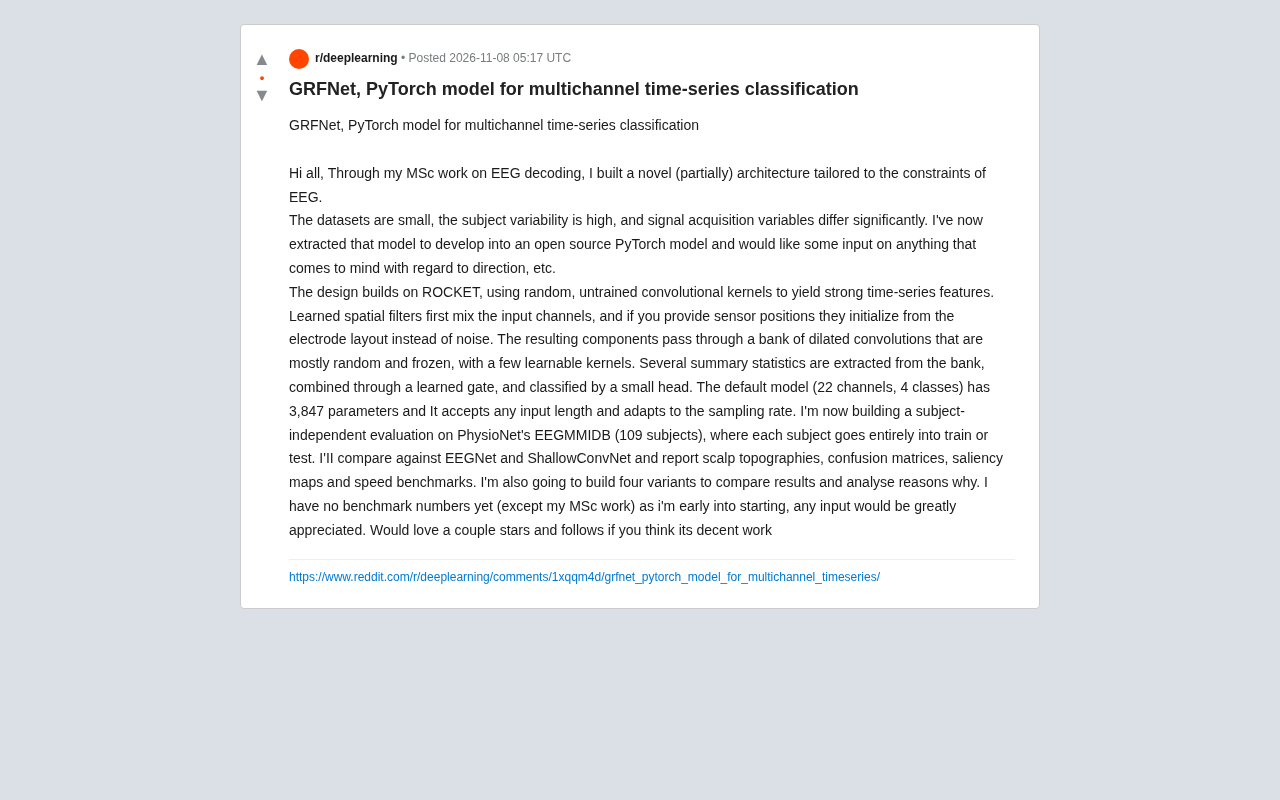
GRFNet: A Lightweight PyTorch Model Designed for Multichannel Time-Series Classification
GRFNet is a lightweight PyTorch model for multichannel time-series classification, originating from EEG decoding research. With only 3,847 parameters, it is based on the ROCKET architecture, combining random convolution kernels with learnable spatial filters, supports arbitrary input lengths, and will soon be evaluated on the PhysioNet dataset.
 Tech Frontiers
CUDA-Accelerated Rocket League Simulator: A Player-Made Hardcore Experiment
A Reddit post shows a "100% Accurate" Rocket League simulator accelerated with CUDA. We analyze its technical context, CUDA's value in game physics simulation, and the significance and limitations of such community projects.