AI Is Taking Entry-Level Jobs — How Can Newcomers Build Experience?

AI is replacing entry-level jobs, cutting off the "learning by doing" growth path for newcomers, and the training cost-sharing mechanism urgently needs restructuring.
The article points out that AI is increasingly adept at handling entry-level basic tasks, which weakens companies' motivation to hire newcomers for "learning by doing." Economic training models show that when AI can complete basic work at a lower cost, the return on investment for companies paying newcomers' learning costs declines, leading to reduced training investment. However, companies need senior employees who can harness AI more than ever before, creating a contradiction. The saying "AI does simple work, humans do difficult work" avoids the key question: simple tasks are the ladder to difficult tasks, and skipping basic practice, newcomers cannot gain the judgment and intuition to handle complex work. The cost-sharing mechanism for training urgently needs redesign, and solutions such as apprenticeships, government subsidies, and school-enterprise cooperation are still being explored but are limited in scale. Before institutional solutions are implemented, actively seeking non-standardized learning paths may be a more realistic choice.
Entry-Level Jobs: The First "Training Ground" to Disappear in the AI Era
Think back to your first job: you handled basic tasks, had your work reviewed by senior colleagues, and gradually grew through making mistakes. The company gained usable output, and you gained experience. This "learning by doing" model is the必经之路 (necessary path) for the vast majority of careers to get started.
But today, AI is becoming increasingly adept at handling these basic tasks. When companies find that AI can complete entry-level tasks at a lower cost, their incentive to hire newcomers to "practice" weakens. Economists have explored this issue in training models: technological progress reduces the value of basic work, and companies' willingness to pay for newcomers' learning costs declines accordingly.

This is not alarmist talk, but a structural change that is already happening. The core of the problem is not whether AI will completely replace humans, but rather: If basic work no longer needs to be done by people, where do newcomers get those necessary "practice opportunities"?
Training Models: Why Companies Are Unwilling to Pay for the "Novice Period"
Economists use training models to analyze this phenomenon. The core logic of the model is not complicated: companies need to pay "learning costs" for newcomers—including wages, training resources, and additional expenses caused by mistakes. When AI can complete basic work at a lower cost, the return on investment for companies paying newcomers' learning costs declines.
To be clear, this does not prove that training will disappear. On the contrary, companies need senior employees who can skillfully use AI more than ever before. But the contradiction is: Someone has to pay for those "early learning years," and now no one is willing to bear this responsibility.
According to economists' analysis, the essence of this dilemma is the problem of cost sharing. The benefits of training are shared by employees and companies, but who bears the cost is becoming increasingly unclear. When AI reduces the "practice value" of basic work, companies naturally tend to reduce investment in training newcomers.

Human capital theory is an important background for understanding this dilemma. Economist Gary Becker proposed in the 1960s that human capital can be divided into two types: general and specific. General skills (such as communication, basic programming) are valuable in multiple companies, and employees may be willing to invest in learning them themselves; while specific skills (such as internal company processes, specific customer knowledge) are only valuable to the current employer, so companies are more motivated to bear the training costs.
The impact of AI is that it simultaneously lowers the market value of the "entry-level portion" of both types of skills. Companies find that letting AI handle basic tasks is more cost-effective than investing in newcomers learning general skills. As a result, specific skills training that should have been borne by companies is also delayed—because newcomers don't even have a solid general foundation, companies are even less willing to take risks. This explains why the "cost sharing" problem in training models has become particularly acute in the AI era.
The Paradox of "AI Does Simple Work, Humans Do Difficult Work"
A saying is popular in the business world: let AI handle simple tasks, and humans focus on difficult and high-value work. This sounds beautiful, but it avoids a key question: Simple tasks are the ladder to difficult tasks. Skipping basic practice, how can people gain the ability to handle complex problems?
The implicit assumption of this division of labor model is that the ability to do difficult work can appear out of thin air, or be acquired through other means. But the reality of career growth is that most judgment, intuition, and professional skills are gradually accumulated through handling a large number of basic tasks. Without those seemingly "low-value" exercises, so-called "high-value work" becomes a castle in the air.

The "ladder effect" in skill acquisition has long been discussed in cognitive science and career development research. Psychologist Herbert Simon's research on expertise formation pointed out that experts can quickly recognize patterns and make judgments because they have accumulated a large number of "chunks"—these chunks come from the experience of repeatedly handling basic cases. Without handling enough simple tasks, the brain cannot build these pattern libraries, and so-called "intuition" and "judgment" cannot be discussed.
In the AI division of labor model, if newcomers directly face complex tasks, what they lack is precisely this chunk accumulation process. They may use AI tools to complete output, but they have not internalized the decision logic behind it. Once AI tools fail or encounter problems beyond the training distribution, they lack the ability to respond independently. Therefore, "AI does simple work" seems to release human labor, but in fact it may cut off the necessary path for expertise formation.
Who Should Pay for "Early Learning"?
There is no simple answer to this question. Companies worry about training talent for competitors, individuals find it difficult to bear learning costs alone, and there is always a gap between the education system and workplace needs.
One possible approach is to redefine the value of "entry-level jobs." If AI takes over repetitive tasks, newcomers' work content might shift to AI supervision, result verification, and more complex collaborative tasks—but these positions themselves require a certain level of judgment, which brings us back to the starting point of "where does experience come from."
Another approach is to make the cost-sharing mechanism for training more transparent. Apprenticeships, government subsidies, school-enterprise cooperation, and other models are being explored, but their scale and coverage are still limited. The question raised by the video author hits the core: when companies say AI will handle simple work and humans will handle difficult work, if no one hires you to start, how do you learn those difficult things?

Conclusion: An Unanswered Structural Problem
AI replacing entry-level jobs is not a simple story of "technology replacing human labor." It touches the foundation of the vocational training system: the path of experience accumulation is being cut off, and a new path has not yet been established.
Companies need senior talent who can harness AI, which反而 (on the contrary) amplifies the demand for newcomers—but only if someone is willing to invest in their growth. Before a new balance is found in the cost-sharing mechanism, "how newcomers get started" will remain an unresolved problem. For those about to enter the workplace or who are transitioning, actively seeking non-standardized learning paths may be more realistic than waiting for institutional solutions.
Related articles

Mysterious Synchronized Disturbances Hit Global Power Grids — German Team Finds the Culprit
Mysterious synchronized power drops hit grids worldwide. A German team found the culprit. This article explains the coordinated disturbances, the research breakthrough, and what it means for grid monitoring and operations.
NVIDIA Board Investigates Espionage Ca…
NVIDIA Board Investigates Espionage Case: CEO's Admission of Extramarital Affair Sparks Internal Turmoil
NVIDIA's board has launched an espionage investigation following the CEO's admission of an extramarital affair. This article analyzes the background, corporate governance logic, and potential impact on NVIDIA, noting that current information is limited and should be viewed rationally.
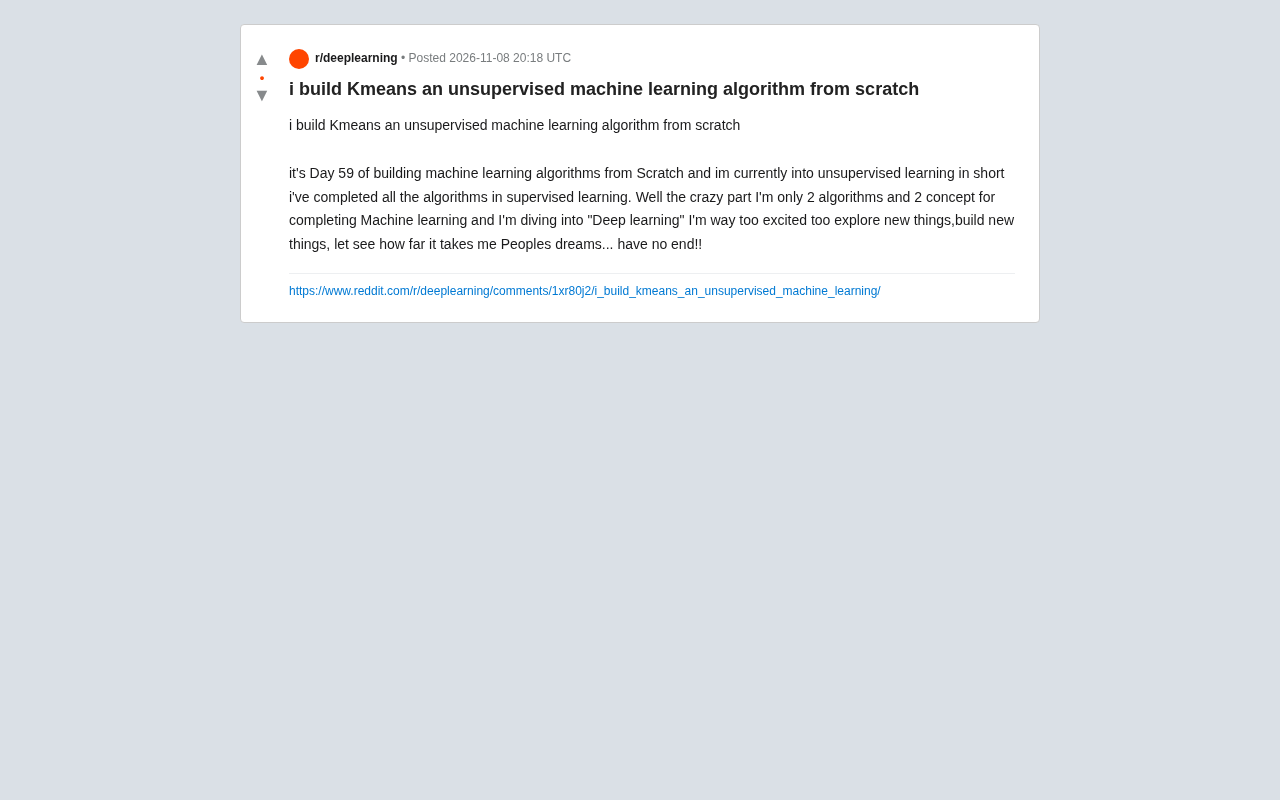
Writing K-Means from Scratch: One Developer's Journey into Machine Learning
A developer shares day 59 of writing K-Means from scratch: finishing all supervised learning algorithms and entering unsupervised learning, covering K-Means++ initialization, vectorized distances, convergence and empty clusters.