AI Large Model Fine-Tuning Full Process in Practice: Thirteen Lessons from Data to Deployment
Bilibili's 13-lesson fine-tuning course covers principles, data engineering, and three major scenario projects.
This article outlines the framework of a 13-lesson practical large model fine-tuning course on Bilibili. The course progresses through three stages: first, it explains underlying principles such as efficient fine-tuning and reinforcement learning as well as data engineering methods; then it implements three typical scenarios in a project-driven way—RAG embedding model fine-tuning, distilling large models into small models, and natural language data analysis; finally, it integrates what has been learned through a comprehensive financial industry project. The article emphasizes that data engineering is the foundation of fine-tuning performance and that the value of the full-process demonstration lies in closed-loop iteration from requirements analysis to effect evaluation. It also reminds readers that the content is essentially promotion for a paid course and that 13 lessons have limited depth, making it more suitable as a systematic introductory reference; it also suggests that self-learners borrow its framework and maintain a closed-loop mindset.
Fine-tuning large models is a key technique for adapting general-purpose models to business scenarios, but most tutorials either focus too heavily on theory or demonstrate only a single step. Recently, a 13-lesson practical course on Bilibili has attempted to explain the complete pipeline of fine-tuning from principles to project deployment. This article, based on that course, outlines its teaching framework and core methodology for developers looking for an entry path into fine-tuning.
Course Framework: Three Progressive Stages
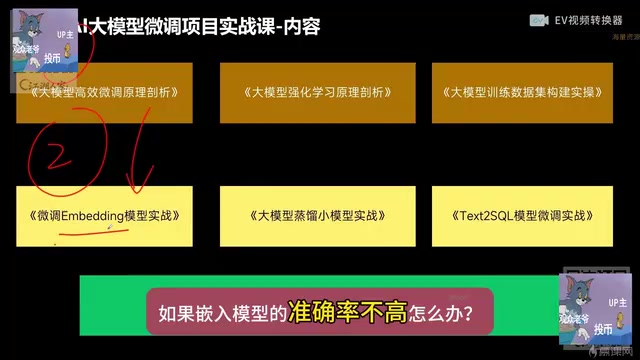
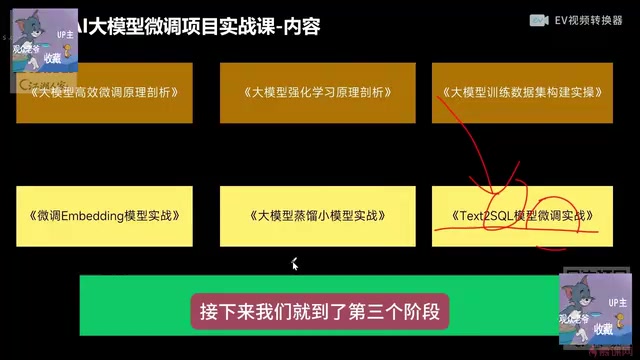
According to the course introduction, the entire content is divided into three major stages. The first stage focuses on foundational knowledge, covering the underlying mechanisms of techniques such as efficient fine-tuning and reinforcement learning. The second stage selects several typical scenarios from post-training and implements them hands-on in a project-driven manner. The third stage is a comprehensive financial industry project, which the course says required 76 lessons in total to explain fully.
The logic behind this progressive design is: first build an understanding of training principles, then accumulate hands-on experience through scenario-based projects, and finally integrate what has been learned in a complex business context. For self-learners, a clear learning path is often more valuable than scattered technical points.
Principles and Data Engineering: The Foundation of Fine-Tuning
The course emphasizes that whether doing reinforcement learning, efficient fine-tuning, or post-training, one step is indispensable—data engineering. The course describes it as "how to turn these data into valuable sequence datasets" and says it will explain the methodology and requirements in depth.
This judgment is consistent with engineering practice. The upper limit of fine-tuning performance is largely determined by data quality; instruction formats, sample distribution, deduplication, and cleaning strategies all directly affect model behavior. Many fine-tuning projects fail not because of the training script, but because hidden problems were planted during the data preparation stage.
In the context of fine-tuning, "sequence dataset" usually refers to converting raw corpus into input-output pairs that the model can consume, with the format determined by the training objective: instruction fine-tuning requires constructing instruction-response pairs, distillation requires teacher model outputs as labels, and embedding model fine-tuning requires positive and negative sample pairs. The serialization process involves details such as truncation length, padding strategy, and insertion of special tokens, and these details directly affect the distribution the model learns. In addition, data engineering also includes sample deduplication (to avoid training set leakage), difficulty stratification (to prevent simple samples from dominating the gradient), and quality filtering (to remove low-quality or harmful content). A common industry practice is to first conduct small-scale manual verification, then use rules or model scoring for batch cleaning, and finally sample by task difficulty and type to balance training efficiency and generalization ability.
Three Typical Scenarios: Embedding Models, Distillation, and Data Analysis
The scenario choices in the second stage are quite representative. The first is fine-tuning embedding models in a RAG knowledge base scenario—when the retrieval accuracy of an embedding model is not ideal, fine-tuning the embedding model itself is a common solution. The course demonstrates this process in a project-driven way.
The second scenario is distillation. Enterprises often have limited computing resources and need smaller models that match their business capabilities, so the course demonstrates how to distill a usable small model from a large model.
The third scenario is intelligent analysis: asking questions in natural language and using a large model to generate analysis code to complete data analysis. However, open-source models are weaker and less accurate on such tasks, so fine-tuning is needed to improve performance. These three scenarios correspond to three types of real needs—retrieval, compression, and generative analysis—and cover a relatively broad range.
Fine-tuning embedding models differs fundamentally from fine-tuning generative models in objectives and methods. Embedding models output vector representations, and training usually adopts a contrastive learning framework: semantically similar sample pairs are treated as positives and unrelated ones as negatives, and retrieval ranking ability is optimized by pulling positive pairs closer and pushing negative pairs farther apart. Common practices include using hard negative mining to improve discrimination and mixing multi-task data during training to prevent overfitting. Evaluation does not look at loss but at retrieval metrics such as Recall@K and MRR. Therefore, when RAG retrieval is inaccurate, the first step is to determine whether the problem is insufficient semantic discrimination in the embedding model or issues with the chunking strategy or index structure, and then decide whether fine-tuning is worth the investment.
The core of knowledge distillation is to make a small model (student) imitate the behavior of a large model (teacher). Common forms include response distillation (using teacher-generated answers as supervision signals) and logit distillation (aligning output probability distributions or intermediate representations). In enterprise deployment, the value of distillation lies in transferring the business capabilities of large models to models with fewer parameters and lower inference costs. But distillation is not simple copying: the student model has limited capacity, so trade-offs are needed in data ratios, temperature parameters, and loss functions, while also being careful that teacher model errors are not inherited. In practice, it is usually necessary to retain some real labeled data for calibration and to conduct targeted evaluations of the distilled model in key scenarios.
Full Process Demonstration: A Closed Loop from Requirements to Evaluation
A major feature claimed by the course is a full-process demonstration: from requirements analysis and technology selection to open-source model download and deployment, dataset construction, script development, process optimization, and then effect evaluation. The course specifically mentions that if evaluation results fall short of expectations, it will analyze the reasons and go through the process again.
This closed loop is precisely the part most easily skipped in real projects and the part that most tests an engineer's abilities. Most tutorials stop at "training completed, loss decreased," while real deployment requires repeated iteration: identifying whether the problem lies in data, hyperparameters, or evaluation criteria. By including this iterative process in the demonstration, the course offers practical reference value for learners.
Course Features and Target Audience
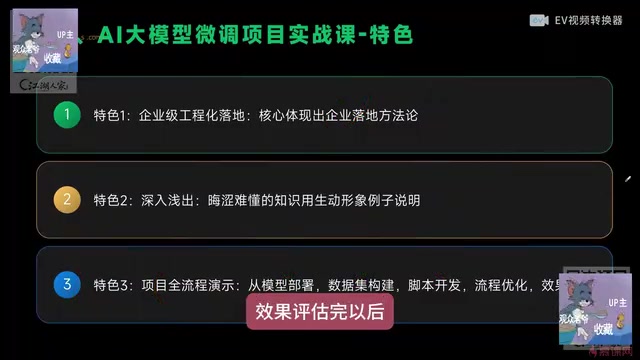
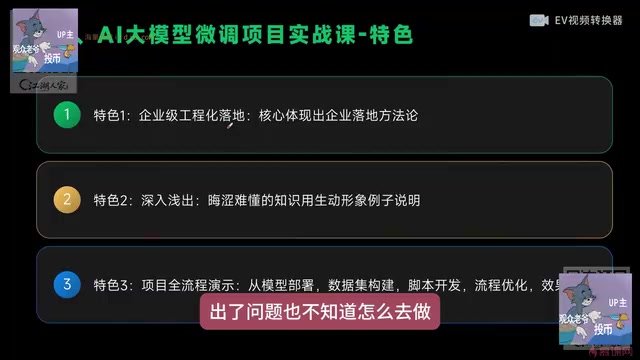
The course summarizes two features: first, it is oriented toward engineering deployment and summarizes enterprise deployment methodologies; second, it explains things in an accessible way, using plain language and vivid examples to explain the underlying principles that cannot be avoided in efficient fine-tuning, reinforcement learning, and distillation. The course also provides supporting materials such as slides, code, manuals, data, and scripts.
Regarding the target audience, the course lists three groups: learners who want to study reinforcement learning, efficient fine-tuning, distillation, and other technologies in depth; people who want to enrich their resumes through high-value projects and apply for AI positions; and practitioners who already have a foundation in AI large models and hope to improve from beginner or intermediate to intermediate-advanced levels.
An Objective View: Course Promotion and Self-Study Advice
It should be noted that this content is essentially a promotional introduction to a paid course. The descriptions of "full process" and "sense of value" in the text have marketing overtones, and learners still need to judge the actual course quality for themselves. In addition, 13 lessons covering principles, data engineering, and three scenario projects may have limited depth in each part, making it more suitable as systematic introductory material than as material for mastery.
If you want to learn fine-tuning on your own, you can borrow its framework: first fill in the gaps in data engineering and training principles, then choose a scenario close to your own business and walk through the complete process once, and finally review the iterative logic in the evaluation stage. Supporting open-source code and datasets are not hard to find in the community; the key is to maintain a closed-loop awareness from requirements to evaluation.
One-line Summary
A 13-lesson fine-tuning course on Bilibili covers principles, data engineering, and three major scenario projects.
Paragraph Summary
This article outlines the framework of a 13-lesson practical course on large model fine-tuning on Bilibili. The course progresses through three stages: first, it explains underlying principles such as efficient fine-tuning and reinforcement learning as well as data engineering methods; then it implements three typical scenarios in a project-driven way—RAG embedding model fine-tuning, distilling large models into small models, and natural language data analysis; finally, it integrates what has been learned through a comprehensive financial industry project. The article emphasizes that data engineering is the foundation of fine-tuning performance and that the value of the full-process demonstration lies in closed-loop iteration from requirements analysis to effect evaluation. It also reminds readers that the content is essentially promotion for a paid course and that 13 lessons have limited depth, making it more suitable as a systematic introductory reference; it also suggests that self-learners borrow its framework and maintain a closed-loop mindset.
Related articles

Gemini 4 Carbon Tops Global Rankings as AI Productivity and Open-Source Ecosystems Surge
Google DeepMind's Gemini 4 Carbon tops global benchmarks, built for complex agents and system security. ByteDance launches Doubao Work integrated with Feishu, Anthropic's AI autonomously breaches 5 system-level attack chains, and ModelBest and Fudan open-source on-device multimodal and image generation models.

Overseas Creator Breaks Down N8n AI Agent Business Playbook: From Tooling to Monetization
An overseas creator breaks down the N8n AI agent business playbook: comparing Zapier, Make, and N8n, detailing four monetizable automation categories—lead capture, WhatsApp follow-up, booking, and content pipelines—plus agency pricing and a sales playbook.

Empacer: The Voice-First AI Assistant for Small Business Owners That Topped Product Hunt
Empacer is a voice-first AI assistant for small business owners: three-question setup, voice requests turned into customer replies, social posts, and invoices—all owner-approved. It won #1 Product of the Day on Product Hunt with 231 upvotes and 47 comments.