AI Math Foundations: Linear Algebra Video Series Explained

Reddit creator shares a linear algebra video series for *Math for AI & ML*, covering core topics from vector spaces to SVD, offering AI learners a systematic math foundation.
The article introduces a YouTube video series created by a Reddit creator for *Math for AI & ML*, covering linear algebra. Spanning Chapters 1–10, it covers vector spaces, inner products, matrix operations, subspaces, orthogonality, QR/LU decomposition, eigendecomposition, symmetric matrices, and SVD—the mathematical bedrock for neural networks, dimensionality reduction, and recommendation systems. The article notes that many AI papers assume readers already grasp these concepts, making it hard for those with weak foundations. The series combines theory with explanation, giving self-learners a path to follow. The author suggests adding more AI examples (like SVD for word embedding dimensionality reduction) and setting per-chapter goals to reduce dropout. Suitable for AI self-learners with weak math backgrounds and practitioners reviewing linear algebra from an AI perspective, it fills the gap between fragmented tutorials and heavy textbooks.
Why Linear Algebra Is the Cornerstone of AI
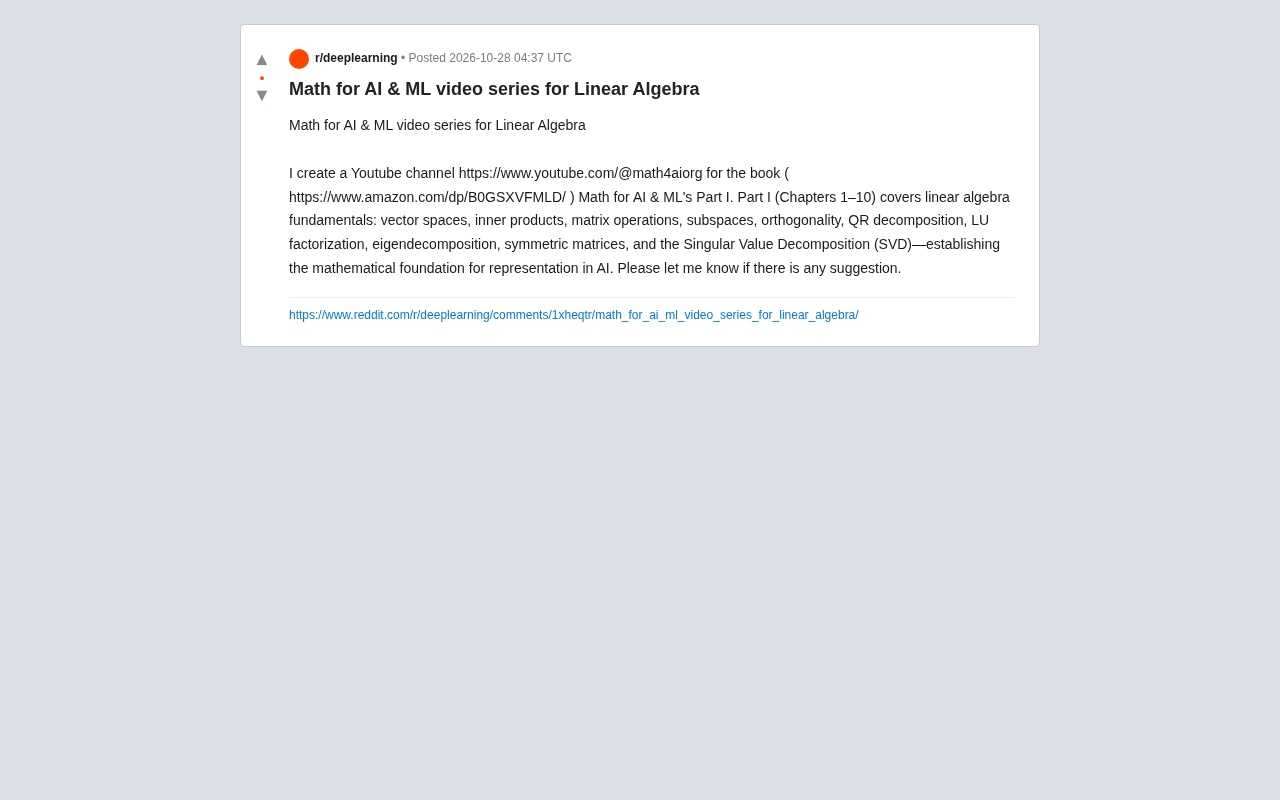
Recently, I came across a Reddit post where a creator shared a YouTube video series he made for the book Math for AI & ML, specifically covering the linear algebra portion. This got me thinking: many people who want to get into AI dive straight into frameworks and models, but overlook the underlying mathematical language. And linear algebra happens to be the most natural tool for describing "representation"—a core concept in AI.
The creator explained in the post that his video series corresponds to Part I of the book (Chapters 1 through 10), covering vector spaces, inner products, matrix operations, subspaces, orthogonality, QR decomposition, LU decomposition, eigendecomposition, symmetric matrices, and singular value decomposition (SVD). These topics essentially form the mathematical bedrock for understanding neural networks, dimensionality reduction, recommendation systems, and other applications.
Core Topics Covered in the Video Series
Looking at the chapter arrangement, this learning path is thoughtfully designed. It doesn't start by piling on formulas; instead, it begins with vector spaces and inner products to build intuition about "length" and "angle," then transitions to matrix operations and subspaces. This order follows cognitive principles: understand the geometric meaning first, then handle algebraic operations.
From Decompositions to SVD: The Most Common Tools in AI
QR and LU decompositions are classic methods in numerical computation, while eigendecomposition and SVD appear extremely frequently in AI. For instance, SVD is used for matrix completion in recommendation systems and for latent semantic analysis in natural language processing; eigendecomposition is closely tied to principal component analysis (PCA) and is fundamental to dimensionality reduction. The special properties of symmetric matrices also make many optimization problems solvable.
Why This Content Matters for AI Learners
Many AI papers and textbooks assume readers already understand these linear algebra concepts and directly use terms like "projection," "orthogonal basis," and "low-rank approximation." Without a solid foundation, reading papers becomes a struggle with mathematical notation. The value of this video series lies in mapping the book's theory to video explanations, giving self-learners a path they can follow.
Suggestions for the Creator and the Value of This Content
The post author sincerely asks for feedback at the end. From a content creator's perspective, this series has already tapped into a pain point in AI math education: there are plenty of linear algebra courses on the market, but content specifically tailored to AI/ML contexts—connecting mathematical concepts to AI application scenarios—is still scarce. Adding more AI examples in the videos, such as using SVD to explain dimensionality reduction in word embeddings, or using eigendecomposition to illustrate how PCA works, would make it more engaging.
Additionally, the one-to-one correspondence between the video series and book chapters is friendly for systematic learning, but it also means viewers need a certain level of self-discipline. Consider starting each chapter with a small goal like "what you'll be able to do after finishing this" to reduce the likelihood of giving up midway.
Who This Is For
This series suits two types of people: first, learners who are self-studying AI but have weak math foundations—they can use it as a companion to the textbook; second, practitioners who want to review linear algebra and re-understand these concepts from an AI perspective. If you're already familiar with the content, you can also use it as a knowledge index for quickly revisiting key definitions and decomposition methods.
Overall, systematic math videos like these, initiated by individual creators, fill the gap between fragmented tutorials and heavy textbooks. Although it's currently just a shared post on Reddit, the learning demand it points to is real. For AI learners, investing time in building a solid linear algebra foundation yields far higher long-term returns than chasing new frameworks.
One-line Summary
A Reddit creator shares a linear algebra video series for Math for AI & ML, covering core topics from vector spaces to SVD, offering AI learners a systematic math foundation.
Paragraph Summary
The article introduces a YouTube video series created by a Reddit creator for the book Math for AI & ML, specifically covering linear algebra. The series corresponds to Chapters 1–10 of the book and covers vector spaces, inner products, matrix operations, subspaces, orthogonality, QR/LU decomposition, eigendecomposition, symmetric matrices, and SVD. These topics are the mathematical bedrock for understanding neural networks, dimensionality reduction, recommendation systems, and other AI applications. The article notes that many AI papers assume readers already grasp these concepts, making it difficult for those with weak foundations. The video series combines theory with explanation, providing self-learners a path to follow. The author suggests the creator include more AI examples (such as using SVD to explain word embedding dimensionality reduction) and set learning goals for each chapter to reduce dropout rates. The series is suitable for AI self-learners with weak math backgrounds and practitioners who want to review linear algebra from an AI perspective, filling the gap between fragmented tutorials and heavy textbooks.
Related articles

Mistral Large 4 Open-Sources a Trillion Parameters, Microsoft Offers Voluntary Severance to 60,000 Employees
Mistral Large 4 open-sources a trillion-parameter multimodal model with a coding agent score of 48; SanDisk earnings show AI inference reshaping NAND demand; Google Gemini adds in-app file editing, OpenAI raises Codex quotas, and Microsoft offers voluntary severance to 60,000 employees.
Mistral Large 4 Opens Its Weights: AI Morning Brief Roundup of Models and Ecosystem Trends
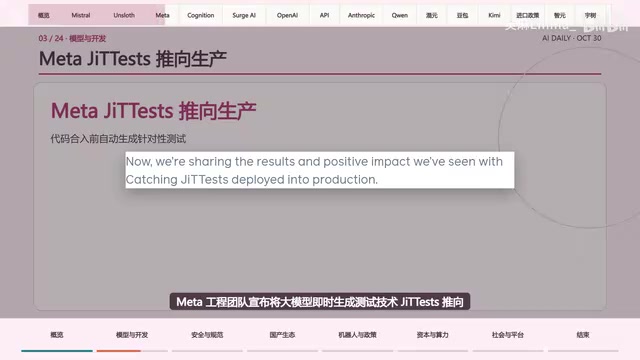
Mistral Large 4 opens its weights, a 1-trillion-parameter MoE architecture that can run locally on MacStudio; Meta's test-generation technology enters production; top tax benchmark pass rate only 10.8%; Canadian government takes a stake in Cohere; Doubao Work opens third-party model calls. This AI Morning Brief rounds up model, ecosystem, capital, and policy developments.
Mistral Large 4 Goes Open Source: A 1T-Parameter European Qwen Challenging DeepSeek
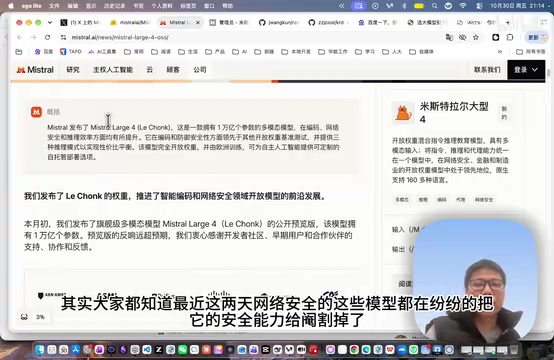
Mistral Large 4 is now open source: 1T total parameters, 52B activated, focused on coding and cybersecurity, with ~610G NVFP4 weights. We analyze its comparison with DeepSeek V4 Flash, API pricing, demo realism, and local deployment value.