AI Music Copyright Storm: Suno Sued Again by Elvis Presley and Eminem Rights Holders
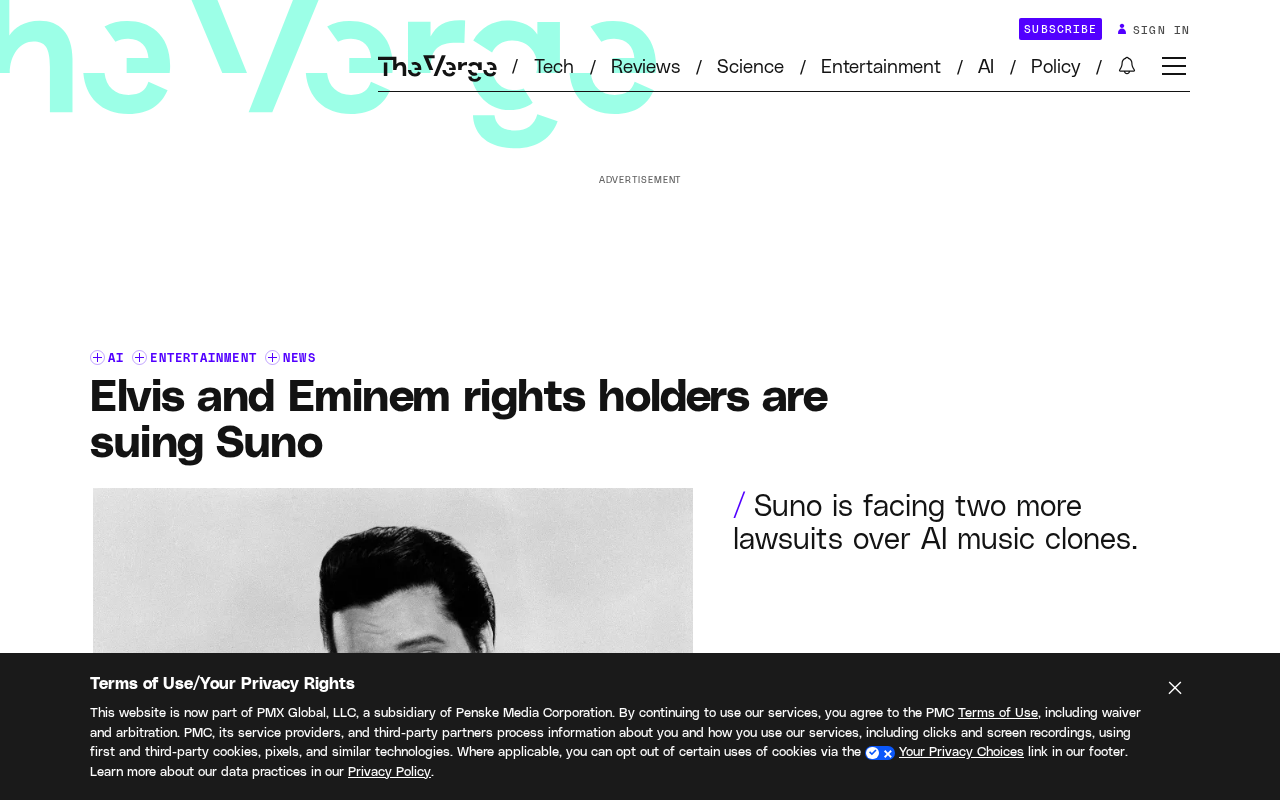
Elvis and Eminem rights holders sue Suno, escalating the AI music copyright dispute.
AI music generation platform Suno faces another copyright lawsuit, with Elvis Presley's music rights holders and some of Eminem's record publishers filing separate suits, accusing its AI model of unauthorized training and generating music and lyrics imitating these artists. The Elvis case invokes Tennessee's "ELVIS Act," which prohibits unauthorized AI imitation of voices; the Eminem case alleges Suno copied classic lyrics and rhythmic structures. Previously, the RIAA sued Suno and Udio on behalf of giants like Universal and Sony. The lawsuits may force AI music companies to adjust training data strategies or seek licensing partnerships, while pushing the industry to establish clearer copyright mechanisms. The case outcomes will directly affect the usability of AI music tools and creative freedom.
AI music generation platform Suno is facing a new round of copyright lawsuits. According to RSS sources, a group of rights holders for Elvis Presley's musical works and the publishers of some of Eminem's hit records have separately filed lawsuits against Suno, accusing it of illegally generating music and lyrics that imitate these artists. This is yet another batch of legal challenges Suno has recently encountered.
The Core of the Lawsuits: Does AI-Generated Content Constitute Infringement?
Both lawsuits focus on whether Suno's AI model used copyrighted works without authorization to train and generate similar content. Lawyers in the Elvis case argue that Suno violated Tennessee law—the state previously passed legislation aimed at protecting voice and likeness rights, known as the "ELVIS Act." The plaintiffs contend that the music and lyrics generated by Suno directly imitate Elvis's distinctive style, infringing on the rights holders' legitimate interests.
Eminem's publishers' complaint emphasizes that when generating rap music, Suno appears to have "copied" the lyrics and rhythmic structure of Eminem's classic works, resulting in output highly similar to the originals. Both cases demand that Suno cease infringing activities and pay damages.
The copyright issue of AI training data is a core point of contention in global judicial practice today. AI music models typically require massive amounts of copyrighted music for training to learn musical structure, style, and lyric patterns. The dispute is: does this training constitute "fair use"? The four fair use factors in U.S. copyright law—the purpose and character of the use, the nature of the original work, the amount and substantiality of the portion used, and the effect on the potential market for the original—have no unified precedent in the AI context. Suno may argue that its generated content is transformative, but rights holders believe the output is highly similar to the originals and constitutes market substitution. Furthermore, even if training occurs outside the U.S., as long as the service targets U.S. users, it may still be subject to U.S. law. This legal uncertainty is precisely the focus of multiple ongoing lawsuits.
Suno's Copyright Controversies Are Not New
This is not the first time Suno has been brought to the defendant's stand over copyright issues. Previously, the RIAA (Recording Industry Association of America), representing giants like Universal Music and Sony Music, filed similar lawsuits against Suno and another AI music company, Udio, accusing them of large-scale infringement of sound recording copyrights. The addition of Elvis and Eminem rights holders means the litigation battlefield has expanded from major record labels to individual artist estates and independent publishers.
Cross-verification of multiple sources shows that Suno's business model has long operated in a copyright gray area. Its AI model is trained on massive music data, and users only need to input prompts to generate complete songs, including vocals and accompaniment. While this capability has sparked discussions about democratizing creativity, it has also continuously angered the traditional music industry.
The RIAA (Recording Industry Association of America) is the representative trade organization for the U.S. recording industry, with members including major record companies such as Universal Music, Sony Music, and Warner Music. In June 2024, the RIAA filed a large-scale copyright infringement lawsuit against Suno and Udio on behalf of the three major record companies, accusing both companies of using copyrighted sound recordings without authorization to train AI models and generating output substantially similar to the originals. This is one of the most emblematic legal actions the music industry has taken against generative AI platforms, with damages potentially reaching billions of dollars. The RIAA's litigation strategy focuses on sound recording copyright, while the Elvis and Eminem rights holders' lawsuits focus on voice likeness rights and lyric copyright respectively, forming a multi-dimensional pincer attack.
Tennessee Law Becomes a New Weapon
The Tennessee law cited in the Elvis case deserves attention. The state is a heavyweight in country and rock music, and its legislature takes a hard line on AI imitating real voices. The relevant law explicitly prohibits the unauthorized use of AI technology to simulate someone's voice or likeness and allows rights holders to file lawsuits. This legal framework provides a reference for legislation at the state and federal levels.
According to discussions by Bilibili creators and YouTube legal analysis channels, the applicability of Tennessee law may become key to the case. If the court determines that Suno's output constitutes "imitation" of Elvis's voice, even if model training occurred in other states, it may still be subject to the law because the service targets Tennessee users.
The ELVIS Act is a law signed into effect in Tennessee in March 2024, officially titled the "Ensuring Likeness, Voice, and Image Security Act," whose acronym coincidentally echoes the name of Elvis Presley. The law explicitly includes "voice" within the scope of protected likeness rights, prohibits the unauthorized use of AI and other technological means to simulate someone's voice, and allows rights holders to file civil lawsuits. Notably, the law targets not only direct imitation but also covers the "deceptive" use of voices, and its protection extends to deceased celebrities. As a heavyweight state in the country and rock music industries, Tennessee's move is seen as a direct response to the impact of AI-generated content on the music industry and provides a model for legislation in other states.
Impact on the AI Music Industry
The succession of lawsuits is reshaping the rules of the AI music generation field. On one hand, companies like Suno and Udio may be forced to adjust their training data sources and seek licensing agreements with rights holders; on the other hand, venture capital institutions may become more cautious about the AI music sector.
However, some argue that copyright litigation will push the industry to establish clearer licensing mechanisms. Just as similar legal disputes in the early days of music streaming eventually gave rise to new business models, AI music may also find a balance through this tug-of-war. Suno has not yet publicly responded to the latest lawsuits, and the progress of the cases remains to be seen.
Conclusion
The lawsuits by Elvis and Eminem rights holders are another emblematic event in the collision between AI-generated content and copyright law. As legal boundaries gradually become clearer, AI music companies need to choose between innovation and compliance. For content creators and musicians, the outcome of these lawsuits will directly affect the usability of future AI tools and creative freedom.
One-line Summary
Elvis and Eminem rights holders sue Suno, escalating the AI music copyright dispute.
Paragraph Summary
AI music generation platform Suno faces another copyright lawsuit, with Elvis Presley's music rights holders and some of Eminem's record publishers filing separate suits, accusing its AI model of unauthorized training and generating music and lyrics imitating these artists. The Elvis case invokes Tennessee's "ELVIS Act," which prohibits unauthorized AI imitation of voices; the Eminem case alleges Suno copied classic lyrics and rhythmic structures. Previously, the RIAA sued Suno and Udio on behalf of giants like Universal and Sony. The lawsuits may force AI music companies to adjust training data strategies or seek licensing partnerships, while pushing the industry to establish clearer copyright mechanisms. The case outcomes will directly affect the usability of AI music tools and creative freedom.
Related articles

Microsoft WebIQ: Verifiable Real-Time Web Grounding for AI Agents
Microsoft WebIQ gives AI Agents real-time, citable web grounding across web, news, images, videos, and Places—164ms P95 latency, 50% fewer tokens, Scopes source control, and MCP integration.
Augmentable Gaussian Splatting: Building Photorealistic Simulation Environments for Robot Training
Team combines Gaussian Splatting with meshes to build photorealistic robot simulation environments, integrating MuJoCo Warp physics and Franka Panda for augmentable, relightable real-site simulation.

Gemini 4 Carbon Released: The Leap from Gemini 3 to Gemini 4 in Under a Year
Google releases Gemini 4 Carbon, less than a year after Gemini 3. In the official demo, Carbon reverse-engineered the Theme Park binary, added a new DeepMind-themed ride, and ported it to the web in one shot.