AI Receptionist Still Sounds Robotic? Roofing Contractor Tests Retell vs. Bland
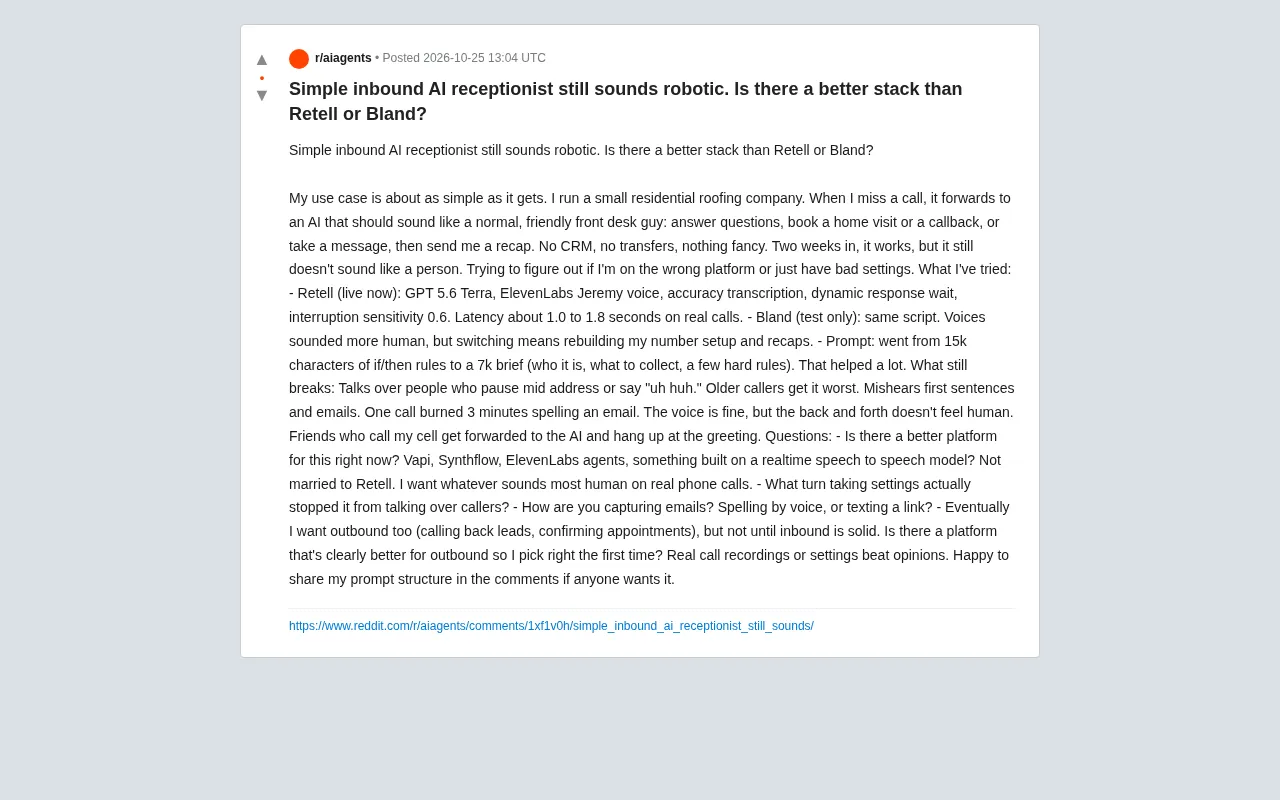
Small roofing company uses AI receptionist; functionality works but conversation sounds robotic, revealing turn-management and speech-recognition gaps.
A small roofing company owner handed missed calls to an AI receptionist. Within two weeks, Q&A, booking, and summary features worked, but the "doesn't sound human" problem persisted. He uses Retell (GPT 5.6 Terra, ElevenLabs Jeremy voice, interruption sensitivity 0.6, latency 1.0-1.8s) and also tested the more natural-sounding Bland. Core pain points center on turn management: the AI misjudges pauses and "uh huh" as end of turn and talks over callers, with elderly users most affected; first-sentence and email recognition also frequently fail. Compressing the prompt from 15k to 7k characters helped noticeably, and he's considering SMS links instead of voice spelling. Candidate platforms include Vapi, Synthflow, ElevenLabs agents, and real-time voice models, but no recording-level comparisons exist yet.
A small residential roofing company owner routed missed calls to an AI receptionist, hoping it would answer questions, book site visits or callbacks, take messages, and send him a summary—like a friendly front-desk guy. After two weeks, the functionality worked, but the "doesn't sound human" problem remained unsolved: the AI interrupts callers who pause mid-sentence, is especially unfriendly to elderly users, frequently mishears the first sentence and email addresses (once spending three minutes spelling out a single email). He posted on Reddit asking for help, wondering whether he chose the wrong platform or just didn't tune the parameters right.
Two Stacks Tested: Retell and Bland
According to the operator, he currently uses Retell, configured with the GPT 5.6 Terra model, ElevenLabs' Jeremy voice, accurate transcription mode, dynamic response waiting, interruption sensitivity set to 0.6, and real-call latency of about 1.0 to 1.8 seconds. He also tried Bland with the same script—the voice sounded more human—but switching would mean rebuilding number settings and the summary workflow, so for now it's just a test.
His prompt went through a major diet: from 15,000 characters of if/then rules compressed to 7,000 characters of brief instructions, keeping only "who you are, what to collect, and a few hard rules." This step brought clear improvement. But the remaining problems center on interaction rhythm—the voice itself is fine, but the back-and-forth doesn't feel human. A friend called his mobile, got transferred to the AI, and hung up immediately upon hearing the opening line.
Interruptions and Talk-Overs: The Real Challenge of Turn Taking
The core pain point in the post is turn management. When a caller pauses mid-address, or says "uh huh," the AI talks over them. This phenomenon is common in voice interaction: the model misjudges a pause as end of turn, or treats filler words as valid input. The operator turned interruption sensitivity down to 0.6, but it still didn't fix the root cause.
He mentioned that elderly users are affected the most, which actually points to an underappreciated variable—different groups vary greatly in speech rate, pausing habits, and confirmatory filler words. A fixed threshold struggles to accommodate both "crisp-speaking middle-aged callers" and "thinking-out-loud elderly callers." A more reasonable approach combines VAD silence thresholds with semantic completeness judgment, rather than relying on a single interruption sensitivity value. However, the original post doesn't specify which parameter combinations he tried, so this part remains an open question.
Voice Activity Detection (VAD) and Semantic Completeness Judgment
Voice Activity Detection (VAD) is a fundamental component in voice interaction, responsible for determining "speech start" and "speech end" from a continuous audio stream. Traditional VAD relies solely on energy thresholds or spectral features, declaring end of turn once silence exceeds a set duration. But in real calls, a speaker's mid-sentence pause (thinking, breathing, organizing thoughts) is acoustically indistinguishable from actually finishing—silence-duration thresholds alone inevitably produce misjudgments.
Semantic completeness judgment adds a layer after VAD: when a suspected end of turn is detected, a lightweight language model judges whether the current transcript forms a complete semantic unit (e.g., whether an address includes a house number, whether a question has been fully asked). The combined strategy is usually: VAD proposes candidate endpoints, the semantic model confirms, and only when semantics are complete does the AI respond—otherwise the waiting window is extended. This is more refined than simply lowering interruption sensitivity, at the cost of 100–300 ms additional latency, requiring a trade-off between "not talking over" and "responding promptly."
Email and First-Sentence Recognition: Structural Weaknesses in Voice Scenarios
Spending three minutes spelling an email is a typical failure of speech-to-text on character-level tasks. Names, emails, and house numbers demand extremely high accuracy, while phone audio quality, accents, and background noise amplify errors. In the post he asked about two directions: continue with voice spelling, or switch to sending an SMS link for the caller to fill in themselves.
From an engineering perspective, the latter is more robust. Voice spelling essentially stuffs a character-recognition problem into a pipeline designed for natural language, whereas an SMS link returns structured input to the user, reducing both error rate and time. The original post doesn't say whether he has tried the SMS approach—only lists it as a to-verify option.
Voice Spelling and Character-Level Recognition
Voice spelling refers to users dictating strings like emails and names letter by letter, with the system performing character-level transcription. This is fundamentally different from natural language transcription: natural language has grammar and context for the language model to correct errors, whereas individual letters (e.g., B/P, M/N, S/F) are easily confused in narrowband phone audio (300–3400 Hz), and there are no semantic constraints between letters. English also has special readings like "double u" and "double r," plus users' spontaneous "B as in boy" clarifications, further complicating parsing.
Common engineering mitigations include: guiding users with the NATO phonetic alphabet, providing candidate confirmation on the UI side, or simply abandoning voice spelling in favor of SMS/web forms. The latter essentially converts unstructured voice input into structured text input, fundamentally bypassing the accuracy bottleneck of character-level recognition—particularly suitable for high-precision fields like emails, addresses, and order numbers.
Platform Selection: Vapi, Synthflow, or Real-Time Voice Models
The candidates he asked the community about include Vapi, Synthflow, ElevenLabs agents, and approaches built on real-time speech-to-speech models. He explicitly stated he's not tied to Retell—his only criterion is "most human-like in real phone calls."
The post offers no comparative conclusions among these platforms, nor did anyone share call recordings as evidence—he himself emphasized that "real recordings or settings beat opinions." This means the choice is still in the information-gathering stage. A human-like voice (Bland's strength) and human-like conversation are two different things: the former depends on TTS, the latter on turn management, latency control, and script design—which is exactly where he's hit a bottleneck.
Cascaded Voice Stacks vs. Real-Time Speech-to-Speech Models
Current AI phone agents follow two mainstream architectures. The cascaded stack splits the process into three independent stages: ASR (speech-to-text) → LLM (understanding and generation) → TTS (text-to-speech); Retell, Vapi, and Synthflow mostly fall into this category. Its advantages are replaceable, observable components and fine-grained prompt control; the drawback is three-stage latency stacking, and ASR transcription errors propagate directly to the LLM.
Real-time speech-to-speech models use a single multimodal model to directly process audio input and output, skipping the intermediate text representation. These approaches are more natural in prosody, tone, and turn transitions, with lower latency, but prompt controllability is weaker, and implementing business logic like function calling and structured information collection is more difficult. The article's observation that "a human-like voice depends on TTS, human-like conversation depends on turn management" precisely maps to this architectural divide: the former is TTS quality, the latter is the result of VAD, latency, and script coordination within the cascaded stack.
Outbound Calling: Stabilize Inbound First, Then Expand
He plans to add outbound later—callback leads, appointment confirmations—but only once inbound is stable enough. He asks whether any platform is clearly stronger on outbound so he can choose right the first time. This sequencing judgment is sound: outbound involves compliance, calling hours, and higher connection-rate requirements; switching platforms before inbound conversation quality meets the bar would just carry unresolved problems into the next scenario.
Practical Takeaways for Small Teams
The value of this case lies in its simplicity: no CRM, no transfers, no complex integrations—just a safety net for missed calls. Even in such a simple scenario, details like 1.0–1.8 second latency, interruption sensitivity, and first-sentence recognition still determine whether users hang up at the opening line. The improvement from compressing the prompt from 15k to 7k characters shows that script simplification may yield bigger gains than switching platforms.
For similar small businesses, the actionable sequence is roughly: first converge the prompt to essential information, then replace high-risk steps like voice spelling with SMS links, and only then compare platforms. As for which stack sounds most human in real calls, this post has yet to provide a recording-level answer.
One-line Summary
A small roofing company uses an AI receptionist to answer calls; functionality works but conversation doesn't sound human, exposing shortcomings in turn management and speech recognition.
Paragraph Summary
A small roofing company owner handed missed calls to an AI receptionist. Within two weeks, Q&A, booking, and summary features worked, but the "doesn't sound human" problem persisted. He uses Retell (GPT 5.6 Terra, ElevenLabs Jeremy voice, interruption sensitivity 0.6, latency 1.0–1.8s) and also tested Bland, whose voice sounds more natural. Core pain points center on turn management: the AI misjudges mid-sentence pauses and "uh huh" as end of turn and talks over callers, with elderly users most affected; first-sentence and email recognition also frequently fail, with one email spelling taking three minutes. Compressing the prompt from 15k to 7k characters brought clear improvement, and he's considering SMS links instead of voice spelling. Candidate platforms include Vapi, Synthflow, ElevenLabs agents, and real-time voice models, but the post has no recording-level comparison conclusions yet.
Related articles

Vibe Coding Full-Stack in Practice: AI Programming from Beginner to Enterprise Deployment
From Cursor to Claude Code, this Bilibili AI programming course uses four progressive projects to cover full-stack development, open-source secondary development, and team collaboration. The article analyzes the shock to frontend roles, the efficiency shift from 50 people to 5, and the methodology required for enterprise-grade projects.

David Blaine's Global Quest for Real Magic: From South Africa to Japan and India
David Blaine travels to South Africa, Japan, and India in his Do Not Attempt special, documenting Spinning drivers, black mamba rescuers, iaijutsu masters, and ascetics—exploring the boundary between magic and real human极限 challenges.

Is a Touchscreen MacBook Coming? Vergecast Reveals Apple Executive's Response
Vergecast podcast reveals a conversation between a reporter and Apple executive John Ternus about a touchscreen MacBook and Apple Pencil support. Ternus says iPad is the best device for a stylus, while the reporter bets MacBook will eventually support Apple Pencil.