AI Regulatory Storm and Model Battles: Pause Calls, Talent Flows, and New Model Benchmarks

Calls to pause AI development grow louder in the US, Hunyuan 4 breaks through with cost-effectiveness, and talent and product updates accelerate in tandem.
This week in AI presents three main threads. On the regulatory front, calls to pause advanced AI development have emerged in US politics, advocating federal approval systems and even asset confiscation; a data center pause proposal passed 43 to 1 with 77% public support, but the path to implementation is unclear, and leading labs may actually benefit from rising compliance costs. On the model front, Tencent Hunyuan 4 scored 35 on the Artificial Analysis Intelligence Index, on par with Grok 4.7, at just $0.78 per task, showing a significant cost-effectiveness advantage; Baidu open-sourced Ernie 5.5 Flash Base (280B total parameters, one-trillion-token context), and the密集 release of open-source base models intensifies selection difficulty. On the product front, Gemini Omni 1.2 Flash is 31% cheaper, AntiGravity natively supports Jupyter Notebook, OpenAI simplifies Dot's interaction entry point, and Apple lowers daily AI spending caps for engineers—refined cost management becomes a common theme. Additionally, several core members from CloudCo and Anthropic have moved to OpenAI, and USTC's StructRFM RNA foundation model was published in Nature.
Regulatory Shift: Why Are Calls to Pause AI Development Growing Louder?
A notable shift has emerged in recent US political discussions around AI regulation. According to a Bilibili creator's AI news video on November 5, Yasamin Ansari—an Iranian-American and protégé of Pelosi—emphasized after the midterm elections that the Democratic Party's top priority should be pausing the development of advanced AI in the US and subjecting it to strong regulation. She advocates establishing a strict federal regulatory system requiring AI companies to undergo approval like pharmaceutical firms, and pushing Congress to legislate limits on AI development. For violating AI companies, a bill she co-sponsored proposes asset confiscation.
Another figure, Abdur El-Sayed—backed by Sanders and Ocasio-Cortez—was also resurfaced in a pre-election interview, stating that even a full pause on training and releasing frontier AI in the US would not worry him about other countries pulling ahead, and calling for international agreements with countries like China similar to nuclear arms control to jointly manage AI risks. This "regulation before tech companies" mindset echoes the data center construction pause proposal mentioned in the previous video—which passed by an overwhelming 43 to 1, with average public support reaching 77%.
However, whether this regulatory shift can actually materialize remains highly uncertain. The creator joked in the video that if a pause really happened, Darriel, Sam Altman, Musk, and others would probably "laugh themselves silly," because these people have always wanted to slow AI development. Behind this joke lies a reality: the beneficiaries of tighter regulation may actually be the leading labs, since they are the ones able to consolidate their advantages as compliance costs rise.
Nuclear Arms Control Analogy: The "international agreements similar to nuclear arms control" mentioned by Abdur El-Sayed refer to the Treaty on the Non-Proliferation of Nuclear Weapons (NPT) and its accompanying verification mechanisms. During the Cold War, the US and the USSR established frameworks for mutual verification and deployment limits through a series of arms control treaties (such as the Strategic Arms Reduction Treaty). The core logic of analogizing AI to nuclear weapons is that both have "dual-use" properties—usable for both civilian and military purposes—and once proliferated, are hard to reverse. But this analogy is also contested: nuclear weapons depend on scarce fissile materials and trackable facilities, while AI training mainly relies on compute and data, making it more concealable and having a lower proliferation threshold, so the feasibility of international verification is far lower than in the nuclear domain. Currently, the EU AI Act and the UK AI Safety Institute follow a "tiered regulation + voluntary commitments" approach, markedly different from the idea of a full pause.
Undercurrents of Talent: Core Members from Anthropic and CloudCo Move to OpenAI
While regulatory discussions heat up, the talent war among AI companies is intensifying. According to the same video source, CloudCo's product lead Kat Wu and core engineer Sarik, along with Anthropic's growth lead Austin Low, recently departed, with Kat Wu and Austin Low confirmed to have joined OpenAI. The community even joked that if Sarik announced joining OpenAI now, it wouldn't be surprising at all.
Such high-level mobility is not rare in the AI industry, but its concentration during a regulatory-sensitive period is worth pondering. On one hand, demand for "compliance-savvy talent" is rising at leading companies; on the other hand, startups face growing uncertainty, making it a rational choice for core members to jump to better-resourced platforms. It should be noted that this information currently comes mainly from a single video source's retelling, and the specific reasons for departure and destination details have not been officially confirmed.
Model Arena: Hunyuan 4 Benchmark Results Out, Cost-Effectiveness Shines
This week's most-watched model development comes from Tencent Hunyuan. Hunyuan 4 scored 35 on the Artificial Analysis Intelligence Index, on par with Grok 4.7 and behind Kimi K 3.1 Pro's 46. But what's really worth noting is cost: Hunyuan 4's cost per task is only $0.78, 10 times cheaper than Grok 4.7 and 13 times cheaper than Kun 3.8 Max.
On specific benchmarks, Hunyuan 4 scored 31.4% on Frontier Code 2.0, nearly on par with Fibonacci 5.1; on AA Omniscience V1.1, its hallucination rate was 89%, second only to MiniMax M3.1 Flash. The signal from this data is clear: in absolute capability Hunyuan 4 is not at the top, but it has a significant advantage in cost-effectiveness. For enterprises needing large-scale model calls, cost differences may carry more decision weight than a few percentage points in score gaps.
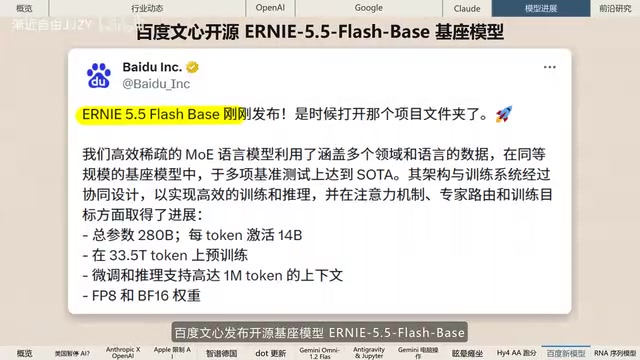
Baidu, meanwhile, released the open-source base model Ernie 5.5 Flash Base, with 280B total parameters, 14B activated per token, and support for a one-trillion-token context. Based on benchmark results, it is positioned against DeepSeekAd V4 Flash and Hi3 Preview. MIMO V2.5 claims to achieve SOTA on multiple benchmarks among base models of the same scale. The密集 release of open-source base models means expanding choices for small and medium teams, but also intensifies the difficulty of selection.
Artificial Analysis Intelligence Index: The benchmark scores cited in this article come from Artificial Analysis, an independent third-party model evaluation platform that scores mainstream large models through standardized prompt sets, covering reasoning, code, knowledge Q&A, and other dimensions, presenting a normalized score from 0-100 as the "Intelligence Index." A key feature of this index is continuous rolling updates—scores are re-measured after model version iterations, so leaderboards from different time points cannot be directly compared across periods. Cost per task is another core metric from the platform, calculating the cost of a single task based on API call prices and average token consumption, used to measure "price per unit of intelligence." Hallucination rate refers to the proportion of factually incorrect content a model generates in its answers; the AA Omniscience benchmark specifically tests models' honesty about the boundaries of their knowledge—the lower the hallucination rate, the more the model tends to admit "I don't know" rather than fabricate. It should be noted that such third-party benchmarks are sensitive to prompts, and a few points' difference between versions may not be statistically significant.
Product and Tool Updates: Gemini, AntiGravity, and OpenAI's Small Quick Steps
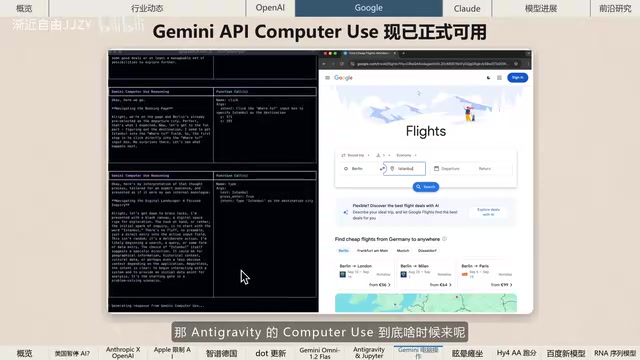
This week's product updates leaned pragmatic. Gemini Omni 1.2 Flash is now available on Google Cloud, priced at $1.50 for all-modality input, $9.00 for text output, and $12.00 for video output—31% cheaper than Omni 1.1 Flash. AntiGravity now natively supports Jupyter Notebook, allowing users to open .ipynb files directly in the file viewer to see code, cells, Markdown, tables, images, and cell outputs without leaving the app. The computer use tool in the Gemini API has also been officially released, introducing no breaking changes compared to the preview version; with improved stability, it can be used in production environments for agents on browsers, mobile, and desktop.
OpenAI, meanwhile, made several updates to Dot: you can reply directly from iOS notifications, share any content directly to Dot, open Dot via the iPhone's Action Button, and the app loads faster when tapping a notification to enter—with corresponding updates on Windows. Individually these changes seem small, but cumulatively they will change user habits—when the AI entry point is compressed to a single click, an increase in usage frequency can be expected.

Another notable piece of news is Apple's cost control. According to Bloomberg, Apple has lowered the daily AI spending cap for some engineers from $300 to $200, with plans for further cuts—some engineering teams may drop to $100, and non-engineering teams may drop from $100 to $25. Tesla's weekly $200 cap is comparable. This may indicate that even within leading tech companies, AI usage costs have entered a phase of refined management.
All-modality input pricing: The billing method for Gemini Omni 1.2 Flash deserves elaboration. The so-called "all-modality input $1.50" typically refers to the input price per million tokens, with text, images, audio, and video all billed at the same rate—unlike early multimodal models that charged extra for images and video. On the output side, text ($9.00/million tokens) and video ($12.00/million tokens) are differentiated because video generation consumes significantly more compute than text. This "unified input, tiered output" pricing structure reflects the actual distribution of inference costs—input is mainly encoding, while output, especially video decoding, is the compute hog. Computer Use refers to models understanding interfaces via screenshots and simulating mouse and keyboard operations. Compared with traditional Function Calling, it does not depend on exposed APIs and can operate legacy software without interfaces, but stability and security remain major concerns for production deployment.
Code Generation and Research: From an Entire Island to an RNA Foundation Model
Demonstrations of code generation capability continue to刷新 perceptions. According to the video, Fibonacci 5.5 created an entire island village, with all elements drawn through code; its "art of creating life" birth animation was generated in one go using pure code in about an hour. The significance of such demos is not showmanship but illustrating the model's improving control over long-range structure and visual consistency—generating a complete scene in one go is far harder than generating a single image.
There is also a noteworthy item in scientific research. The Miracle Lab at the University of Science and Technology of China released an open-source RNA sequence foundation model, StructRFM, pre-trained on about 21 million computationally annotated sequence secondary-structure pairing data, capable of extracting nucleotide-level and nucleotide-pair-level features from input sequences alone. The related research was published in the international academic journal Nature in the early hours of November 5. The penetration of foundation models into the life sciences may be faster than most people expect.
Judgment Under Multi-Source Cross-Referencing
Taken together, this week's information can be summarized into three threads. On the regulatory front, calls to pause AI development have a real public opinion base, but the path to implementation remains unclear, and leading companies may be indirect beneficiaries of tighter compliance. On the model front, Hunyuan 4 enters the competition with cost-effectiveness, open-source base models are released密集ly, and the selection dimension shifts from "who is strongest" to "who is most suitable." On the product front, entry-point compression and cost control have become common themes—Apple lowering AI spending caps and OpenAI simplifying Dot's interaction are essentially answering the same question: how to make AI cheaper and more convenient to use.
It should be noted that the benchmark scores, pricing, and personnel information in this article mainly come from a single video source's retelling, and some details (such as specific reasons for departure and the legislative progress of regulatory bills) have not been independently verified; readers should remain cautious when citing them.
Related articles
 Tech Frontiers
MuJoCo: An Analysis of DeepMind's Open-Source General-Purpose Physics Simulator
An in-depth analysis of Google DeepMind's open-source physics simulator MuJoCo: high-performance C++ kernel, MJCF modeling format, contact solving principles, MJX GPU acceleration, and robot reinforcement learning use cases.
 Tech Frontiers
Claude API Quick Start: The Official Quickstarts Project Collection
Anthropic's official claude-quickstarts project collection helps developers quickly build deployable apps with the Claude API. Nearly 20k stars, Python-based, great for beginners and prototyping.
 Tech Frontiers
AI Agents Connecting Directly to APIs: Which Calls Can Be Safely Allowed?
AI agents can call any API, but the real challenge is deciding which calls can be safely allowed. This article analyzes allowance decisions from three dimensions—intent matching, least privilege, and controllable impact—and argues that the control layer should sit outside the agent, combined with audit traceability to build a trustworthy API call governance mechanism.