AI Reverse-Engineered My 1994 Jeep ECU: Claude Code and Codex in an Arduino Field Test

Developer uses Claude Code and Codex with a $3 Arduino to reverse-engineer a 1994 Jeep ECU, testing AI coding tools' hardware limits.
A developer used Claude Code and Codex with a $3 Arduino to reverse-analyze a 1994 Jeep's engine control unit (ECU). The large models handled firmware understanding, protocol guessing, and debug script generation, while the Arduino served as a cheap physical interface for signal probing. The experiment compresses work that once took professional equipment and weeks of manual analysis into an interactive loop, though AI still relies on human verification of hardware timing and electrical behavior. The attempt lowers the entry barrier for old ECU reverse engineering but has depth and detail limitations due to its single-source nature.
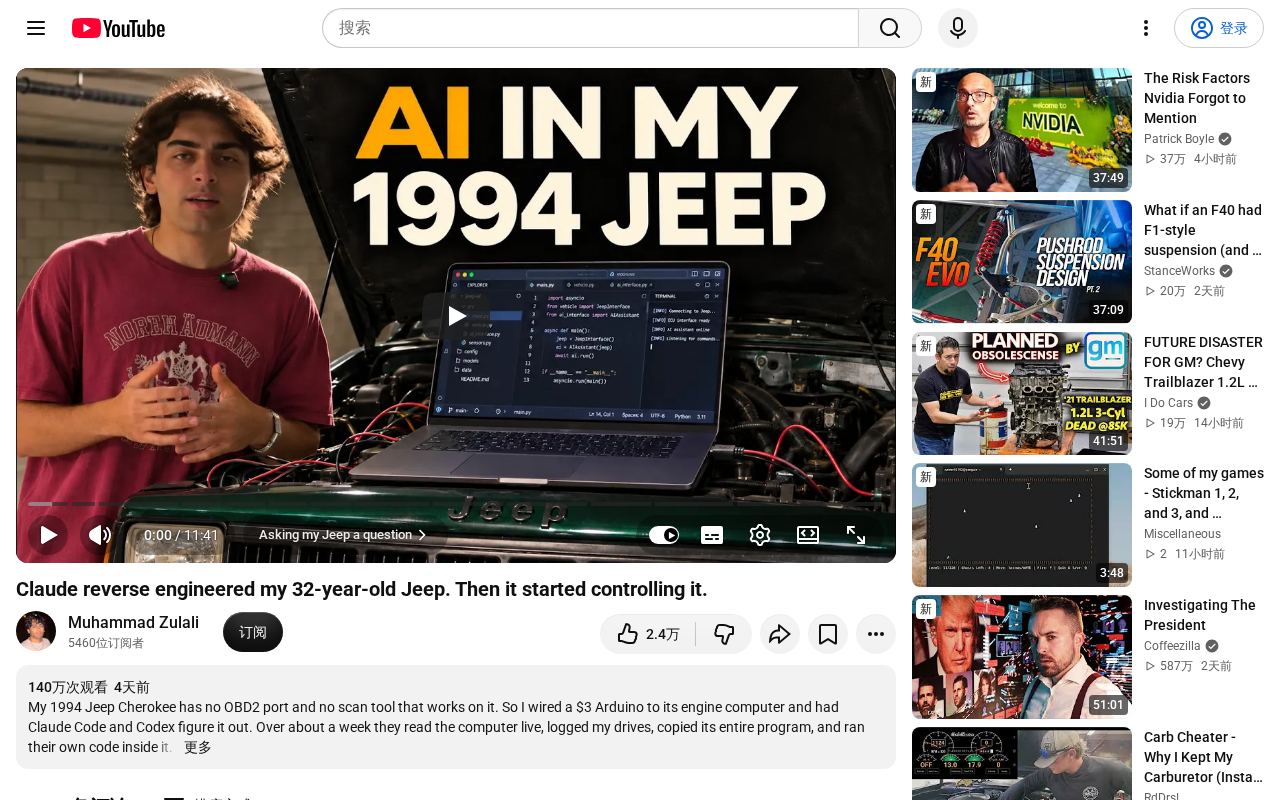
What happens when generative AI takes on a hard problem—reverse-engineering an old vehicle computer? One developer used Claude Code and Codex, with nothing but a $3 Arduino, to try to crack the ECU of a 1994 Jeep. It sounds like a geek's weekend joke, but it reveals a real cross-section of how AI coding tools perform at the hardware level.
A Low-Cost Reverse-Engineering Experiment
According to a share on Hacker News, the developer used Claude Code and Codex as primary tools, paired with an Arduino board costing just $3, to reverse-analyze the engine control unit (ECU) of a 1994 Jeep. The 1994 ECU is far less complex than modern vehicles with their encryption and bus protections, but it still involves assembly instructions, memory mapping, and real-time control logic.
The core value of this experiment isn't the cracking itself, but the tool combination: large models handle understanding code and protocols and generating debug scripts, while the Arduino serves as a cheap physical interface for signal transmission and protocol probing. Together, they compress work that once required professional equipment and weeks of manual analysis into an interactive, iterative process.
ECU (Engine Control Unit) is the core electronic module in a vehicle that controls engine operation, responsible for real-time adjustment of parameters like fuel injection volume and ignition advance angle based on sensor inputs (such as intake air volume, RPM, and oxygen sensor signals). ECUs from the early 1990s generally used 8-bit or 16-bit microcontrollers, with firmware burned directly into ROM. Communication protocols were mostly manufacturer-specific serial or K-line variants—neither standardized nor equipped with modern encryption or diagnostic security access mechanisms. This means reverse engineers can directly read or probe commands through physical-layer probing without bypassing signature verification or gateway firewalls—this is precisely the technical premise that allowed the experiment to start at extremely low cost.
Arduino plays the role of a "physical-layer translator" in such scenarios: it connects directly to the ECU's communication pins via GPIO, UART, or custom timing simulation, converting the probing commands generated by the large model into electrical signals while capturing the ECU's responses back to the developer. A $3-level Arduino (such as a Pro Mini or Nano-compatible board) has limited clock precision and level adaptation capability, but it's sufficient for low-speed protocol probing and basic signal transmission and reception—this is also the key to keeping the experiment's cost extremely low.
The Role of AI Coding Tools in Hardware Reverse Engineering
The advantage of tools like Claude Code and Codex lies in "understanding code and generating executable operations." When faced with old ECU firmware or communication protocols, the model can quickly infer instruction set structures, generate test code, and explain anomalous responses. Developers don't need to start from scratch flipping through manuals; they can describe goals in natural language and let the model output probing scripts.
But these tools are not omnipotent. ECU reverse engineering depends on real-time feedback and physical-layer verification. The model cannot directly "sense" voltage or timing, and developers still need to build a closed loop with the Arduino. AI here is more like a tireless pair analyst than an automated black box. According to the sharer's description, the entire process is a typical "generate—flash—observe—correct" loop.
"Protocol guessing" in reverse engineering refers to inferring frame structures, checksum methods, and command semantics from captured byte streams in the absence of documentation. The advantage of large models in this step is that they can propose structural hypotheses about unknown byte sequences based on the large amount of embedded code and communication protocol patterns seen in training (such as "the first two bytes might be a length field" or "the last byte looks like CRC-8") and generate verification scripts. But the model cannot replace a logic analyzer or oscilloscope to confirm actual timing, nor can it determine level polarity or baud rate deviations—these must be measured by the developer at the physical layer. Therefore, AI-generated hypotheses always require an Arduino closed loop to falsify or confirm, forming a division of labor where "the model proposes hypotheses, the hardware judges."
Why This Matters
ECU reverse engineering of older vehicles has long been a niche hardcore field with high barriers to entry and scarce documentation. The intervention of AI tools significantly lowers the entry difficulty: protocol guessing, code commenting, and test case generation can all be delegated to the model. For vintage car modification, repair diagnostics, and even security research, this opens a low-cost path.
At the same time, it's a real-world test of the capability boundaries of AI coding tools. Models perform stably on structured code tasks, but when it comes to hardware timing and electrical characteristics, human judgment is still required. This "human-machine collaboration" model may be closer to current reality than fully automated narratives.
Limitations and Controversies
A single-source share cannot cover all details—for example, how deep the reverse engineering went and whether key data was successfully read are not elaborated in the original. ECU reverse engineering involves vehicle safety and emissions compliance, and boundaries must be noted in public discussion. Additionally, the physical limitations of a $3 Arduino mean it's more suited for protocol probing than complete firmware extraction, so the depth of the experiment may be limited.
Overall, this is a symbolic attempt: AI coding tools are moving from pure software to scenarios combining software and hardware, and low-cost hardware has become an excellent testing ground for validating model capabilities.
Firmware extraction and protocol probing are two different depths of reverse engineering. Protocol probing only requires passively listening on the communication bus or actively sending legitimate frames and observing ECU responses, with lower hardware requirements; complete firmware extraction typically requires reading the ECU's internal ROM (such as through BDM/JTAG debug interfaces or desoldering the chip and reading it with a programmer), involving finer timing control and electrical operations. The GPIO toggle rate and clock stability of a $3 Arduino are hard-pressed to meet the demands of high-speed parallel reading or precise timing handshakes, so the experiment more likely stayed at the protocol-layer interaction rather than a complete firmware dump. This also explains why the original is vague about "how deep the reverse engineering went"—the experiment's symbolic significance outweighs its engineering depth.
One-line Summary
Developer uses Claude Code and Codex with a $3 Arduino to reverse-engineer a 1994 Jeep ECU, validating the collaboration boundaries of AI coding tools at the hardware level.
Paragraph Summary
A developer used two AI coding tools, Claude Code and Codex, paired with an Arduino board costing just $3, to reverse-analyze the engine control unit (ECU) of a 1994 Jeep. The core value of the experiment lies in the tool combination: large models handle understanding firmware code, guessing communication protocols, and generating debug scripts, while the Arduino serves as a cheap physical interface for signal transmission and protocol probing, compressing work that traditionally required professional equipment and weeks of manual effort into an interactive iterative loop. The article notes that AI plays the role of a "pair analyst" in reverse engineering, but hardware timing and electrical verification still require a human closed loop—AI is not a fully automated black box. The attempt lowers the entry barrier for reverse engineering old ECUs while exposing the limitations of a single-source share regarding experimental depth and result details.
Related articles

ClawDOS: Bringing AI Coding Capabilities to DOS
ClawDOS is an AI coding agent project for DOS, exploring the possibility of bringing AI coding assistance into resource-constrained retro computing environments. This article analyzes its positioning, use cases, and community response.

Baseten Releases Bison-1 and Groundhog-1, Topping the Decision Model Leaderboard
Baseten releases open-weight decision models bison-1 and groundhog-1 built on Gemma 4; bison-1 scores 76 on the AA Decision Index v2.1 to top the leaderboard. Both support 128k context and image input—here we analyze their capability combination, benchmark significance, and selection advice for developers.

Cline CLI v3.0.75 Released: Yolo Mode Now Default for One-Shot Runs
Cline CLI v3.0.75: one-shot runs now default to yolo mode, --timeout and Ctrl+C can interrupt the first round, read_files is no longer truncated to 8k chars, plus reasoning parameter fixes and 94 new providers.