AI SDK Ecosystem Update: @ai-sdk/zai 2.0.19 Patch Released

@ai-sdk/zai releases 2.0.19 patch, syncing underlying openai-compatible to 2.0.91.
`@ai-sdk/zai` released patch version 2.0.19, with the core change being an upgrade of the underlying dependency `@ai-sdk/openai-compatible` to 2.0.91 — a dependency-sync update. The article explains that `openai-compatible` serves as a general adapter layer for OpenAI-compatible API formats, and its updates can affect the runtime behavior of multiple providers. For developers, patch versions introduce no breaking changes, so upgrade risk is low, but it is still advisable to verify streaming output and error handling and to check the lockfile to ensure sub-dependency synchronization. Finally, it notes that high-frequency minor releases reflect an active AI SDK ecosystem, and enterprises can use tools like Dependabot to manage upgrades while retaining rollback capability.
The AI SDK ecosystem components continue to iterate. Recently, the @ai-sdk/zai package released version 2.0.19, a patch update that primarily syncs changes from upstream dependencies. For developers using the Vercel AI SDK to build AI applications, understanding the significance of such minor version updates helps maintain project dependencies more effectively.
Specifics of the Patch Update
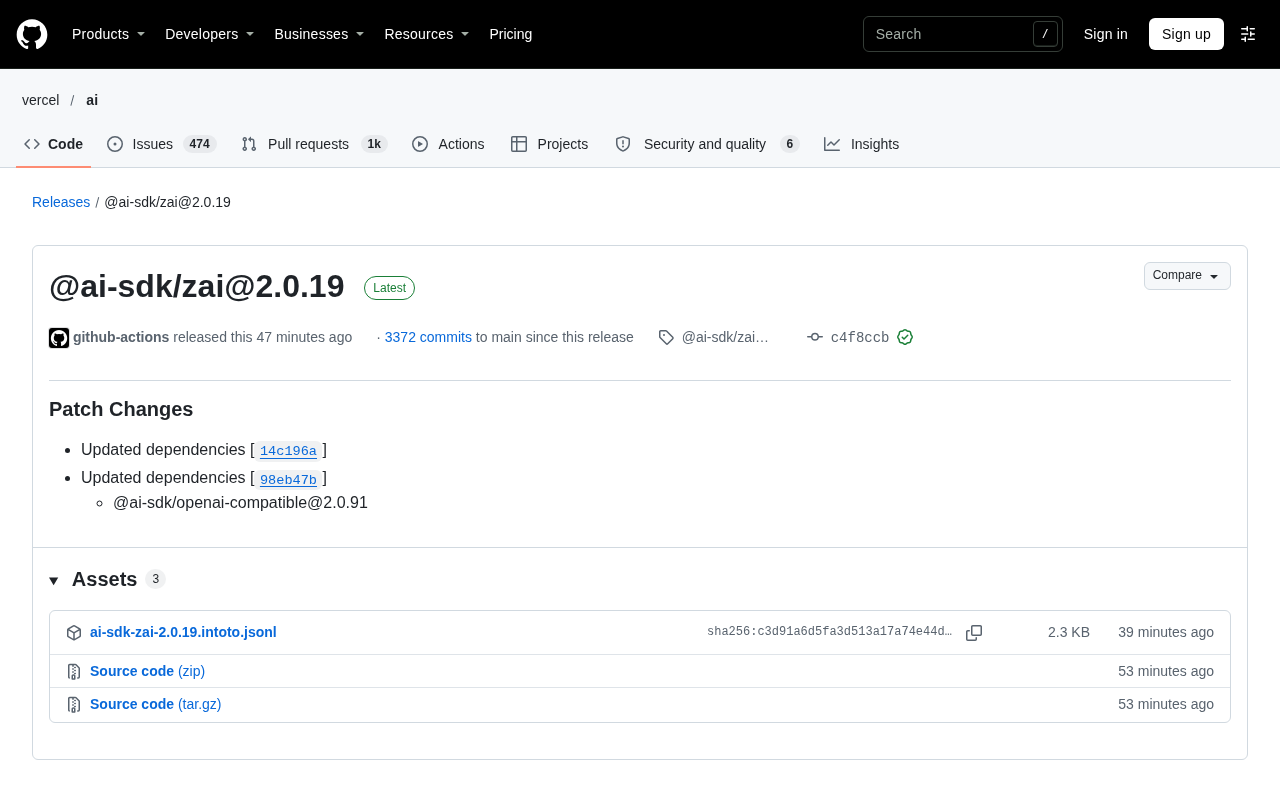
According to the release records on GitHub, @ai-sdk/zai@2.0.19 is classified as Patch Changes. Its core change is updating dependencies, specifically upgrading the dependency on @ai-sdk/openai-compatible@2.0.91. The commit messages reference two dependency-update-related commits (14c196a and 98eb47b), indicating that this release is mainly about keeping the dependency chain in sync.
Patch versions typically do not include new features or breaking changes; instead, they fix issues or sync improvements from underlying libraries. For @ai-sdk/zai, which serves as an adapter layer between the AI SDK and the Z.ai model service, its stability depends on the compatibility of the underlying openai-compatible package.
Why Dependency Updates Matter
@ai-sdk/openai-compatible is a general-purpose package in the AI SDK for connecting to model providers that are compatible with the OpenAI API format. Many third-party model services adopt similar interface specifications, so updates to this package often affect multiple provider adapters.
@ai-sdk/zai relies on it to forward requests, handle streaming responses, and manage errors. When openai-compatible releases a new version, @ai-sdk/zai needs to follow up to ensure consistent behavior. Version 2.0.91 of openai-compatible may include adjustments to protocol details or bug fixes, and @ai-sdk/zai 2.0.19 is precisely meant to pass these improvements on to end users.
Practical Impact on Developers
If you use @ai-sdk/zai directly in your project, upgrading to 2.0.19 is generally safe. Patch versions follow semantic versioning and do not introduce incompatible API changes. However, dependency updates can sometimes indirectly affect runtime behavior, such as request retry logic or response parsing.
It is recommended to run existing test cases after upgrading, especially scenarios involving streaming output and error handling. If your project locks dependencies via a lockfile, check whether @ai-sdk/openai-compatible has also been updated to 2.0.91 to avoid potential issues caused by version inconsistencies.
Semantic Versioning (SemVer) specifies that version numbers MAJOR.MINOR.PATCH correspond to breaking changes, new features, and bug fixes, respectively. An increment in the patch position means it contains only backward-compatible fixes and can theoretically be replaced directly. However, note that patch updates in the dependency chain can still change behavior through transitive dependencies: for example, if @ai-sdk/openai-compatible adjusts how the usage field is accumulated in streaming responses in a patch version, while @ai-sdk/zai only upgrades the dependency without changing its own code, the output statistics perceived by end users may change. Therefore, "patch version safety" should be understood as the API contract remaining unchanged, not that runtime behavior is absolutely unchanged. Regression testing for streaming and error paths after upgrading is still necessary.
Lockfile such as package-lock.json, pnpm-lock.yaml, or yarn.lock records the exact version and integrity hash of each package in the dependency tree. When a project directly depends on @ai-sdk/zai@2.0.19, the version of its sub-dependency @ai-sdk/openai-compatible is determined by the range declared in @ai-sdk/zai's package.json. If the range is written as ^2.0.0, the lockfile may still remain at the older 2.0.90. In this case, although zai has been upgraded, the actually running openai-compatible has not been synced, and the two may behave inconsistently. Check the resolved version of that sub-dependency in the lockfile; if necessary, run npm update @ai-sdk/openai-compatible or delete the lockfile and reinstall to ensure dependency chain consistency.
Maintenance Rhythm Behind Version Iterations
From the release records, this update came only a few commits after the previous release (3372 commits to main since this release indicates that the main branch had a large number of commits during this period, but this version itself is an independent small-step update). This high-frequency minor version release pattern reflects the active maintenance status of the AI SDK ecosystem.
For enterprise applications, it is advisable to pay attention to the frequency and content of such patch updates. If dependencies are updated frequently, consider using automation tools (such as Dependabot) to manage version upgrades while retaining rollback capability.
Summary
@ai-sdk/zai@2.0.19 is a patch version focused mainly on dependency syncing, with low upgrade risk. Developers should pay attention to version changes in its underlying @ai-sdk/openai-compatible and perform basic functional verification after upgrading. In a rapidly evolving AI toolchain, keeping dependencies updated is a necessary habit for maintaining project health.
Background Supplement
OpenAI-compatible API specification refers to the fact that many third-party model services (such as Z.ai, Together AI, Groq, etc.) provide HTTP interfaces that mimic OpenAI's /v1/chat/completions and other endpoints in paths, request bodies, and response formats, so that client code written for OpenAI can be reused by simply changing the baseURL and apiKey. @ai-sdk/openai-compatible is precisely a general adapter layer abstracted based on this fact; it handles common logic such as request construction, SSE (Server-Sent Events) streaming parsing, and error response mapping. When different providers have subtle differences in the specification (such as finish_reason values or the nesting of delta fields), the package introduces configurable parameters or internal corrections, so its version updates often directly change the runtime behavior of multiple downstream adapters.
Related articles
 Tech Frontiers
MuJoCo: An Analysis of DeepMind's Open-Source General-Purpose Physics Simulator
An in-depth analysis of Google DeepMind's open-source physics simulator MuJoCo: high-performance C++ kernel, MJCF modeling format, contact solving principles, MJX GPU acceleration, and robot reinforcement learning use cases.
 Tech Frontiers
Claude API Quick Start: The Official Quickstarts Project Collection
Anthropic's official claude-quickstarts project collection helps developers quickly build deployable apps with the Claude API. Nearly 20k stars, Python-based, great for beginners and prototyping.
 Tech Frontiers
AI Agents Connecting Directly to APIs: Which Calls Can Be Safely Allowed?
AI agents can call any API, but the real challenge is deciding which calls can be safely allowed. This article analyzes allowance decisions from three dimensions—intent matching, least privilege, and controllable impact—and argues that the control layer should sit outside the agent, combined with audit traceability to build a trustworthy API call governance mechanism.