AI SDK Sandbox Tool just-bash Releases 1.0.162 Patch Update

@ai-sdk/sandbox-just-bash releases patch 1.0.162, synchronized with harness.
The article covers the release of patch version 1.0.162 of the sandbox tool @ai-sdk/sandbox-just-bash in the AI SDK ecosystem. It was automatically published by the github-actions bot through the official CI channel, is associated with only two commits, and also adjusts the version of @ai-sdk/harness in sync. The three-digit patch number reflects high-frequency, small-step iteration, and such updates usually do not introduce breaking changes, so upgrade risk is low. Keeping sandbox and harness versions in sync is a typical monorepo unified release practice, and consumers should keep both consistent in the lockfile to avoid interface mismatches. Since the Release notes do not list specific changes, it is recommended to confirm details by comparing adjacent tag diffs and to verify in a test environment before deploying to production.
A Low-Key Patch Release
The sandbox tool @ai-sdk/sandbox-just-bash in the AI SDK ecosystem has released version 1.0.162. According to the information disclosed on the GitHub Release page, this is a standard patch-level update, automatically published by the github-actions bot and containing only a few commits.
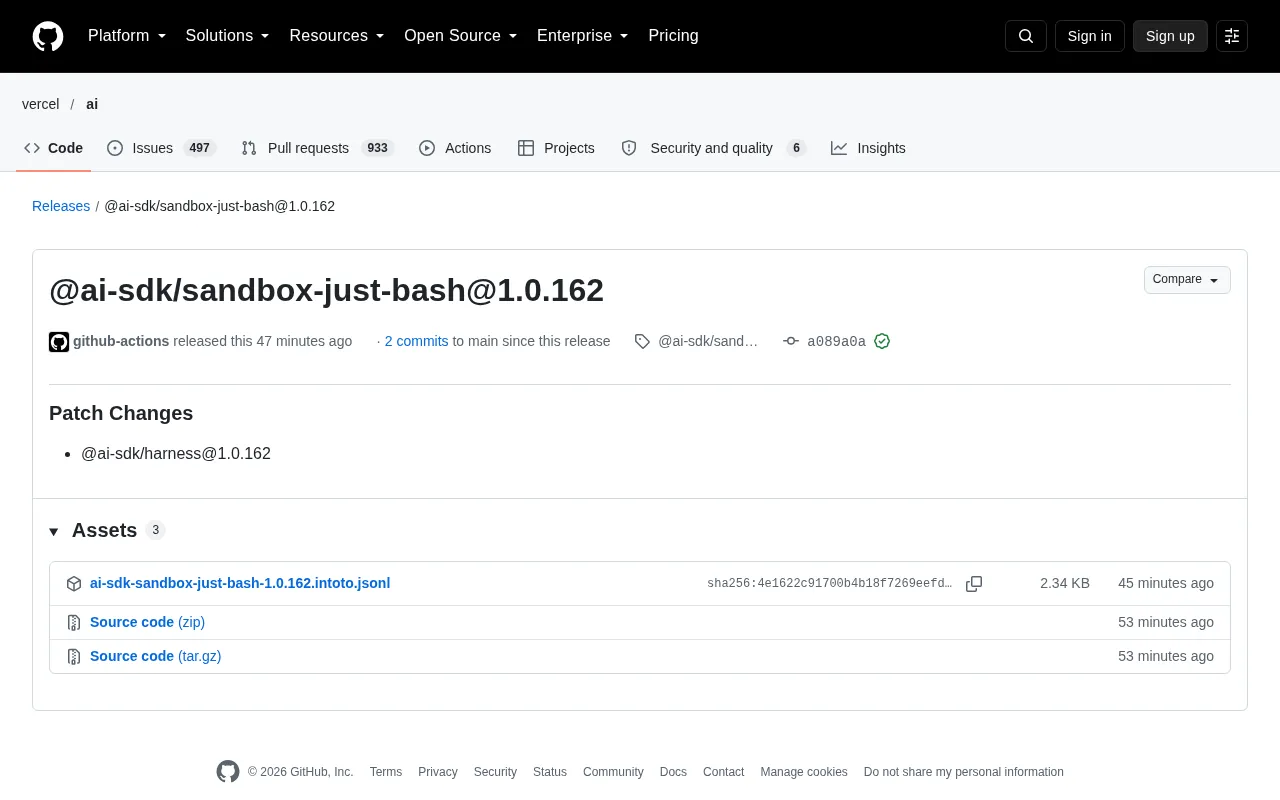
The release page shows that this update is associated with two commits and also applies a patch adjustment to @ai-sdk/harness@1.0.162. The commit records carry GitHub verified signatures, indicating that the release process went through the official CI channel rather than being manually pushed.
What the Version Number Signals
A version number like 1.0.162 speaks for itself: the project is in a phase of high-frequency iteration, the major version has long been stable at 1.x, and the patch number has accumulated to three digits. Such versions typically do not introduce breaking changes, focusing instead on bug fixes, aligning dependency versions, or correcting build configurations. For teams that depend on this package in production, the upgrade risk is low, but it is still advisable to check the changelog to confirm there are no implicit behavior changes.
Semantic Versioning (SemVer) is the premise for understanding numbering like 1.0.162. SemVer splits a version number into three segments: major.minor.patch. A major version increment indicates incompatible API changes, a minor version increment indicates backward-compatible new features, and a patch increment indicates backward-compatible bug fixes. The judgment in this article that "patch-level updates do not introduce breaking changes" is based on this convention. However, SemVer is only a specification, not an enforcement mechanism; whether it is actually compatible still depends on how strictly maintainers follow it. Therefore, for production environments, checking the changelog or comparing the diff between adjacent tags remains a necessary step. The patch number reaching three digits also indirectly indicates that the package is released frequently and that individual changes are small in scope.
The Linkage Between Sandbox and Harness
You may not have noticed that this update touches both @ai-sdk/sandbox-just-bash and @ai-sdk/harness. In the toolchain design of the AI SDK, the sandbox provides a controlled execution environment, while the harness handles testing and orchestration responsibilities. Keeping the two version numbers in sync (both at 1.0.162) is a typical practice of unified releases in a monorepo. This means that a fix in either one may require a synchronized upgrade of the other, and consumers should keep both versions consistent in lockfile management to avoid interface mismatches.
Monorepo unified releases refer to multiple interdependent packages being stored in the same code repository and built and published uniformly by the same CI pipeline. A common practice is to have these packages share the same version number (fixed/locked mode), so that after any commit, all packages' versions are bumped together. The benefit is that dependencies are clear at a glance and consumers only need to remember one version number; the cost is that even if a package itself has not changed, its version number advances along with the others. The fact that sandbox-just-bash and harness are both at 1.0.162 in this article reflects this pattern. For dependency management, consumers should lock both to the same version via the lockfile to avoid interface mismatches caused by partial upgrades.
A lockfile is a file generated by a package manager (such as npm, pnpm, or yarn) after installing dependencies, used to precisely record the resolved versions and integrity checksums of each dependency and its transitive dependencies. Its purpose is to ensure that installations on different machines and at different times produce exactly the same dependency tree, thereby avoiding "works on my machine" problems. When a project depends on packages like sandbox-just-bash and harness that require version alignment, the lockfile can prevent one of them from being resolved to a mismatched version. When updating dependencies, the lockfile should be committed together, and locked installation (such as npm ci) should be used in CI to ensure reproducible environments.
Practical Impact on Users
Since the official Release notes do not list specific change entries and only mark Patch Changes, the actual impact is limited. Developers can confirm the details by comparing the diff between adjacent tags. For scenarios that rely on this sandbox to execute AI-generated code, it is recommended to verify in a test environment before pushing to production, paying particular attention to whether boundary behaviors such as bash execution timeouts and permission isolation have changed.
Overall, this release is one part of the routine maintenance rhythm. There are no new features worth writing home about, but continuous small, fast steps are precisely how the open-source AI toolchain stays vibrant.
FAQ
Q: Do I need to upgrade immediately for this update? A: Patch-level updates are usually fixes, so they can be handled according to your normal dependency update rhythm; there is no need for urgent follow-up.
Q: Why are the Release notes so brief? A: Notes generated by automated release processes often only list package names and change types; the detailed diff must be viewed in the commit history.
Q: Must sandbox and harness be upgraded at the same time? A: The two are released with synchronized version numbers, so it is recommended to keep them consistent to avoid interface incompatibility.
One-line Summary
@ai-sdk/sandbox-just-bash releases patch version 1.0.162, synchronized with harness.
Paragraph Summary
The article introduces the release of patch version 1.0.162 of the sandbox tool @ai-sdk/sandbox-just-bash in the AI SDK ecosystem. This version was automatically published by the github-actions bot through the official CI channel, is associated with only two commits, and also adjusts the version of @ai-sdk/harness in sync. The article notes that the three-digit patch number reflects a phase of high-frequency, small-step iteration, and that such updates usually do not introduce breaking changes, so upgrade risk is low. At the same time, keeping the version numbers of sandbox and harness in sync is a typical practice of unified releases in a monorepo, and consumers should keep both consistent in the lockfile to avoid interface mismatches. Since the Release notes do not list specific changes, it is recommended to confirm details by comparing the diff between adjacent tags and to verify in a test environment before deploying to production.
Related articles

Vibe Coding Full-Stack in Practice: AI Programming from Beginner to Enterprise Deployment
From Cursor to Claude Code, this Bilibili AI programming course uses four progressive projects to cover full-stack development, open-source secondary development, and team collaboration. The article analyzes the shock to frontend roles, the efficiency shift from 50 people to 5, and the methodology required for enterprise-grade projects.

David Blaine's Global Quest for Real Magic: From South Africa to Japan and India
David Blaine travels to South Africa, Japan, and India in his Do Not Attempt special, documenting Spinning drivers, black mamba rescuers, iaijutsu masters, and ascetics—exploring the boundary between magic and real human极限 challenges.

Is a Touchscreen MacBook Coming? Vergecast Reveals Apple Executive's Response
Vergecast podcast reveals a conversation between a reporter and Apple executive John Ternus about a touchscreen MacBook and Apple Pencil support. Ternus says iPad is the best device for a stylus, while the reporter bets MacBook will eventually support Apple Pencil.