@ai-sdk/svelte 3.0.266 Released: Patch Update for Vercel AI SDK

Vercel AI SDK's Svelte adapter releases patch v3.0.266, syncing with core package ai@5.0.266.
`@ai-sdk/svelte 3.0.266` is a patch-level maintenance update auto-triggered by GitHub Actions, with the primary change being synchronization with `ai@5.0.266`. The package serves as Vercel AI SDK's official Svelte adapter, encapsulating capabilities like streaming conversations and chat state management into Svelte's reactive paradigm. The shared patch number (266) reflects Vercel's Monorepo + Changesets release strategy, helping developers quickly assess compatibility. For active projects, this patch update should be folded into routine dependency maintenance with test environment validation before production deployment.
The Svelte adapter package @ai-sdk/svelte in Vercel's official AI SDK ecosystem has released version 3.0.266. This is a patch-level update, primarily synchronized with the core package upgrade to ai@5.0.266. While the version bump may seem minor, keeping up with patch releases is generally good practice for Svelte developers building AI applications with this SDK — it tends to mean better stability and compatibility.
Release Overview
This release was pushed on September 24th via Vercel's github-actions automation pipeline, with a verified GPG signature (key ID: B5690EEEBB952194) confirming the integrity and authenticity of the release. The release notes explicitly label this as a Patch Changes update, with the only listed change being the upgrade of the core dependency ai@5.0.266.
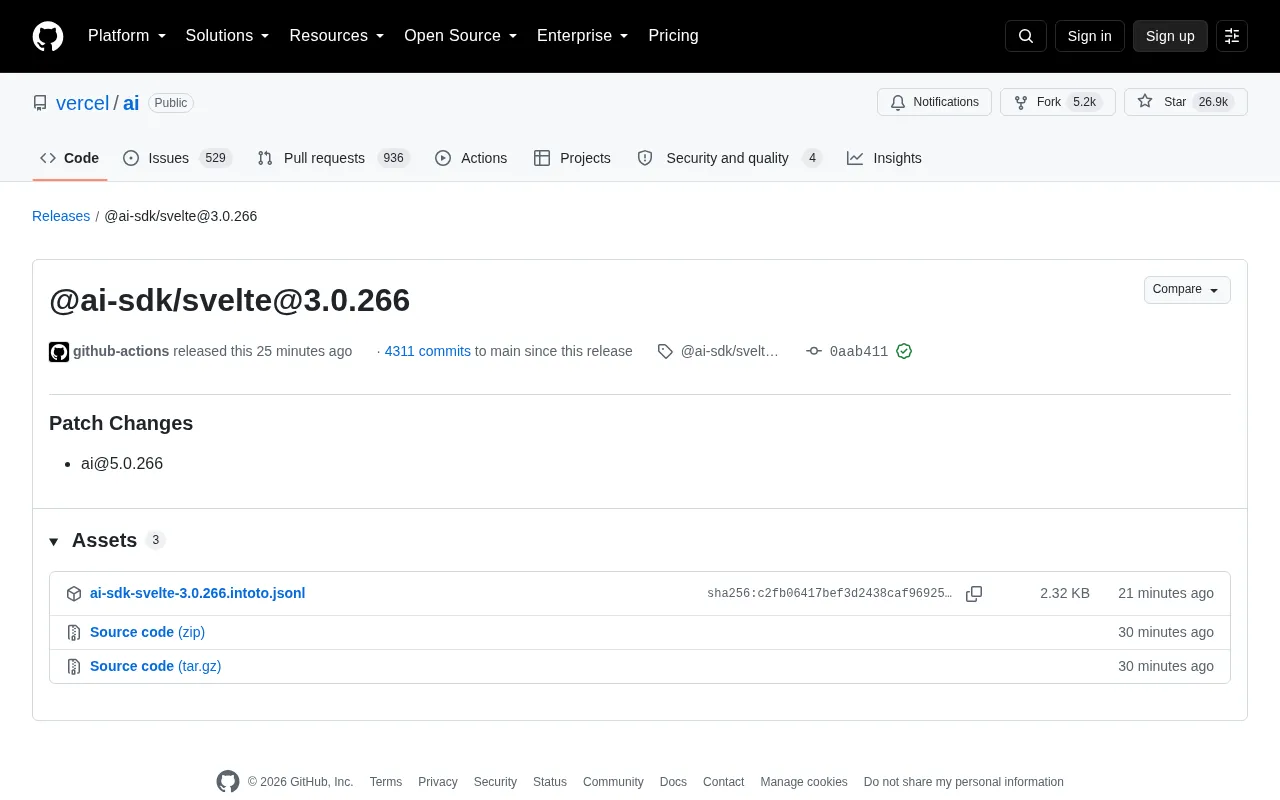
Patch releases typically don't introduce breaking changes or major new features — they focus on bug fixes, internal dependency updates, and minor adjustments. For projects running in production, these updates are generally safe to apply with confidence.
What Is @ai-sdk/svelte
@ai-sdk/svelte is the official Svelte framework binding for the Vercel AI SDK. The Vercel AI SDK is one of the more popular toolkits in the frontend and full-stack space for building AI-powered applications — especially conversational UIs and streaming text generation — providing a unified interface for integrating with providers like OpenAI, Anthropic, and others.
This Svelte adapter lets developers use the SDK's capabilities in a way that aligns with Svelte's reactive programming model, including managing chat state, handling streaming responses, and building real-time AI interfaces. The Vercel AI repository on GitHub has accumulated over 27,000 stars and 5,200 forks, with more than 4,311 commits to the main branch as of this release — a clear sign of an active and well-maintained project.
Svelte's reactivity model differs from other popular frameworks like React and Vue: it compiles reactive logic into vanilla JavaScript at build time rather than relying on a virtual DOM at runtime. This means the adapter layer needs to translate the SDK's state management — such as progressively appending streamed text or tracking request loading state — into Svelte Stores or Svelte 5's Runes syntax, rather than React's useState/useEffect hooks. @ai-sdk/svelte plays exactly this "translation" role, wrapping the core ai package's general-purpose capabilities into idiomatic Svelte APIs like createChat and createCompletion, so developers don't have to deal with low-level concerns like SSE (Server-Sent Events) parsing or stream buffering themselves.
Version Alignment Strategy
Worth noting is how the Svelte package version (3.0.266) and the core package version (5.0.266) share the same patch number (266). This reflects Vercel AI SDK's Monorepo unified release strategy, where sub-packages increment their patch numbers in sync with the core package, making it easy for developers to quickly assess dependency compatibility at a glance.
For users, this version alignment has a clear benefit: when the core ai package is upgraded, the corresponding framework adapter packages follow suit, preventing the compatibility issues that can arise from version mismatches. When upgrading, developers simply need to confirm that major versions are consistent — the patch number can safely track the latest.
A Monorepo (single repository) is an engineering pattern where multiple related packages or projects are managed together in a single Git repository. Vercel AI SDK uses pnpm Workspaces combined with the Changesets tool to implement this workflow. Changesets tracks each change and automatically determines the appropriate version bump (patch/minor/major) for each package at release time. When the core ai package receives a patch fix, Changesets automatically triggers a corresponding patch increment across all dependent sub-packages — including @ai-sdk/svelte, @ai-sdk/react, and others — resulting in aligned patch numbers. The advantage of this mechanism is that developers can quickly tell whether a framework adapter has picked up the latest core fixes just by comparing patch numbers, without having to dig through each package's individual changelog.
Should You Upgrade
For projects already using @ai-sdk/svelte, this kind of patch update is recommended as part of routine dependency maintenance. Since no specific feature changes were listed in the release notes, the practical impact comes primarily from whatever fixes are included in ai@5.0.266. Developers can:
- Check the core
aipackage's changelog for that version to understand what was actually fixed - Validate in a test environment before pushing to production
- Keep major version alignment with the core package (5.x) and avoid mixing different major versions
For Svelte projects that haven't yet integrated AI capabilities, this release is also a signal: Vercel AI SDK's Svelte support is actively being maintained and iterated on, making its ecosystem maturity and release cadence worth considering when evaluating your tech stack.
Summary
@ai-sdk/svelte 3.0.266 is a typical patch maintenance update. Its core value lies in staying in sync with ai@5.0.266, addressing potential issues, and continuing the SDK's stable evolution. While there's little to highlight in any single update, the high-frequency and consistent release cadence demonstrates that Vercel continues to invest significantly in maintaining framework adapters across the AI SDK ecosystem — a positive signal for developers who rely on it.
Related articles

Vibe Coding Full-Stack in Practice: AI Programming from Beginner to Enterprise Deployment
From Cursor to Claude Code, this Bilibili AI programming course uses four progressive projects to cover full-stack development, open-source secondary development, and team collaboration. The article analyzes the shock to frontend roles, the efficiency shift from 50 people to 5, and the methodology required for enterprise-grade projects.

David Blaine's Global Quest for Real Magic: From South Africa to Japan and India
David Blaine travels to South Africa, Japan, and India in his Do Not Attempt special, documenting Spinning drivers, black mamba rescuers, iaijutsu masters, and ascetics—exploring the boundary between magic and real human极限 challenges.

Is a Touchscreen MacBook Coming? Vergecast Reveals Apple Executive's Response
Vergecast podcast reveals a conversation between a reporter and Apple executive John Ternus about a touchscreen MacBook and Apple Pencil support. Ternus says iPad is the best device for a stylus, while the reporter bets MacBook will eventually support Apple Pencil.