@ai-sdk/svelte 5.0.136 Released: A Deep Dive into This Dependency Update Patch

@ai-sdk/svelte 5.0.136 patches dependency sync with ai@7.0.136 — no breaking changes.
`@ai-sdk/svelte` 5.0.136 is a typical dependency-sync patch update, automatically published via GitHub Actions with GPG signature verification. The core change is upgrading the underlying dependency to `ai@7.0.136`, with no new features or logic changes in the adapter itself. As a patch release, it carries minimal upgrade risk and imposes virtually no migration cost on existing Svelte projects. This is standard practice in a monorepo structure for keeping core libraries and framework adapters version-aligned. Developers are advised to let dependency management tools handle such patches automatically, reserving focused attention for Minor or Major releases.
Version Overview
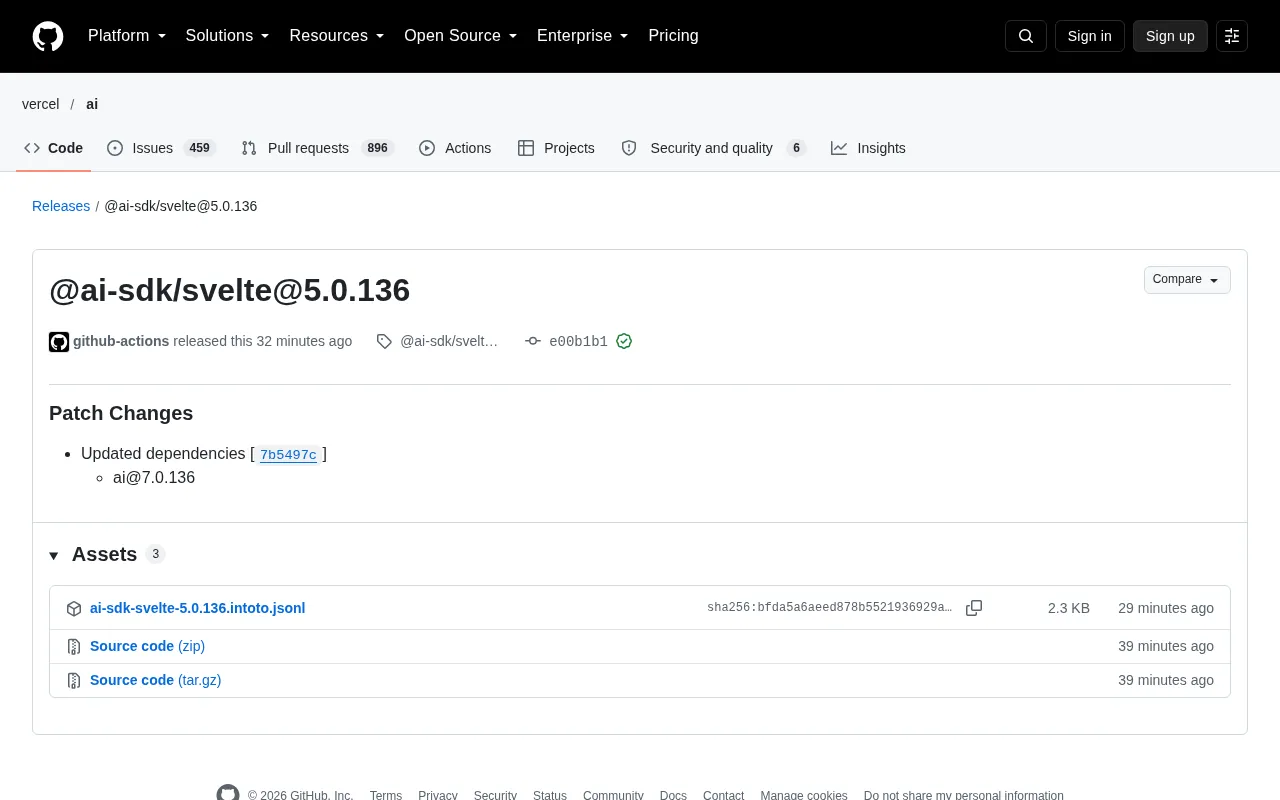
The Svelte adapter package @ai-sdk/svelte in the AI SDK ecosystem has recently released version 5.0.136. This is a patch-level update, published via GitHub Actions automation and completed through GitHub's verified signing process (GPG key ID: B5690EEEBB952194).
By semantic versioning conventions, a patch release typically means backward-compatible fixes with no breaking API changes. For Svelte developers who have already integrated this package in production, this is a low-stakes, incremental upgrade you can apply with confidence.
What Changed in This Release
According to the official Release Notes, the core changes in 5.0.136 are narrowly focused — a classic dependency sync update:
- Patch Changes: Updated dependencies
- Underlying core package upgraded to
ai@7.0.136
In other words, @ai-sdk/svelte itself introduces no new features or standalone logic changes. Instead, it simply follows the version cadence of the core ai package with a synchronized upgrade. This type of dependency-propagation update is extremely common in open-source projects organized as monorepos — once the core package ships a fix or improvement, each framework adapter (React, Vue, Svelte, etc.) publishes a corresponding patch to maintain version consistency across the entire ecosystem.
What is a Monorepo? A monorepo (monolithic repository) is a project organization strategy where multiple related packages are managed together in a single Git repository. The Vercel AI SDK uses this structure to maintain the core
aipackage, framework adapters (@ai-sdk/react,@ai-sdk/svelte,@ai-sdk/vue, etc.), and provider integrations all in one place. When the coreaipackage ships a new version, the build system (typically powered by tools like Turborepo or Changesets) automatically detects dependency relationships and triggers synchronized patch releases across all downstream adapter packages. This is why@ai-sdk/svelte's version number increments even when its own code hasn't changed — it's not a redundant publish, but a necessary mechanism to ensure that dependency relationships in the npm ecosystem remain explicit and traceable.
What This Means for Developers
@ai-sdk/svelte is the official Vercel AI SDK binding for the Svelte framework, enabling developers to easily integrate large language model capabilities — such as streaming responses and chat interactions — into Svelte applications.
For projects currently using this package, upgrading to 5.0.136 offers the following benefits:
- Stay in sync with the core library: Any fixes in the underlying
ai@7.0.136are promptly reflected in the Svelte adapter layer - Low-risk upgrade: As a patch release, the upgrade cost is minimal — existing business logic typically requires no changes
- Verified release integrity: This release was published with a GitHub verified signature, providing supply chain security guarantees
It's recommended that developers update the version in package.json accordingly, or rely on your lockfile's automatic resolution to pick up this patch.
A Note on Supply Chain Security Supply chain security has become an increasingly important topic in the frontend ecosystem. If npm packages are published without verification, malicious code could silently enter production environments through transitive dependencies. GitHub's Trusted Publishing combined with GPG signing can prove that an npm package was genuinely published by a repository's CI/CD pipeline, rather than uploaded by a hijacked personal account. Developers can verify the signature integrity of installed packages using the
npm audit signaturescommand — a security habit worth cultivating, especially for projects with deep dependency chains.
On Frequent Minor Version Iterations
Active open-source projects like the AI SDK often release patch versions at a high frequency, reflecting both a vibrant community and the direct output of modern CI/CD automation in frontend toolchains. As a user, you don't need to scrutinize every patch release closely. A more practical approach is to focus your attention on Minor or Major version milestones as noted in the CHANGELOG, and let your dependency management tooling handle patch updates automatically.
It's worth noting that this release's notes are fairly terse — they only indicate a dependency update without specifying exactly what was fixed in ai@7.0.136. For a full picture of what changed under the hood, it's worth consulting the release notes for the corresponding version of the core ai package.
Related articles

world2vec: Building Mechanistic World Models with Latent Dynamics Learning
world2vec proposes a reward-free method for learning mechanistic world models via latent dynamics, faithfully reproducing systems over long horizons with at least an order of magnitude fewer parameters than DreamerV3, TD-MPC2, and LeWM, and achieving accurate system identification on 71 attractor benchmarks.

A New KL-DRO Paradigm: Adaptive Scenario Generation Around a Learned Density Model
KL-DRO research proposes centering the KL ball on a learned density model instead of the empirical distribution, with adaptive scenario generation guiding sampling toward the worst case. Experiments show lower cost under distribution shift when records are scarce and the model can extrapolate, with comparable in-distribution cost.

ODE Samplers for Discrete Diffusion Models: Exponential Residual Flows Accelerate Generation
Discrete diffusion models lack deterministic ODE sampling? This article introduces Exponential Residual Flows (ERFs), which introduce continuous residual variables per token to construct piecewise ODEs for deterministic sampling and support consistency distillation acceleration. Superior to prior methods on code and text generation tasks.