AI SDK Svelte 5.0.156 Patch Released: The Ecosystem Signals Behind a Minor Version Update

AI SDK's Svelte adapter package releases patch 5.0.156, an automatic alignment update following the core package.
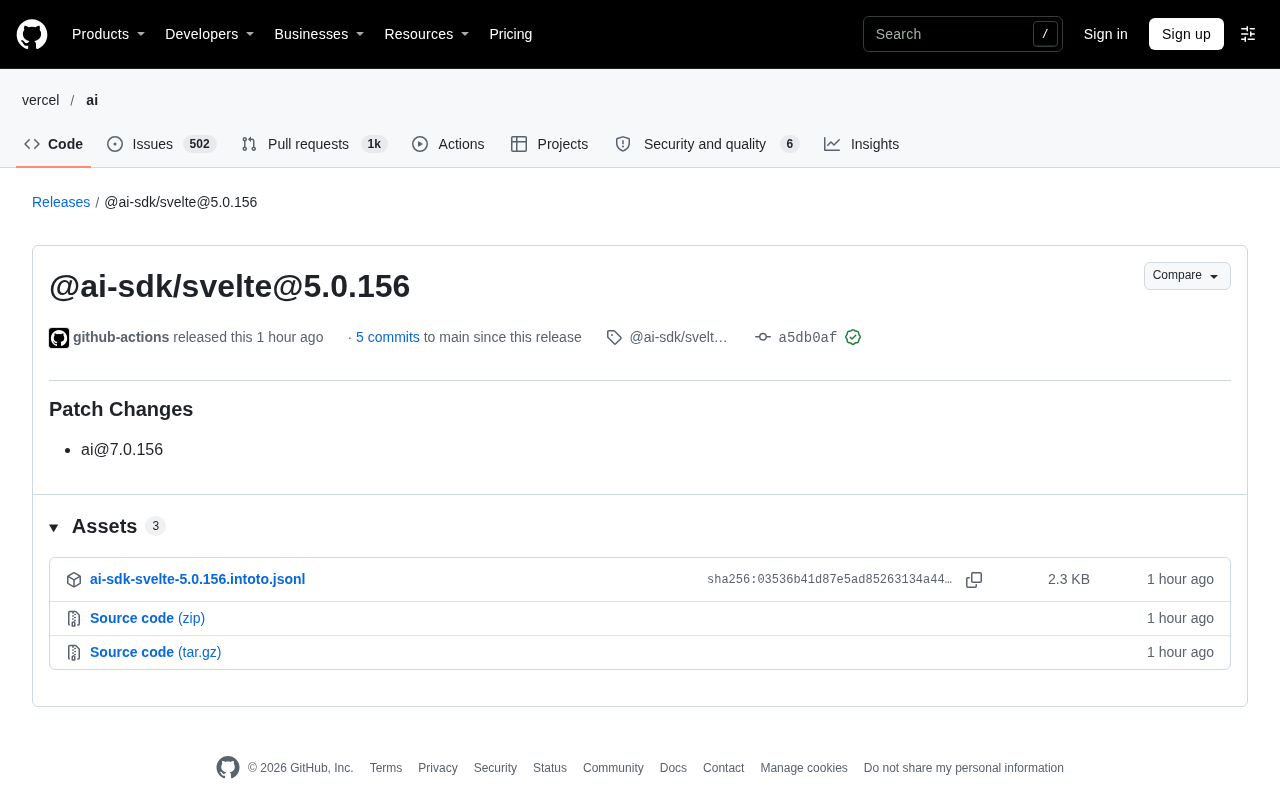
The AI SDK's Svelte adapter package @ai-sdk/svelte has released patch version 5.0.156, automatically triggered by github-actions, including 5 commits merged into main with a GPG verified signature. The release notes are extremely restrained, with Patch Changes pointing only to core package ai@7.0.156, indicating this is a follow-up release aligned with the upstream version rather than introducing new features. For production projects, such patch upgrades are typically low-risk, but because the release notes have low information density, troubleshooting regressions still requires going back to the commit level. The article recommends that Svelte developers run integration tests after upgrading, focusing on streaming responses and state management behavior.
The AI SDK's Svelte adapter package has quietly shipped patch version 5.0.156. Judging from the release record on GitHub, this is a typical patch-level update.
A "quiet" patch release
The release page shows that this update was automatically published by the github-actions account, with a timestamp of 28 Oct 18:36, and includes 5 commits merged into the main branch. The commit tagged a5db0af carries a GitHub verified signature (GPG key ID: B5690EEEBB952194), indicating that this release went through a standardized automated pipeline rather than a manual push.
The changes listed in the release notes are quite restrained: the Patch Changes section points only to ai@7.0.156. In other words, this version bump for the Svelte package is essentially a follow-up action to align with the core ai package version.
GPG signature verification is a cryptographic signature that GitHub automatically attaches to commits created through the web interface or API, generated using GitHub's own GPG private key (here the key ID is B5690EEEBB952194). A verified signature confirms that the commit was indeed created by GitHub's systems and has not been tampered with in transit, but it is not equivalent to a human review of the code content. For automated release pipelines, the signature primarily provides source authenticity and non-repudiation, making supply chain auditing easier for downstream consumers.
Why patch versions are worth noting
Looking at the version number alone, 5.0.156 is just a routine increment in the patch position. But for frontend teams that depend on the AI SDK, the cadence of these minor releases itself conveys information.
The AI SDK uses a multi-framework adapter architecture, and the Svelte package keeps its version number in sync with the core ai package, meaning every upstream patch propagates down to the downstream framework binding package. The fact that ai@7.0.156 is listed separately in the release record suggests that the core package had changes in that version, and the Svelte adapter layer was re-released accordingly to ensure dependency consistency.
For projects that pin versions in production, these follow-up releases typically do not introduce breaking changes, but it is still advisable to confirm the specific fixes in core ai package 7.0.156 before upgrading, to avoid unexpected interactions between upstream bug fixes and local custom logic.
Semantic Versioning (SemVer) specifies version numbers in the form MAJOR.MINOR.PATCH: a MAJOR change indicates incompatible breaking changes, MINOR indicates backward-compatible feature additions, and PATCH indicates backward-compatible bug fixes. Therefore, 5.0.156 moving up one from 5.0.155 should in theory only contain bug fixes and should not introduce API changes. Note that the AI SDK's Svelte adapter package version number is not synchronized with the core ai package's 7.x — the former evolves independently, and "version alignment" in this article refers to the dependency declaration pointing to the same upstream version, not the two sharing the same version number.
The maturity of the automated release pipeline
One detail can be read from the metadata of this release: triggered by github-actions, carrying a GPG verified signature, and 5 commits merged into main. This combination shows that the AI SDK's release pipeline is highly automated, with the human intervention point compressed down to the code merge stage.
(According to the GitHub release page, this release lists only Patch Changes and the ai@7.0.156 dependency, with no additional explanatory text.)
For users, this means good version traceability — each release corresponds to a specific commit and signature, making auditing easier. But it also means the information density of the release notes is low, and when it comes to troubleshooting regressions, you still need to go back to the commit level to see the specific changes.
github-actions is GitHub's built-in CI/CD service, which can automatically run builds, tests, and releases when events such as code merges or tag creation occur, via workflow files. The AI SDK repository typically uses tools like changesets to manage versions and changelogs: developers submit change descriptions, and the release workflow aggregates them, automatically calculates version numbers, generates a changelog, creates a git tag, and pushes to npm. This is exactly why the change entries in the release notes are concise and published by a bot account, and it also explains why the explanatory text naturally has low information density.
The practical impact on Svelte developers
The Svelte ecosystem has always relied on community adapter layers for AI application frontend integration, and the officially maintained Svelte package from the AI SDK provides a relatively stable integration path. The real value of patches like 5.0.156 is not new features, but enabling Svelte projects to keep up with the core SDK's fix cadence.
If your project uses @ai-sdk/svelte to call model capabilities, this upgrade falls into the low-risk category: version numbers are aligned, and no breaking changes are flagged. Nevertheless, it is still advisable to run your existing integration tests after upgrading, especially the parts involving streaming responses and state management, to confirm that upstream core package changes have not affected Svelte-side reactive update behavior.
Summary
@ai-sdk/svelte@5.0.156 is not a headline-grabbing release; it is more like a thermometer for ecosystem health: the automated pipeline is running normally, the version-following mechanism is effective, and signature verification is in place. For developers, the right way to handle such patches is to upgrade as needed and keep an eye on upstream core package changes, rather than expecting surprises in the release notes.
Related articles

Build a Reasoning Model from Scratch: An 11-Hour Open-Source Course Breakdown
Sebastian Raschka releases a free 8-episode, ~11-hour video course teaching you to build a reasoning model from scratch with Python and PyTorch—from a small Qwen3 model through Verifier, Inference Time Scaling, GRPO, and distillation, with open-source code on GitHub.

An 11-Hour Reasoning Model Course in Practice: How Small Models Learn to Think
Starting from Sebastian Raschka's 11-hour reasoning model course and HN buzz, this analyzes small-model training, legal text version control, Anthropic data policy, and product reliability reviews.

Lightpanda: A Headless Browser Built for AI and Automation
Lightpanda is a headless browser built from scratch in Zig for AI and automation, with 37,852 GitHub stars. This analysis covers its technical approach, design choices, and use cases.