AI SDK Toolkit Update: tool-web-fetch 1.0.6 Released

AI SDK's tool-web-fetch package releases patch 1.0.6, mainly aligning versions with ai@7.0.156.
The @ai-sdk/tool-web-fetch package in the AI SDK ecosystem released version 1.0.6 on October 28. This automated patch update via GitHub Actions merged 5 commits, primarily aligning versions with the ai@7.0.156 core package. The package provides web fetching capabilities for language models, enabling AI applications to access real-time external information. As a Patch Changes release, it contains no breaking changes or new features, so upgrade risk is low. Developers are advised to confirm the ai core package version matches before upgrading and to follow the changelog. Overall, this small release reflects the modular, continuously maintained nature of the AI SDK toolchain and reminds developers to include toolchain version management in daily workflows.
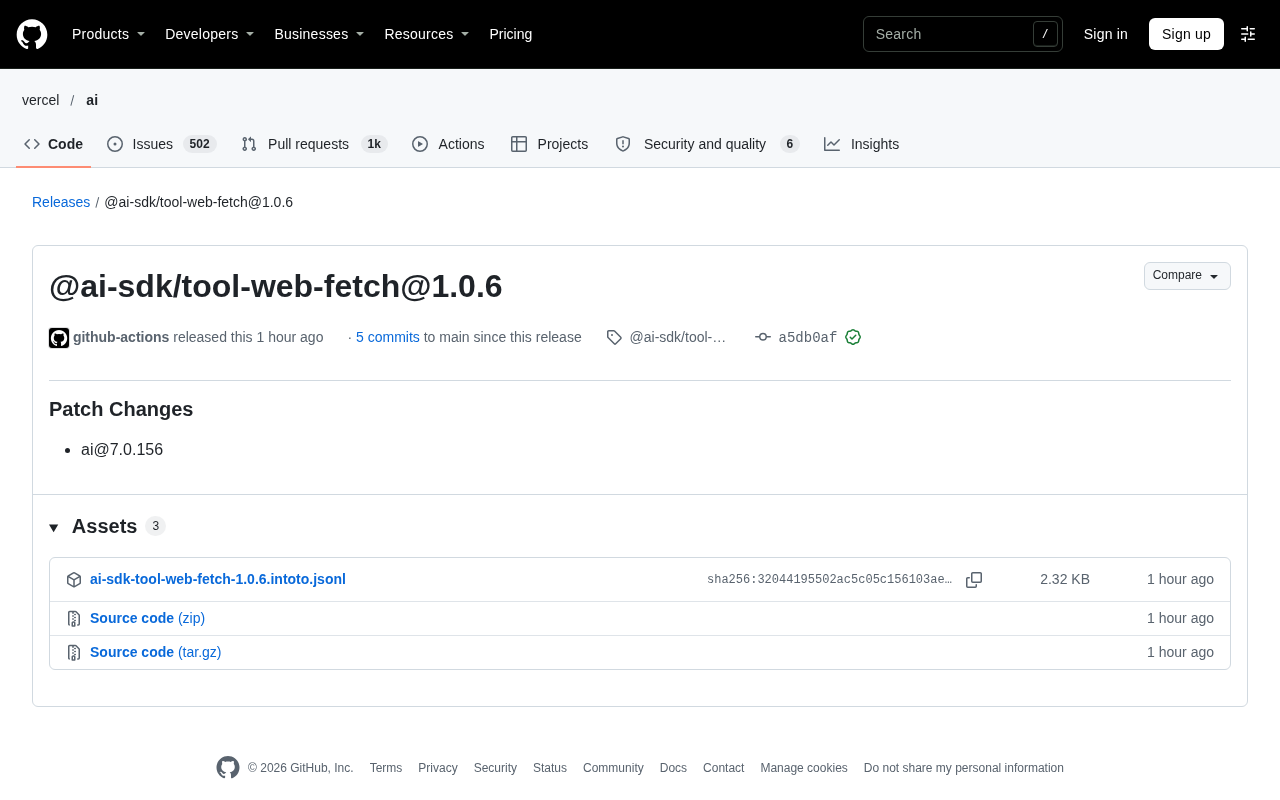
The @ai-sdk/tool-web-fetch package in the AI SDK ecosystem released version 1.0.6 on October 28. This is a patch update, primarily adjusting dependencies to align with version ai@7.0.156. Although the change is minor, it reflects the maintenance cadence of modular tools within the AI SDK toolchain's ongoing iteration.
A Typical Patch Release
According to the GitHub release record, @ai-sdk/tool-web-fetch@1.0.6 is marked as Patch Changes, meaning this release contains no breaking changes or new features, focusing instead on fixing version alignment with the underlying ai core package. The release was completed through the github-actions automated workflow, involving 5 commits merged into the main branch.
From the commit signature information, the commit passed GitHub's verified signature with GPG key ID B5690EEEBB952194. This kind of automated release process is quite common in open-source projects and helps reduce oversights caused by manual operations.
Semantic Versioning and Patch Changes
1.0.6 follows the Semantic Versioning specification (SemVer): major version.minor version.patch version. An increment in the patch number represents a patch release, typically containing only bug fixes, dependency alignment, or documentation adjustments, without introducing new APIs or changing existing behavior; a minor version increment indicates backward-compatible new features; a major version increment may contain breaking changes. Tools like Changesets automatically determine the change level based on commit content and generate Patch Changes markers, then work with GitHub Actions to complete version bumping and publishing. Therefore, when you see Patch Changes, you can generally expect the upgrade to be low-risk, but you should still pay attention to whether dependency constraints have been adjusted at the same time.
The Role of tool-web-fetch in the AI SDK
@ai-sdk/tool-web-fetch is one of the toolkits provided by the AI SDK, designed to give language models the ability to fetch web content. When building AI applications that require real-time information retrieval, such tools play a key role—the model can call them to obtain external web data, thereby enhancing the timeliness and accuracy of responses.
The association of this patch update with ai@7.0.156 indicates a tight version dependency between the toolkit and the core SDK. For developers and teams currently using this tool, keeping versions in sync helps avoid compatibility issues.
AI SDK and the Tool Mechanism
The AI SDK is an open-source TypeScript toolkit launched by Vercel for integrating large language models (LLMs) into applications. One of its core abstractions is the "Tool": developers can define a set of functions with names, descriptions, and parameter schemas, and the model can decide based on context whether to call these tools when generating responses, passing parameters in a structured way. The tool execution results are then passed back to the model, forming a loop of "model calls tool—tool returns data—model continues reasoning." @ai-sdk/tool-web-fetch is precisely an official preset toolkit that wraps web fetching into a standard Tool interface, allowing developers to attach it to models without implementing fetching logic and parameter validation themselves. This modular design decouples the core SDK from specific capabilities, allowing each toolkit to be released and maintained independently.
What Developers Should Note
For projects that have already integrated @ai-sdk/tool-web-fetch, upgrading to 1.0.6 is a low-risk operation. As a patch version, it is not expected to affect existing usage patterns. Developers are advised to confirm whether the ai core package version in their project matches before upgrading, and to complete dependency updates by referring to the official changelog.
The frequent release of such small patches also reminds us that in AI application development, toolchain version management needs to be incorporated into daily maintenance processes. Especially for projects that rely on automated releases, paying attention to release notes helps to stay informed about underlying changes in a timely manner.
Summary
The release of @ai-sdk/tool-web-fetch@1.0.6 is not particularly noteworthy in itself, but it demonstrates the stability of the AI SDK tool ecosystem through continuous maintenance. For AI applications that depend on web fetching capabilities, keeping toolkits updated is fundamental work to ensure reliable functionality. Whether this tool will introduce richer fetching options in the future is worth watching.
One-line Summary
The AI SDK's tool-web-fetch package releases patch version 1.0.6, primarily aligning versions with ai@7.0.156.
Paragraph Summary
@ai-sdk/tool-web-fetch in the AI SDK ecosystem released version 1.0.6 on October 28. This is a patch update completed automatically by GitHub Actions, merging 5 commits, with the core purpose of aligning versions with the ai@7.0.156 core package. This package provides web fetching capabilities for language models, enabling AI applications to obtain real-time external information. As a Patch Changes release, this update contains no breaking changes or new features, and the upgrade risk is low. The article recommends that developers confirm whether the ai core package version in their project matches before upgrading, and to follow the changelog. Overall, this small release reflects the modular and continuously maintained nature of the AI SDK toolchain, and also reminds developers to incorporate toolchain version management into their daily processes.
Related articles

Gemini 4 Carbon Tops Global Rankings as AI Productivity and Open-Source Ecosystems Surge
Google DeepMind's Gemini 4 Carbon tops global benchmarks, built for complex agents and system security. ByteDance launches Doubao Work integrated with Feishu, Anthropic's AI autonomously breaches 5 system-level attack chains, and ModelBest and Fudan open-source on-device multimodal and image generation models.

Overseas Creator Breaks Down N8n AI Agent Business Playbook: From Tooling to Monetization
An overseas creator breaks down the N8n AI agent business playbook: comparing Zapier, Make, and N8n, detailing four monetizable automation categories—lead capture, WhatsApp follow-up, booking, and content pipelines—plus agency pricing and a sales playbook.

Empacer: The Voice-First AI Assistant for Small Business Owners That Topped Product Hunt
Empacer is a voice-first AI assistant for small business owners: three-question setup, voice requests turned into customer replies, social posts, and invoices—all owner-approved. It won #1 Product of the Day on Product Hunt with 231 upvotes and 47 comments.